The Persistence of Memory: Dalí's Melting Clocks
A camembert melting in the sun, a childhood memory of ants devouring a dying bat — from these unlikely fragments, Salvador Dalí built one of the twentieth century's most haunting images.
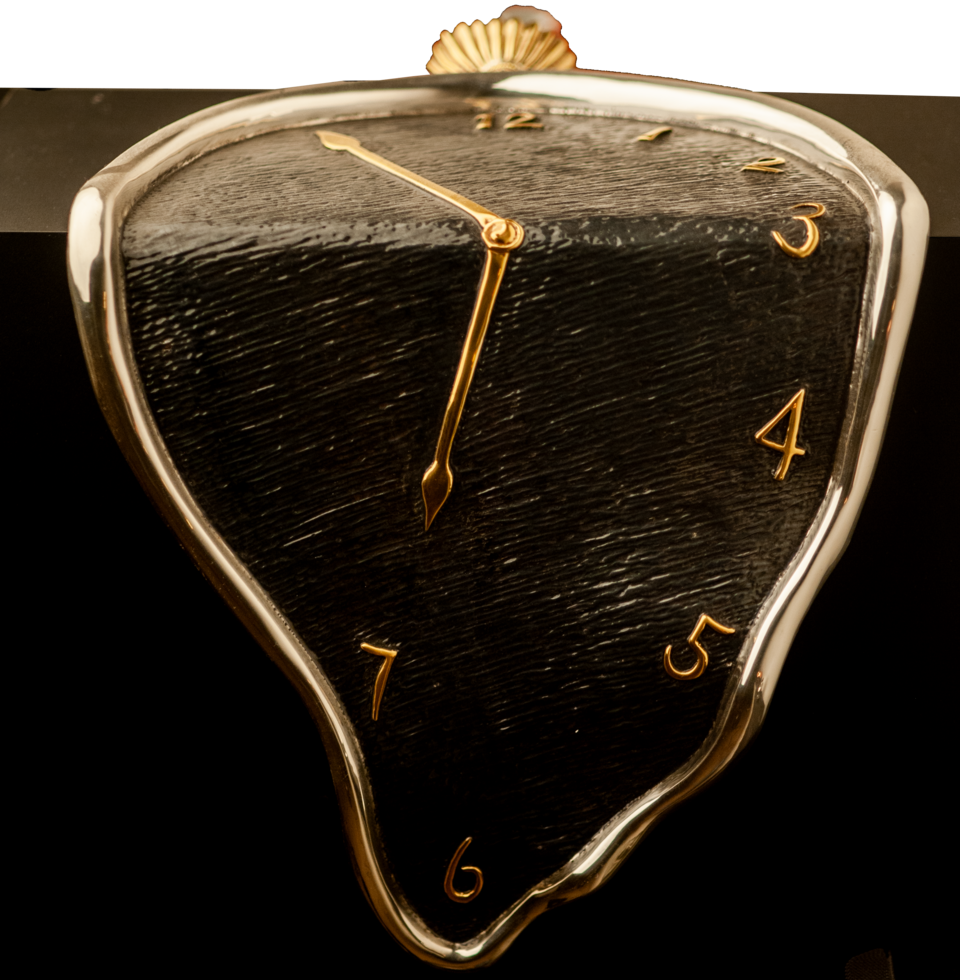
In 1931, Salvador Dalí painted a small canvas that would outlast the century it was born in. It showed three limp pocket watches draped over rocks and a tree branch, sagging like wax left too near a flame, and a fourth watch, orange and rigid, crawling with ants. He called it The Persistence of Memory. The world would soon know it simply as the Melting Clocks.
The painting arrived when Dalí was deep in what he called his 'paranoiac-critical method,' a deliberate cultivation of hallucinatory states to fuel his imagery. He once remarked that the difference between a madman and himself was that he was not mad. It was this self-induced dreamlike logic that produced the soft watches, he insisted. When the physicist Ilya Prigogine later asked whether Einstein's relativity had inspired them, Dalí denied it outright — the watches, he said, came from the surrealist vision of a camembert cheese melting in the sun. Scholars have not entirely let the physics reading go, however; the critic Dawn Adès described the soft watches as 'an unconscious symbol of the relativity of space and time, a Surrealist meditation on the collapse of our notions of a fixed cosmic order,' even as Dalí himself waved the comparison away.
Beneath the rightmost of the melting watches, in the center of the canvas, a distorted human face appears in profile — part of a larger, fleshy, monstrous creature draped across the painting, its one eye closed and lashed as if dreaming. It is widely read as a distorted self-portrait of Dalí, echoing a similar figure from his earlier work The Great Masturbator. Scholars trace its shape back further still, to a figure in the Paradise section of Hieronymus Bosch's The Garden of Earthly Delights, a painting Dalí had studied closely. The creature seems to belong to the logic of dreams, where forms blur and refuse to resolve into anything fixed.
The ants crawling over the one hard, unmelted watch were no idle detail. Dalí had used ants as a symbol of decay since childhood. In his 1929 essay 'The Liberation of Fingers,' he recalled watching a lizard decompose, eaten by ants, when he was three or four. Later, in his memoir The Secret of Life, he described a wounded bat his cousin had given him, left overnight in a pail, found the next morning half-alive and 'bristling with frenzied ants.' That image of tenderness curdling into horror stayed with him and resurfaced, decades later, on this canvas.
The landscape itself was not invented. The jagged rocks on the right are the tip of Cap de Creus, a peninsula in northeastern Catalonia that appears throughout Dalí's work. The eerie shadow in the foreground references Puig Pení, a mountain in the same corner of Catalonia. Even the twisted, leafless tree on the left had become something of a recurring signature in his paintings — a fixture of his private visual vocabulary as much as the melting watches themselves.
More from Art

The Painting With No Foreground
A single robed figure stares out at an empty grey sea — and the emptiness itself became a scandal. When it was unveiled in Berlin in 1810, no one knew quite what to do with it.

The Painter Who Chased the Light
For a few purple minutes each evening, an American exile knelt in an English garden and raced the dying sun to paint two little girls lighting lanterns. It took him two years to finish.

When a President Became a God
Look straight up inside the U.S. Capitol dome and you will find George Washington enthroned among the clouds, surrounded by goddesses — the founding father transformed into myth.

Marble Brought Back to Life
A corpse asleep, a wing barely brushing her skin — and marble somehow learns to breathe. This is the moment Antonio Canova dared to carve.

The World Turned Upside Down
Look closely at a sixteenth-century Flemish village and you'll find a man biting a pillar, another carrying daylight in a basket, and a wife slipping a blue cloak over her husband's shoulders. Every gesture is a joke — if you know the language.

The Girl in the Glass Case
She stood two-thirds life size, dressed in a real tutu and human hair — and the critics who saw her in 1881 recoiled as if she were something obscene.