The Pinch in the Bathtub
A stolen glance through a parted curtain, a ring, a pinched nipple — one small gesture in an anonymous 1594 painting has been whispered about, veiled, and stolen for four centuries.
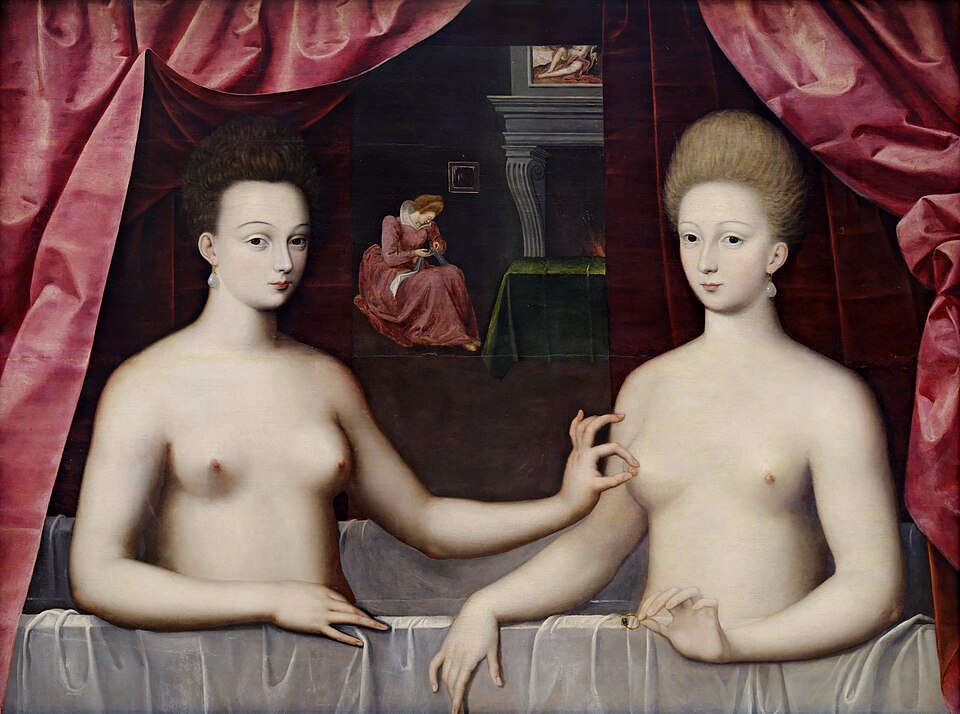
Around 1594, an unknown painter of the Fontainebleau School produced a portrait unlike any other hanging today in the Louvre. Two women sit together in a bath, nude but for their pearl earrings, revealed to the viewer as though a stage curtain has just been drawn back. One of them holds a ring between her fingers. The other reaches across and pinches her sister's right nipple, an oddly intimate gesture frozen mid-motion for anyone who cares to look.
The woman with the ring is Gabrielle d'Estrées, mistress to King Henry IV of France. Beside her sits her sister, Julienne-Hyppolite-Joséphine. In the background, almost easy to miss, a seamstress works quietly near a large fireplace, above which hangs another painting — this one of a male nude. Every element in the room seems arranged to hint at something without ever quite saying it aloud.
Early in the seventeenth century, the writer Pierre de Bourdeille, seigneur de Brantôme, recorded a story about a crowd gathered to view the picture. He described the women in it as touching, stroking, and intertwining with each other, and claimed that one noblewoman in the audience grew so overcome watching the painting that she begged her lover to leave at once and take her home, unable to contain the feeling it stirred in her.
Centuries later, the painting turned up somewhere far less romantic: the Prefecture of Police in Paris, hanging above a doorway where the public passed freely. According to a 1935 account by Dr. Ver Heyden de Lacey, nobody could explain how it got there. Eventually a nervous official decided the image was too much for public eyes and had a green curtain drawn across it — not removing it, just hiding it in plain sight, turning it into an open secret.
The story took a stranger turn still. Someone later decided to unveil the painting for a civic ceremony, arranging for it to be cleaned beforehand. When the curtain was finally drawn back for the assembled guests, the frame was empty. The painting had vanished.
More from Art

The Painting With No Foreground
A single robed figure stares out at an empty grey sea — and the emptiness itself became a scandal. When it was unveiled in Berlin in 1810, no one knew quite what to do with it.

The Painter Who Chased the Light
For a few purple minutes each evening, an American exile knelt in an English garden and raced the dying sun to paint two little girls lighting lanterns. It took him two years to finish.

When a President Became a God
Look straight up inside the U.S. Capitol dome and you will find George Washington enthroned among the clouds, surrounded by goddesses — the founding father transformed into myth.

Marble Brought Back to Life
A corpse asleep, a wing barely brushing her skin — and marble somehow learns to breathe. This is the moment Antonio Canova dared to carve.

The World Turned Upside Down
Look closely at a sixteenth-century Flemish village and you'll find a man biting a pillar, another carrying daylight in a basket, and a wife slipping a blue cloak over her husband's shoulders. Every gesture is a joke — if you know the language.

The Girl in the Glass Case
She stood two-thirds life size, dressed in a real tutu and human hair — and the critics who saw her in 1881 recoiled as if she were something obscene.