The Piper Who Vanished With the Children of Hamelin
On a summer feast day in 1284, a stranger in strange colours walked into a German town — and 130 of its children walked out with him, never to return.
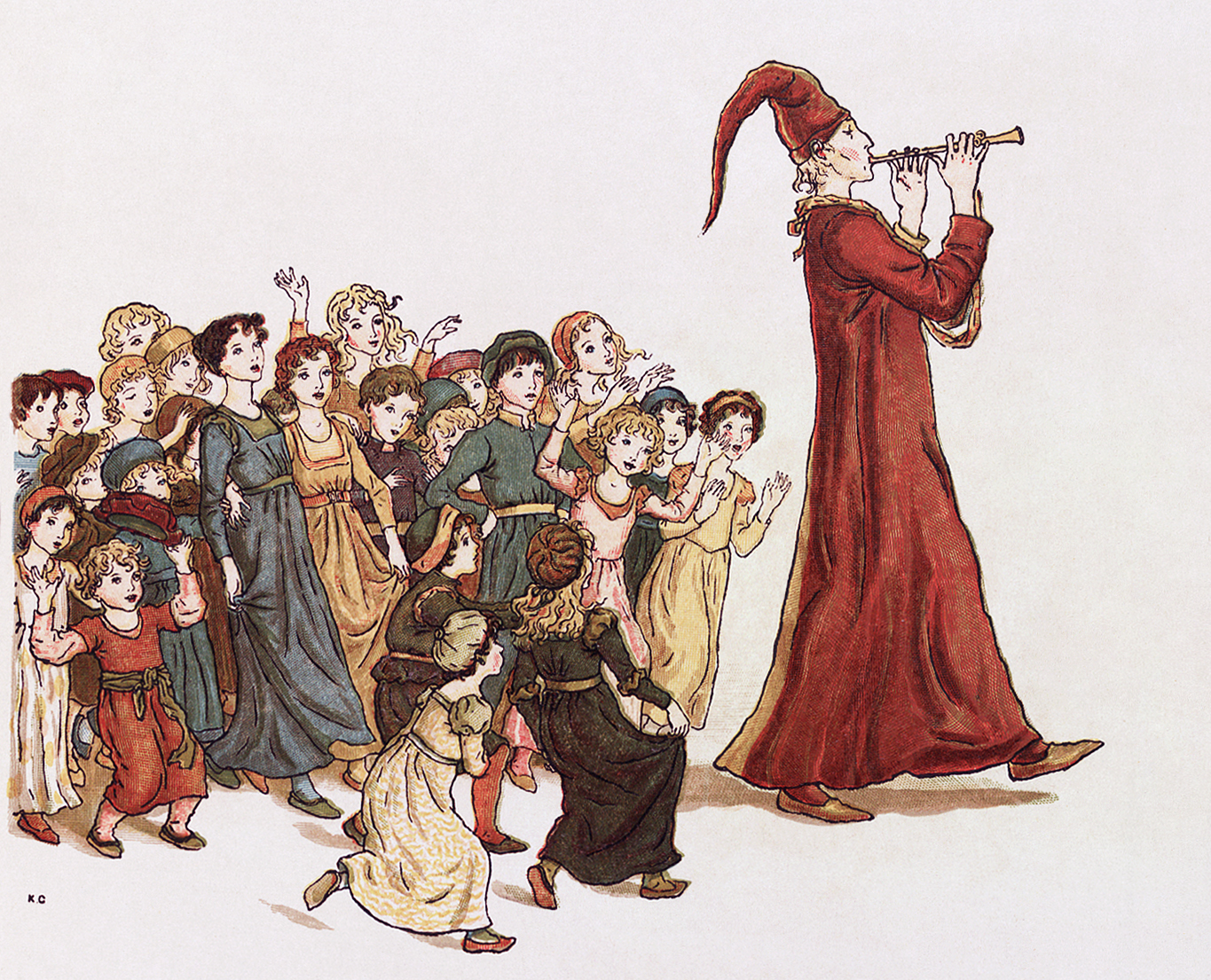
In the town of Hamelin, in the diocese of Minden, a stained-glass window was placed in the church around the year 1300. It showed a colourfully dressed piper and several children clothed in white. For centuries this window would be the earliest surviving trace of a story that the town itself seemed determined to remember: a tragedy dated precisely to the Feast of Saints John and Paul, in the Year of Our Lord 1284.
The fullest early account survives not in the window, which was destroyed in 1660, but on the back of a manuscript called The Golden Chain, written in Latin by the monk Heinrich of Herford in 1370. A later hand added a note describing a young man of about thirty, handsome and finely dressed, who crossed the bridges into Hamelin through the West Gate and began playing a silver pipe through the streets. All the children who heard him — 130 in number — followed him out through the East Gate to a place called Calvary, and there they vanished without a trace. Mothers ran from town to town searching, and found nothing.
The account notes something remarkable: the people of Hamelin did not simply forget. They began counting time from the disappearance, marking years since their children's departure the way others counted years since a birth or a reign. A town record dated 1384 states plainly: 'It is 100 years since our children left.'
The rats, so central to the story as most people know it today, are entirely absent from these earliest tellings. They were not added until a version composed around 1559. Before that date, the piper's grievance and his revenge had nothing to do with vermin at all — only with children, a pipe, and an unexplained vanishing.
In the fuller legend that eventually took shape, the town hires the piper to rid it of a rat infestation for a promised fee of 1,000 guilders. He lures the rats into the river Weser with his music, drowning them all. But the town's leader reneges, offering a fraction of the sum — some tellings say as little as fifty guilders — and even accuses the piper of having caused the infestation himself. Enraged, the piper leaves, vowing revenge. He returns on the feast day, dressed now in green like a hunter, and plays a different tune. This time it is the children who follow, led out of town and into a mountainside, never to be seen again. In some versions, three children remain behind — one lame, one deaf, one blind — and it is they who tell the townsfolk what happened.
More from Mythology

The Doctor Who Sang a Nation Into Being
A country doctor rode into the forests of Karelia armed with nothing but a notebook — and rode out with the soul of a nation.

The Boat That Carried the Sun
Every sunset, the ancient Egyptians believed, the sun climbed into a boat and sailed straight into the realm of the dead — only to fight a monstrous serpent before dawn could return.

The Wild Man of the Snows
At 21,000 feet, a colonel found tracks in the snow that he blamed on a wolf — but his guides knew better, and gave the world a name that would echo for a century.

The Knight Who Went Mad for Love: Orlando Furioso
A hero so devoted to duty he was Charlemagne's greatest paladin loses his mind—not to a sword wound, but to heartbreak. To cure him, a friend must ride a flying horse to the Moon.

The Book That Turned the World Into Myth
A poet condemned to exile spent his final years in Rome finishing a poem that would outlive empires—a poem about nothing standing still, not gods, not lovers, not even the shape of a man.

Paradise Lost: Milton's Rebel Angel
A blind poet, dictating verses in the dark, dared to explain the ways of God to men — and in doing so, made Hell's ruler unforgettable.