The Poet Who Outlasted an Empire
One man spent thirty-three years writing 50,000 couplets to keep a fallen empire's memory alive — and it worked.
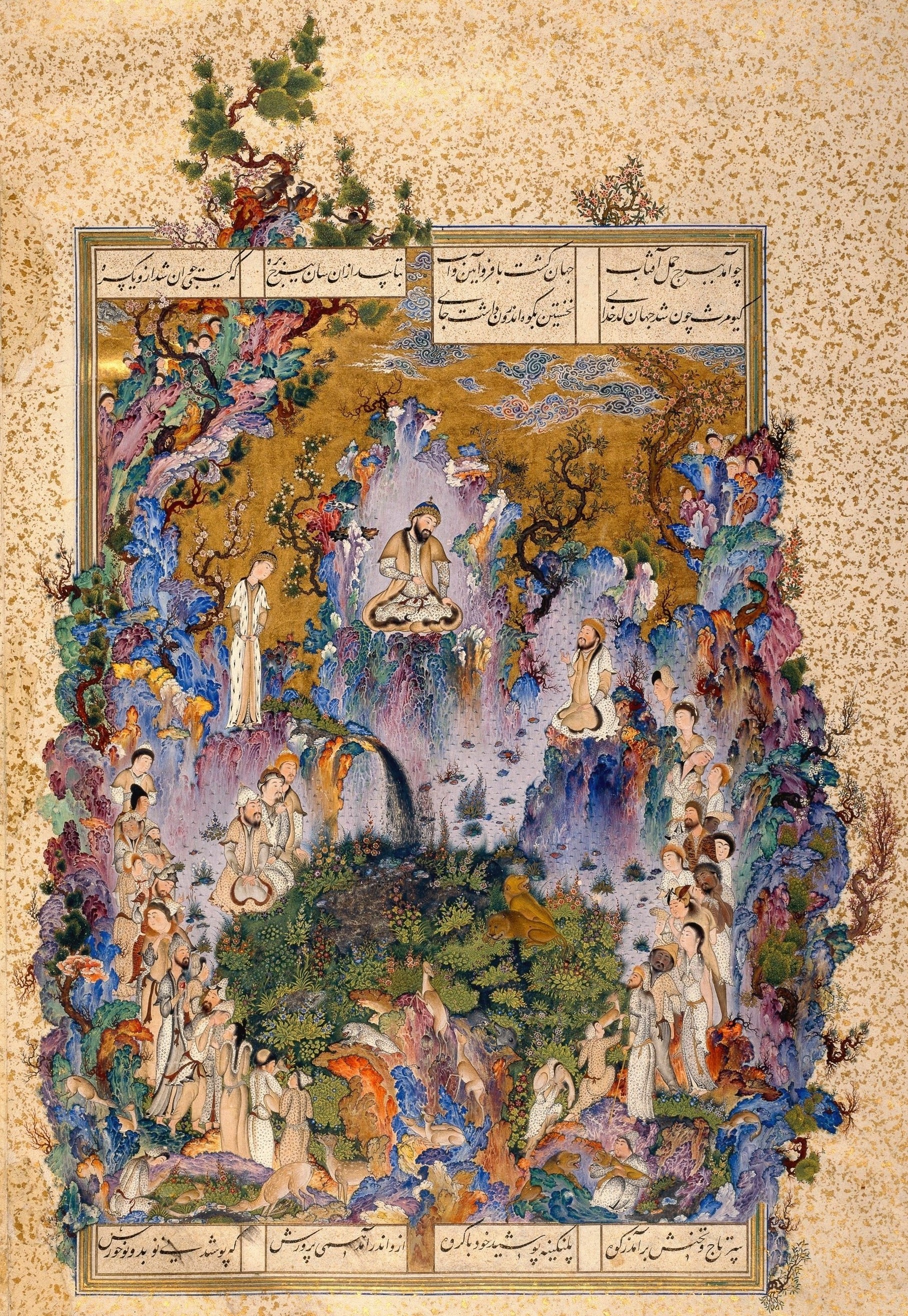
Somewhere in the city of Tus, in the last decades of the tenth century, a poet named Ferdowsi bent over his desk with an ambition that bordered on madness: to gather the whole mythical and historical past of Iran, from the creation of the world to the Arab conquest of the seventh century, and pour it into verse. He began around 977 CE. He did not finish until 8 March 1010. Thirty-three years of a human life, spent on a single book.
The result, the Shahnameh — the Book of Kings — runs to some 50,000 distichs, making it one of the longest epic poems ever composed, and the longest ever written by one person alone. Ferdowsi was not inventing from nothing. He drew heavily on an earlier prose Shahnameh compiled in his own city of Tus, which itself descended from a Middle Persian (Pahlavi) work called the Khwaday-Namag, the 'Book of Kings' assembled under the late Sasanians, chronicling rulers and heroes from mythical antiquity down to Khosrow II, who died in 628. Only scattered passages throughout the poem are entirely Ferdowsi's own invention.
He was not even the first to try turning this chronicle into verse. A contemporary poet named Daqiqi, working at the Samanid court, began the task first — but managed only 1,000 verses, on the rise of the prophet Zoroaster, before he came to a violent end. Ferdowsi absorbed those thousand lines into his own poem, crediting Daqiqi by name, and pressed on alone with the rest. Other Middle Persian sources fed the work too, notably the Kar-Namag i Ardashir i Pabagan, an account of how Ardashir I seized power, written close enough to the events to be considered unusually reliable.
The poem unfolds in three great movements. The mythical age is brief, barely 4 percent of the whole — the creation of the world, the first man-king Keyumars, his grandson Hushang discovering fire and founding the Sadeh feast, and the reigns of Tahmuras, Jamshid, Zahhak, and Fereydun. Then comes the heroic age, nearly two-thirds of the entire epic, stretching from King Manuchehr to the conquest of Alexander the Great. Here the Saka heroes of Sistan carry the story: Sam, his son Zal, and Zal's son Rostam — 'the bravest of the brave' — whose exploits, romances, and tragedies, including the sorrowful tale of Rostam and Sohrab, dominate the narrative. Finally the historical age carries the tale through the Parthians and into the Sasanian Empire itself.
Traditional accounts hold that Ferdowsi wrote out of grief — grief for the fallen Sasanian Empire, now ruled by Arabs and Turks, and a determination to preserve Persia's golden age for future generations so they might learn from it. Not all scholars accept that this was his sole motive, but the preservation of pre-Islamic myth and history remains at the poem's core.
More from Mythology

The Doctor Who Sang a Nation Into Being
A country doctor rode into the forests of Karelia armed with nothing but a notebook — and rode out with the soul of a nation.

The Boat That Carried the Sun
Every sunset, the ancient Egyptians believed, the sun climbed into a boat and sailed straight into the realm of the dead — only to fight a monstrous serpent before dawn could return.

The Wild Man of the Snows
At 21,000 feet, a colonel found tracks in the snow that he blamed on a wolf — but his guides knew better, and gave the world a name that would echo for a century.

The Knight Who Went Mad for Love: Orlando Furioso
A hero so devoted to duty he was Charlemagne's greatest paladin loses his mind—not to a sword wound, but to heartbreak. To cure him, a friend must ride a flying horse to the Moon.

The Book That Turned the World Into Myth
A poet condemned to exile spent his final years in Rome finishing a poem that would outlive empires—a poem about nothing standing still, not gods, not lovers, not even the shape of a man.

Paradise Lost: Milton's Rebel Angel
A blind poet, dictating verses in the dark, dared to explain the ways of God to men — and in doing so, made Hell's ruler unforgettable.