The Portrait That Made a Lady Immortal
A woman recovering from the flu sat for six sessions in a Bergère chair — and walked away with a face that would outlive her fortune.
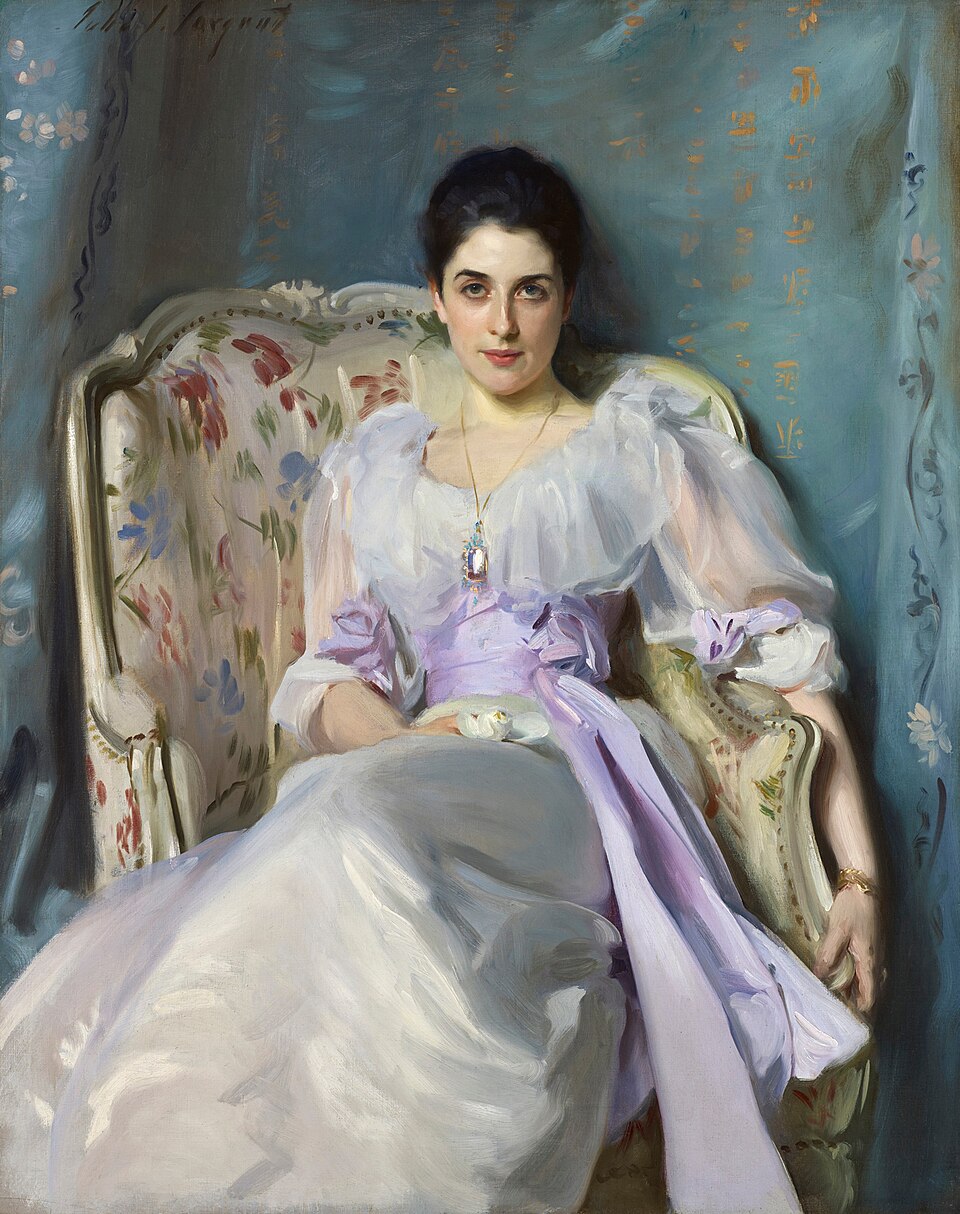
In 1892, Sir Andrew Noel Agnew, 9th Baronet of Lochnaw Castle, commissioned the American painter John Singer Sargent to paint his wife. Gertrude Vernon Agnew, born in 1864 to the Hon. Gowran Vernon and granddaughter of Robert Vernon, 1st Baron Lyveden, had married Sir Andrew in 1889. She was, by all outward accounts, an ordinary aristocratic wife of Wigtownshire. What emerged from Sargent's studio would make her one of the most recognisable faces of the era.
Sargent completed the portrait that same year, working across just six sessions — a fact he later cited as proof that his best results sometimes came from the fewest sittings. He painted her seated in an 18th-century French Bergère chair, its curving back used, as art historian Richard Ormond put it, to create 'a distinctive, languid elegance' around her figure. She wears a white gown accented by a silk mauve sash, posed against a wall draped in blue Chinese silk.
What startled viewers was her expression. Ormond and art historian Elaine Kilmurray noted that Lady Agnew was convalescing from influenza during the sittings, which may explain the languor of her pose. Yet her gaze is anything but weary — described by the pair as 'quietly challenging', with 'something withheld and inviting in her quizzical half-smile'. It gives the sense that the sitter is engaged in an intimate conversation with whoever looks at her.
The painting, measuring 127 by 101 centimetres, was exhibited at the Royal Academy in London in 1893. It proved a sensation. An unattributed review in The Times, dated 29 April 1893, called it 'not only a triumph of technique but the finest example of portraiture... that has been seen here for a long time,' praising Sargent for abandoning his usual mannerisms to make 'a beautiful picture of a charming subject, under conditions of repose.' The writer declared it a masterpiece. The acclaim is thought to have helped Sargent's election as an associate of the Royal Academy the following January.
The portrait travelled further still, appearing at Boston's Copley Hall in 1899 and the Carnegie Institute in Pittsburgh in 1924. It remains today in its original antique French rococo frame — though it is uncertain whether this is the very frame Sargent mentioned in an 1893 letter to Sir Andrew, describing an old frame he'd found for around £20, adding that it was 'hardly worth the money' unless the picture looked remarkably well in it.
More from Art

The Painting With No Foreground
A single robed figure stares out at an empty grey sea — and the emptiness itself became a scandal. When it was unveiled in Berlin in 1810, no one knew quite what to do with it.

The Painter Who Chased the Light
For a few purple minutes each evening, an American exile knelt in an English garden and raced the dying sun to paint two little girls lighting lanterns. It took him two years to finish.

When a President Became a God
Look straight up inside the U.S. Capitol dome and you will find George Washington enthroned among the clouds, surrounded by goddesses — the founding father transformed into myth.

Marble Brought Back to Life
A corpse asleep, a wing barely brushing her skin — and marble somehow learns to breathe. This is the moment Antonio Canova dared to carve.

The World Turned Upside Down
Look closely at a sixteenth-century Flemish village and you'll find a man biting a pillar, another carrying daylight in a basket, and a wife slipping a blue cloak over her husband's shoulders. Every gesture is a joke — if you know the language.

The Girl in the Glass Case
She stood two-thirds life size, dressed in a real tutu and human hair — and the critics who saw her in 1881 recoiled as if she were something obscene.