The Portrait That Set the Salon on Fire
A hasty portrait of a wife in a fantastical hat drew crowds who wanted to scratch the paint off the canvas — and one American who wanted to buy it on the spot.
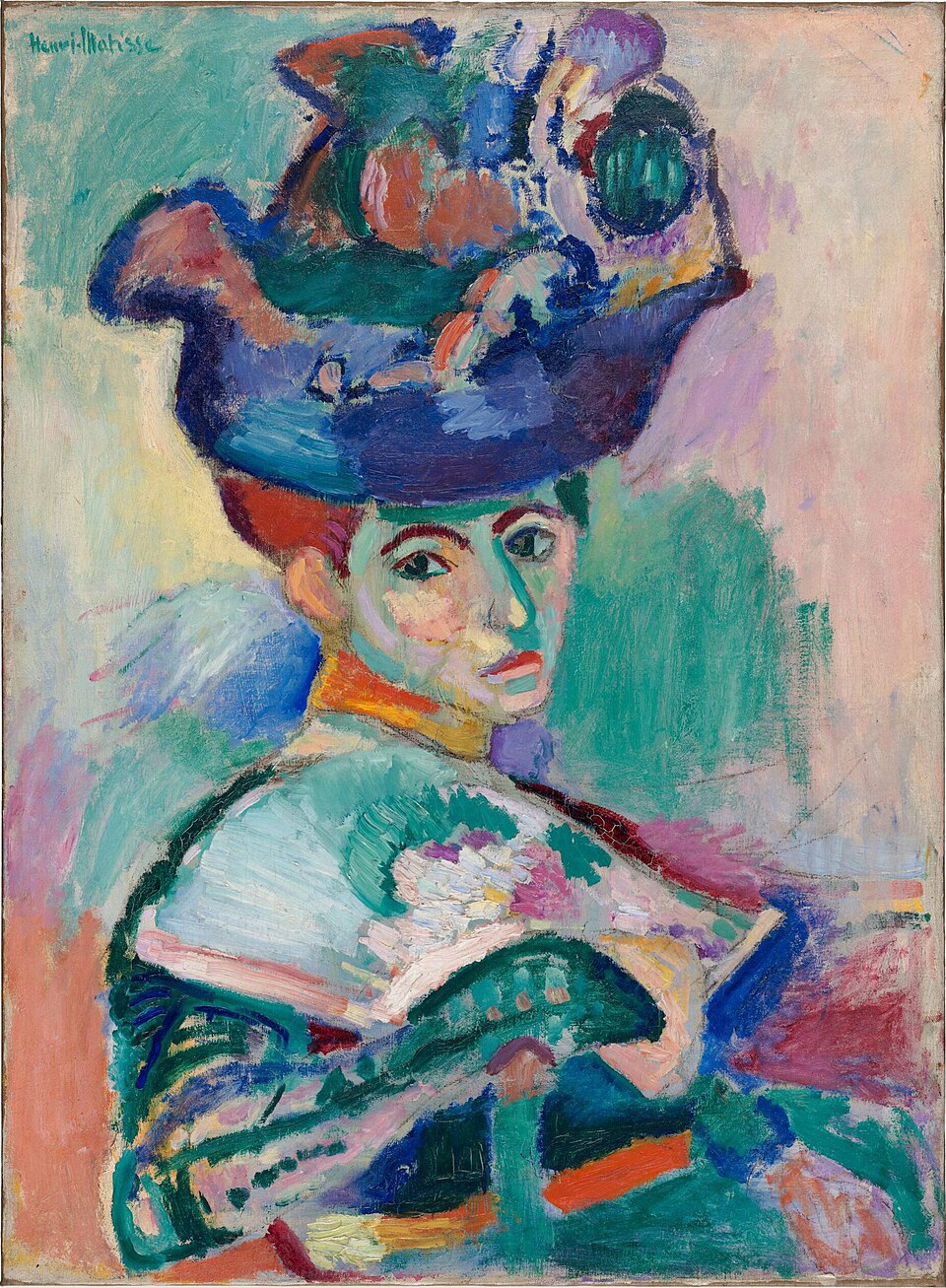
In September 1905, in the fishing town of Collioure in the south of France, Henri Matisse sat his wife Amélie down and began a portrait unlike any he had attempted before. He worked quickly, filling the canvas with rough, contrasting strokes of color rather than carefully rendered shapes. A green line sliced across her face to suggest shadow. The hat perched atop her head was pure invention, bearing little resemblance to any object in the real world. By October, the painting was finished and shipped to Paris for the Salon d'Automne.
Matisse had spent the summer with fellow painter André Derain, who joined him in Collioure. Together the two artists pursued an idea that seems simple now but was radical then: color could be treated as a material in its own right, like stone or wood, rather than merely a tool for describing reality. Woman with a Hat became the clearest expression of that idea, marking Matisse's break from the pointillist, Divisionist technique of his earlier work toward something looser, bolder, and far more expressive.
When the Salon d'Automne opened, the painting, shown alongside works by Derain, Maurice de Vlaminck, and others soon grouped under a single startling label, drew the largest crowds of any entry — but for the wrong reasons. Critic Louis Vauxcelles, surveying the room and comparing the paintings to a Renaissance-style sculpture displayed nearby, coined the phrase 'Donatello chez les fauves' — Donatello among the wild beasts. The name stuck, and Fauvism was born.
The public reaction to Woman with a Hat itself was fierce. Critic John Klein later noted that its bright palette and seemingly haphazard brushwork drew the harshest scorn of all the Fauvist works on display. Viewers and journalists alike dismissed it as infantile, even as evidence of madness. It was, by most accounts, the single most controversial canvas at the entire exhibition.
Amid the outrage stood two Americans who saw something else entirely: siblings Gertrude and Leo Stein. Gertrude later recalled the scene in The Autobiography of Alice B. Toklas, describing a show that was mostly pleasant except for one picture that 'infuriated the public' — a portrait of a woman with a long face and a fan, strange in its color and its anatomy. She wanted it immediately.
More from Art

The Painting With No Foreground
A single robed figure stares out at an empty grey sea — and the emptiness itself became a scandal. When it was unveiled in Berlin in 1810, no one knew quite what to do with it.

The Painter Who Chased the Light
For a few purple minutes each evening, an American exile knelt in an English garden and raced the dying sun to paint two little girls lighting lanterns. It took him two years to finish.

When a President Became a God
Look straight up inside the U.S. Capitol dome and you will find George Washington enthroned among the clouds, surrounded by goddesses — the founding father transformed into myth.

Marble Brought Back to Life
A corpse asleep, a wing barely brushing her skin — and marble somehow learns to breathe. This is the moment Antonio Canova dared to carve.

The World Turned Upside Down
Look closely at a sixteenth-century Flemish village and you'll find a man biting a pillar, another carrying daylight in a basket, and a wife slipping a blue cloak over her husband's shoulders. Every gesture is a joke — if you know the language.

The Girl in the Glass Case
She stood two-thirds life size, dressed in a real tutu and human hair — and the critics who saw her in 1881 recoiled as if she were something obscene.