The Quiet Heat of a Poured Stream
A woman pours milk in a bare room, and for over three centuries no one has been able to say for certain what she is thinking.
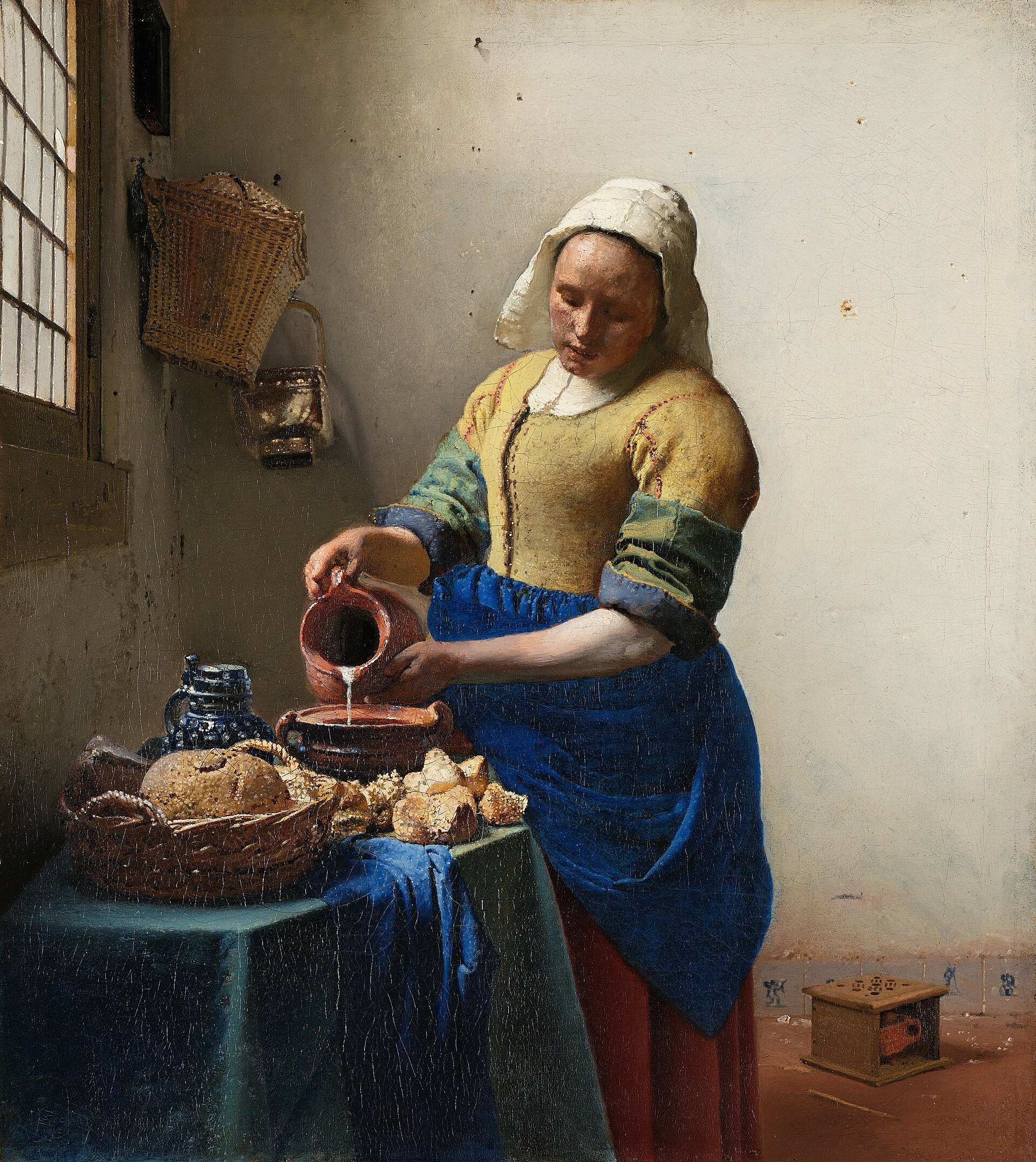
There is almost nothing happening in the picture. A young woman, sturdily built, in a crisp linen cap and blue apron, stands at a table pouring milk from a jug into a squat earthenware container. Bread sits beside her. Light pours through a window on the left, hard and clear, and yet it does not flatten anything — not the rough crust of the bread, not the thick weight of her forearms, not the volume of her shoulders. Johannes Vermeer painted this scene, though the exact year is lost to history: the Rijksmuseum estimates circa 1658, the Metropolitan Museum of Art dates it to about 1657 or 1658, and the Essential Vermeer website gives a broader window of 1658 to 1661. It now hangs in the Rijksmuseum in Amsterdam, which calls it one of its finest attractions.
At the time, this woman would not have been called a milkmaid at all. Milkmaids milked cows; kitchen maids worked indoors. She is the latter — a maid-of-all-work, doing an ordinary domestic chore in a plain room. Behind her, near a foot warmer resting on the floor, two Delft tiles are visible on the wall: one showing Cupid, the other a figure with a pole. These small details, easy to miss, carry centuries of meaning that Vermeer's contemporaries would have understood instantly.
For at least two hundred years before Vermeer picked up his brush, maids — milkmaids and kitchen maids alike — carried a reputation in Dutch and Flemish art as women inclined toward love and sex. Painters in Antwerp, Utrecht, and Delft built an entire visual tradition around this idea. Joachim Beuckelaer and Frans Snyders in Antwerp, Pieter Aertsen, the Utrecht Mannerist Joachim Wtewael and his son Peter — all painted market and kitchen scenes thick with suggestive symbolism. Closer to Vermeer's own time, Nicolaes Maes turned the same subject into comedy, with paintings like The Lazy Servant.
But there was another current running through Dutch art of the era, one that painted women at work in the home as models of domestic virtue rather than objects of male desire. Vermeer's Milkmaid sits at the crossing of these two traditions. Half her face is in shadow; her eyes are downcast, her lips faintly pursed. The art critic Karen Rosenberg wrote that it's impossible to tell whether her expression carries wistfulness or simple concentration. Walter Liedtke, longtime curator of European paintings at the Metropolitan Museum of Art, compared the effect to the Mona Lisa: she is going about her daily task, faintly smiling, and viewers cannot stop asking what she is thinking.
And yet the old symbolic language has not entirely vanished from the canvas. The Cupid tile near the foot warmer hints at either the arousal of a woman daydreaming about a man, or simply the presence of an idea lingering at the edge of her chores. The jug she pours from, wide-mouthed, was a common stand-in for female anatomy in Dutch painting. The foot warmer itself, which heats the body beneath a skirt when placed under a woman's clothing, was frequently used by artists as a symbol of sexual arousal — its enclosed coals read either as the heat of illicit lust or, according to art historian Serena Cant, the hidden but genuine passion of a woman for her husband.
More from Art

The Painting With No Foreground
A single robed figure stares out at an empty grey sea — and the emptiness itself became a scandal. When it was unveiled in Berlin in 1810, no one knew quite what to do with it.

The Painter Who Chased the Light
For a few purple minutes each evening, an American exile knelt in an English garden and raced the dying sun to paint two little girls lighting lanterns. It took him two years to finish.

When a President Became a God
Look straight up inside the U.S. Capitol dome and you will find George Washington enthroned among the clouds, surrounded by goddesses — the founding father transformed into myth.

Marble Brought Back to Life
A corpse asleep, a wing barely brushing her skin — and marble somehow learns to breathe. This is the moment Antonio Canova dared to carve.

The World Turned Upside Down
Look closely at a sixteenth-century Flemish village and you'll find a man biting a pillar, another carrying daylight in a basket, and a wife slipping a blue cloak over her husband's shoulders. Every gesture is a joke — if you know the language.

The Girl in the Glass Case
She stood two-thirds life size, dressed in a real tutu and human hair — and the critics who saw her in 1881 recoiled as if she were something obscene.