The Rock That Refused to Drown
Twice a day, the sea swallows the causeway whole — and for over a thousand years, that fact alone kept an island fortress unconquered.
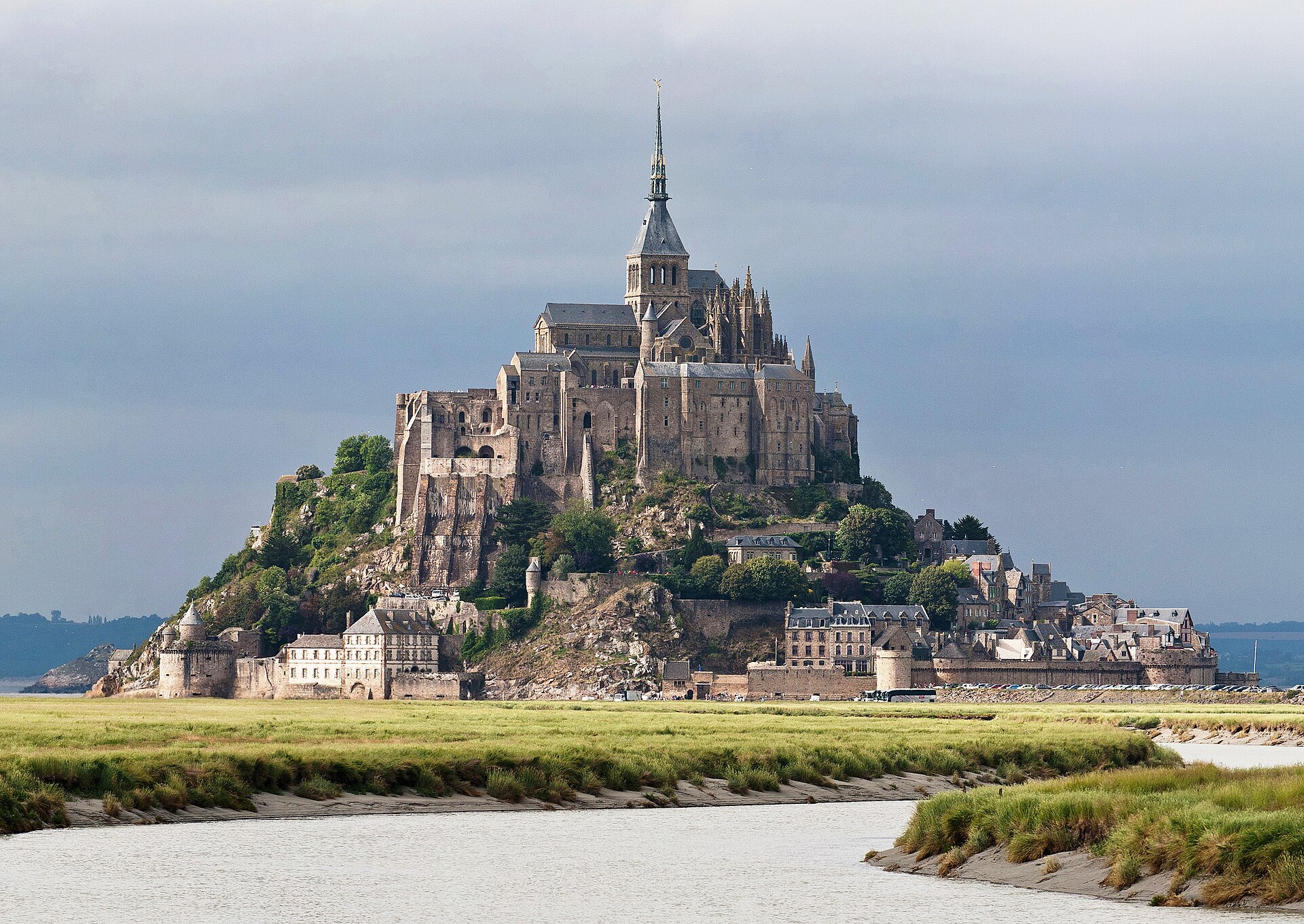
Off the north-western coast of France, where the Couesnon River spills into the sea near Avranches, a granite outcrop rises 92 metres above the tidal flats. Today it is called Mont-Saint-Michel, but before the 8th century it was simply Mont Tombe — a lump of leucogranite that solidified from magma some 525 million years ago, one of the younger fragments of the Mancellian granitic batholith. It shares its ancient stone with nearby outcrops like Tombelaine, Mont Dol, and Lillemer, all survivors of an eroding coastline that drowned the softer rock around them.
The island's transformation into something sacred began, according to legend, in 708, when the archangel Michael is said to have appeared to Aubert, bishop of Avranches, instructing him to build a church on the rocky islet. From that moment, Mont Tombe became Mont-Saint-Michel, and pilgrims began crossing the exposed sands at low tide to reach it — a crossing so perilous that medieval travellers nicknamed the site 'St. Michael in peril of the sea'.
The tides here are extreme: up to 14 metres separate the highest and lowest water marks, among the greatest variations in Europe. That same danger that threatened pilgrims also protected the mount militarily. During the Hundred Years' War, the incoming water stranded, drove off, or drowned attackers on foot, and the island was never conquered. In 1433, a small garrison successfully repelled a full English assault.
Ownership of the surrounding lands shifted over the centuries. Unable to hold off Viking raids, the king of the Franks ceded the Cotentin Peninsula and the Avranchin — including Mont-Saint-Michel — to the Bretons under the Treaty of Compiègne, though the mount was never truly absorbed into the Duchy of Brittany. In 933, William Longsword annexed the Cotentin from a weakened Brittany, making the mount permanently part of Normandy. It later appears on the Bayeux Tapestry, commemorating the Norman Conquest.
Louis XI later recognised the strategic value of the island's natural defences and converted the abbey into a prison, a role it retained regularly throughout the Ancien Régime — pilgrims' sanctuary turned place of confinement.
More from Architecture

Stonehenge: The Stones That Refuse to Explain Themselves
For more than 4,500 years, a ring of leaning giants has watched the sun rise and set on the same two days each year — and no one alive can say for certain why.

The Dome That Refused to Fall
Two thousand years ago, Roman engineers poured a dome so vast that no one has dared build a bigger one from unreinforced concrete since. It still stands, open to the sky.

A Minaret Rising Over Kingsland Road
On a busy London street better known for shops and buses, the tallest minaret in Britain quietly reaches into the sky. Its story began not in Sinan's sixteenth-century Istanbul, but in 1990s Hackney.

The Bridge That Was Killed Twice
For 427 years it arched over the Neretva like a stone rainbow. Then, in a matter of days in 1993, it simply ceased to exist.

Hoover Dam: The Concrete That Tamed a River
In the scorched depths of Black Canyon, thousands of men built the largest concrete structure the world had ever seen — and finished it two years early, at a cost of over a hundred lives.

Neuschwanstein: The Castle Built for a Ghost
A king who despised his own palace built the most famous fairy-tale castle on earth — and died before he ever truly lived in it.