The Rocks Where Song Became a Weapon
A voice so sweet it could unmake a ship — and the only defense was wax, rope, and refusing to listen.
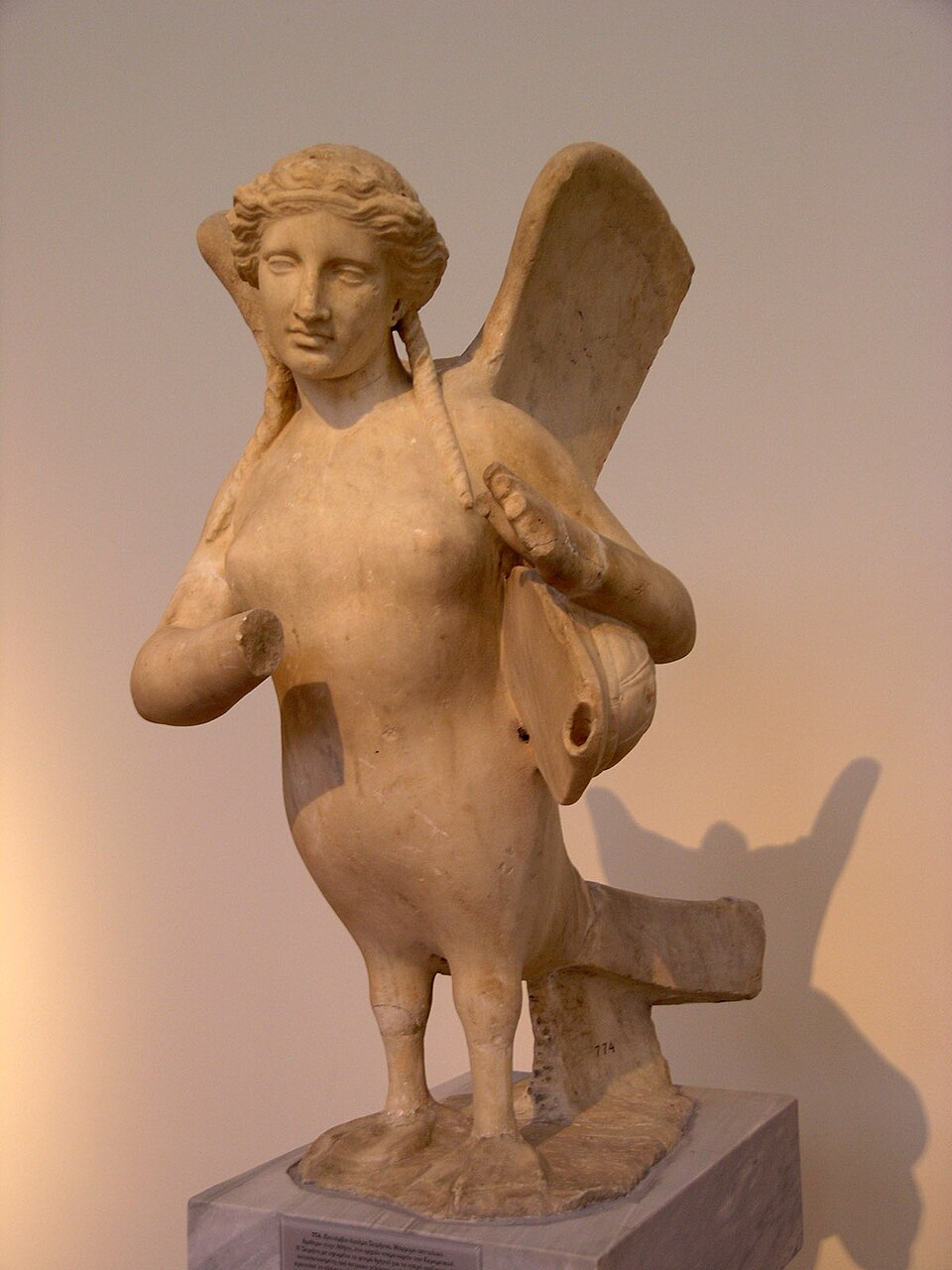
On a stretch of sea littered with cliffs and hidden rocks, sailors reported the same strange terror: a song drifting across the water, so achingly beautiful that men steered straight toward the sound, and straight into ruin. The creatures singing it were called sirens, and for nearly three thousand years they have occupied one of mythology's strangest positions — beings whose danger lay not in claws or fire, but in beauty itself.
Homer's Odyssey gives us the earliest surviving account, though it offers almost no physical description at all, leaving sirens to the imagination of every artist who came after. By the 7th century BC, Greek vase painters had settled on an image: human-headed birds, often with scaly feet, sometimes clutching a lyre, kithara, or aulos as they sang. Apollonius of Rhodes, writing in the Argonautica in the 3rd century BC, described them explicitly as part woman and part bird. The tenth-century Byzantine dictionary called the Suda described them as sparrow-bodied from the chest up, with women's forms below — a hybrid strange enough that scholars still argue over its origins, some pointing to Egypt's ba-bird as inspiration.
Curiously, sirens were not always female. Early Greek art shows both male and female versions, but by the fifth century BC the male siren vanished from artistic tradition entirely, leaving only women-birds behind.
Their parentage varies by source, but most accounts name the river god Achelous as their father, with a Muse — Terpsichore, Melpomene, or Calliope — as mother. Their number shifts wildly across ancient texts: Homer counted two, and later writers offered three, four, or more. Apollonius, like Hesiod, gave their names as Thelxinoe, Molpe, and Aglaophonos, while Hyginus counted four — Teles, Rhaidne, Molpe, and Thelxiope — and still other writers offered different tallies and names, among them Parthenope, Ligeia, Leucosia, Peisinoe, and Rhaidne.
The most famous siren scene remains Odysseus's escape. Warned in advance, he ordered his crew's ears sealed with wax while he alone listened, bound tightly to the ship's mast so that no matter how desperately he begged to be freed, his men would only tighten the ropes further. It worked — he heard the song and survived it, the only man in the old stories said to do so and live.
More from Mythology

The Doctor Who Sang a Nation Into Being
A country doctor rode into the forests of Karelia armed with nothing but a notebook — and rode out with the soul of a nation.

The Boat That Carried the Sun
Every sunset, the ancient Egyptians believed, the sun climbed into a boat and sailed straight into the realm of the dead — only to fight a monstrous serpent before dawn could return.

The Wild Man of the Snows
At 21,000 feet, a colonel found tracks in the snow that he blamed on a wolf — but his guides knew better, and gave the world a name that would echo for a century.

The Knight Who Went Mad for Love: Orlando Furioso
A hero so devoted to duty he was Charlemagne's greatest paladin loses his mind—not to a sword wound, but to heartbreak. To cure him, a friend must ride a flying horse to the Moon.

The Book That Turned the World Into Myth
A poet condemned to exile spent his final years in Rome finishing a poem that would outlive empires—a poem about nothing standing still, not gods, not lovers, not even the shape of a man.

Paradise Lost: Milton's Rebel Angel
A blind poet, dictating verses in the dark, dared to explain the ways of God to men — and in doing so, made Hell's ruler unforgettable.