The Room He Meant to Ruin
He took the biggest commission of his life, then set out to make the diners who paid for it lose their appetite. What Mark Rothko built instead was one of the strangest acts of artistic defiance in modern painting.
In 1954, New York announced a new monument to postwar prosperity: the Seagram Building, backed by a staggering $43 million design budget. Its crown jewel would be the Four Seasons, a luxury restaurant demanding art worthy of its opulence. Mark Rothko, already a leading figure of color-field painting, was chosen to provide the murals. Architect Philip Johnson told him he could design the walls 'any way he chose.'
Rothko visited the space and came away with an unusual ambition. He said he hoped to 'ruin the appetite of every son of a bitch who ever eats in that room.' It was a strange mission for a commercial commission, but it fit Rothko's long-standing belief that art should operate on the 'scale of human feeling,' not merely decorate a wall.
Over 1958 and 1959, Rothko produced roughly forty mural-sized canvases across three sets of panels. Scholars Michael Compton and Thomas Kellein believe he intended to hang seven of them: one on the south wall, three each on the east and west. But his studio assistant, Dan Rice, recalled that pinning down a final sequence was nearly impossible, since Rothko kept rearranging the paintings.
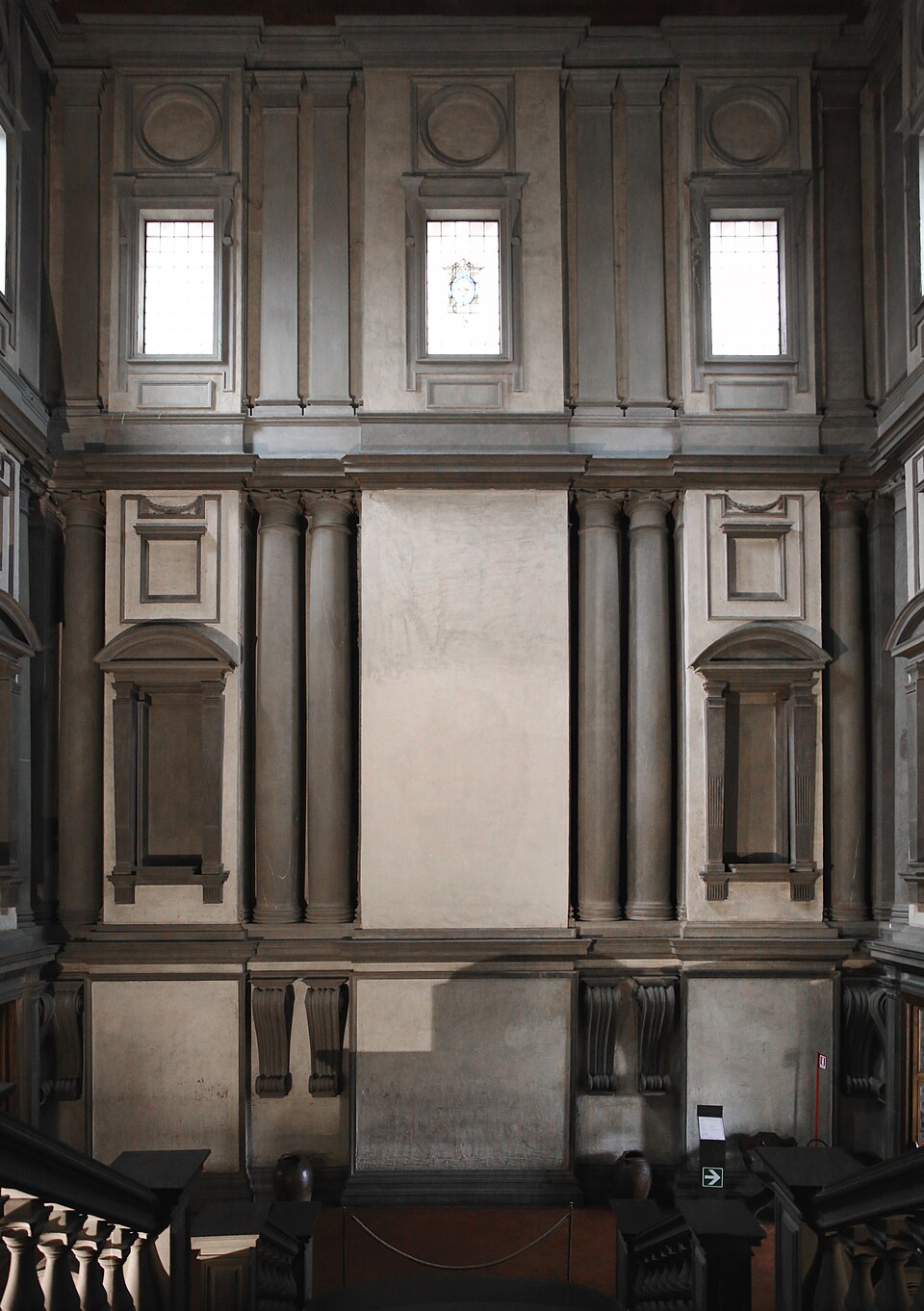
The palette was unlike anything he had shown before: maroons, dark reds, browns, and blacks, layered into an enveloping gloom. Rothko pointed to Michelangelo's staircase wall in Florence's Medicean Library as an influence, saying Michelangelo achieved 'just the kind of feeling I'm after,' trapping viewers in a room whose doors and windows seem bricked shut.
Unlike his earlier, more luminous works, these paintings responded to the demands of a dining room by turning horizontal rectangles onto their sides, suggesting open voids. Critic James Breslin described brown and black rectangles resembling vertical columns while red areas seemed to recede, as though opening between them. Art historian Rina Arya saw in these forms a new imagery of windows, doors, and portals, placing viewers at a threshold between presence and absence, fullness and emptiness.
More from Art

The Painting With No Foreground
A single robed figure stares out at an empty grey sea — and the emptiness itself became a scandal. When it was unveiled in Berlin in 1810, no one knew quite what to do with it.

The Painter Who Chased the Light
For a few purple minutes each evening, an American exile knelt in an English garden and raced the dying sun to paint two little girls lighting lanterns. It took him two years to finish.

When a President Became a God
Look straight up inside the U.S. Capitol dome and you will find George Washington enthroned among the clouds, surrounded by goddesses — the founding father transformed into myth.

Marble Brought Back to Life
A corpse asleep, a wing barely brushing her skin — and marble somehow learns to breathe. This is the moment Antonio Canova dared to carve.

The World Turned Upside Down
Look closely at a sixteenth-century Flemish village and you'll find a man biting a pillar, another carrying daylight in a basket, and a wife slipping a blue cloak over her husband's shoulders. Every gesture is a joke — if you know the language.

The Girl in the Glass Case
She stood two-thirds life size, dressed in a real tutu and human hair — and the critics who saw her in 1881 recoiled as if she were something obscene.