The Room Where Nine Men Were Watched by Painted Virtues
In a council chamber in Siena, a painter turned governance itself into a wall-sized morality tale—and dared the men who ruled to look up and see themselves judged.
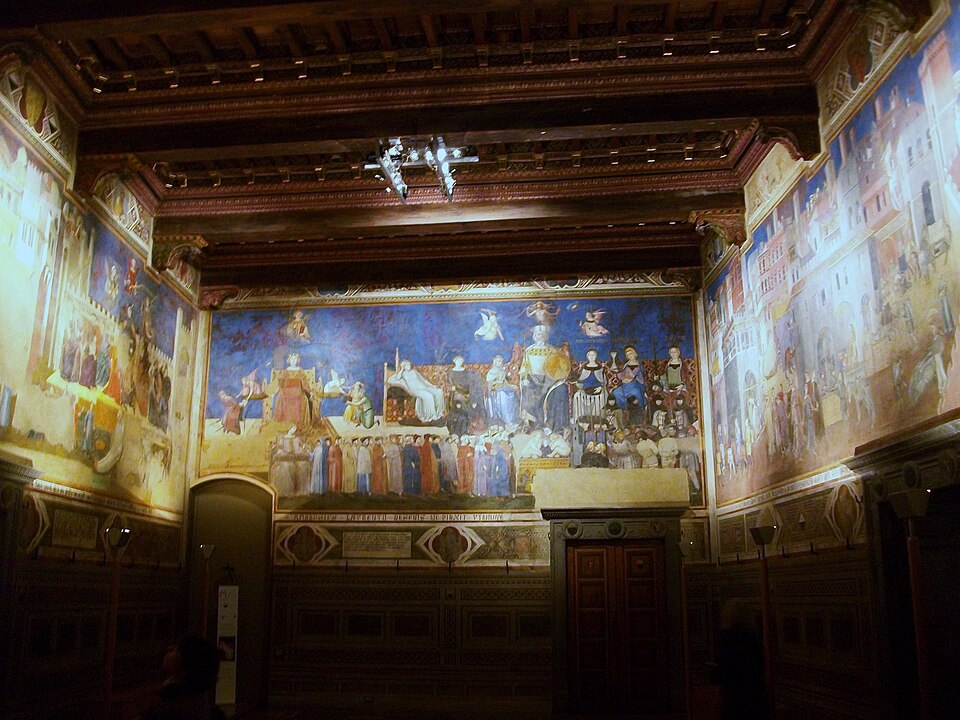
Between February 1338 and May 1339, Ambrogio Lorenzetti climbed the scaffolding of the Palazzo Pubblico in Siena and began covering three walls of a single room with paint. The room was the Sala dei Nove—the 'salon of nine'—where the nine executive magistrates of the Republic of Siena gathered to make the decisions that governed one of the most powerful city-states in fourteenth-century Italy. What Lorenzetti gave them was not saints or scripture, unlike almost every other major fresco cycle of the age, but a meditation on power itself: The Allegory of Good and Bad Government.
The fourteenth century was a violent, unstable time for Italian cities—party struggles turned deadly, governments toppled, and the Black Death would soon devastate the peninsula. The Council of Nine, the civic body running Siena, commissioned this cycle for exactly that reason: to remind the magistrates, quite literally, of what was at stake every time they sat down to legislate. It is now considered Lorenzetti's undisputed masterpiece.
The murals cover three of the four walls of the chamber. The southern wall, holding the room's only window, was left bare. The door the councilors used to enter sat on the northern wall, and it was there, overlooking everything, that Lorenzetti placed the personified virtues of good government. On the eastern wall he painted the Effects of Good Government; on the western wall, opposite, the Allegory and Effects of Bad Government.
In the Allegory of Good Government, the composition unfolds in three horizontal bands. In the foreground stand the citizens of contemporary Siena, symbolic stand-ins for the city's officers and magistrates, bound together by two woven cords—concords—that trail down from beneath the scales held by Lady Justice. Behind them, on a raised stage, sit two grouped clusters of allegorical figures joined by a procession of councilors. Above it all floats a heavenly band of bodiless virtues, with Wisdom hovering over the head of the personification of the Commune of Siena himself.
That ruling figure sits enthroned, holding an orb and scepter, dressed in the black-and-white colors of the Balzana, Siena's coat of arms. Around his head run the letters C S C V—Commune Saenorum Civitatis Virginis—identifying him as the embodiment of the Sienese council, guided by Faith, Hope, and Charity. Around him sit six crowned female figures representing Peace, Fortitude, Prudence, Magnanimity, Temperance, and Justice, rendered with a naturalism that reflected Sienese ideals of feminine beauty. At his feet, two children play—possibly Ascius and Senius, the legendary sons of Remus said to have founded Siena, or perhaps Romulus and Remus themselves. The lower border carries an inscription declaring that this sacred virtue, Justice, unites citizens' souls into a Common Good, and that a ruler who never turns his eyes from the surrounding Virtues receives taxes, tributes, and dominion in return—without war.
More from Art

The Painting With No Foreground
A single robed figure stares out at an empty grey sea — and the emptiness itself became a scandal. When it was unveiled in Berlin in 1810, no one knew quite what to do with it.

The Painter Who Chased the Light
For a few purple minutes each evening, an American exile knelt in an English garden and raced the dying sun to paint two little girls lighting lanterns. It took him two years to finish.

When a President Became a God
Look straight up inside the U.S. Capitol dome and you will find George Washington enthroned among the clouds, surrounded by goddesses — the founding father transformed into myth.

Marble Brought Back to Life
A corpse asleep, a wing barely brushing her skin — and marble somehow learns to breathe. This is the moment Antonio Canova dared to carve.

The World Turned Upside Down
Look closely at a sixteenth-century Flemish village and you'll find a man biting a pillar, another carrying daylight in a basket, and a wife slipping a blue cloak over her husband's shoulders. Every gesture is a joke — if you know the language.

The Girl in the Glass Case
She stood two-thirds life size, dressed in a real tutu and human hair — and the critics who saw her in 1881 recoiled as if she were something obscene.