The Rooms That Outshone a Rival Pope
In the shadow of a hated predecessor's apartments, a young painter from Urbino was given four rooms and a chance to rewrite history in fresco.
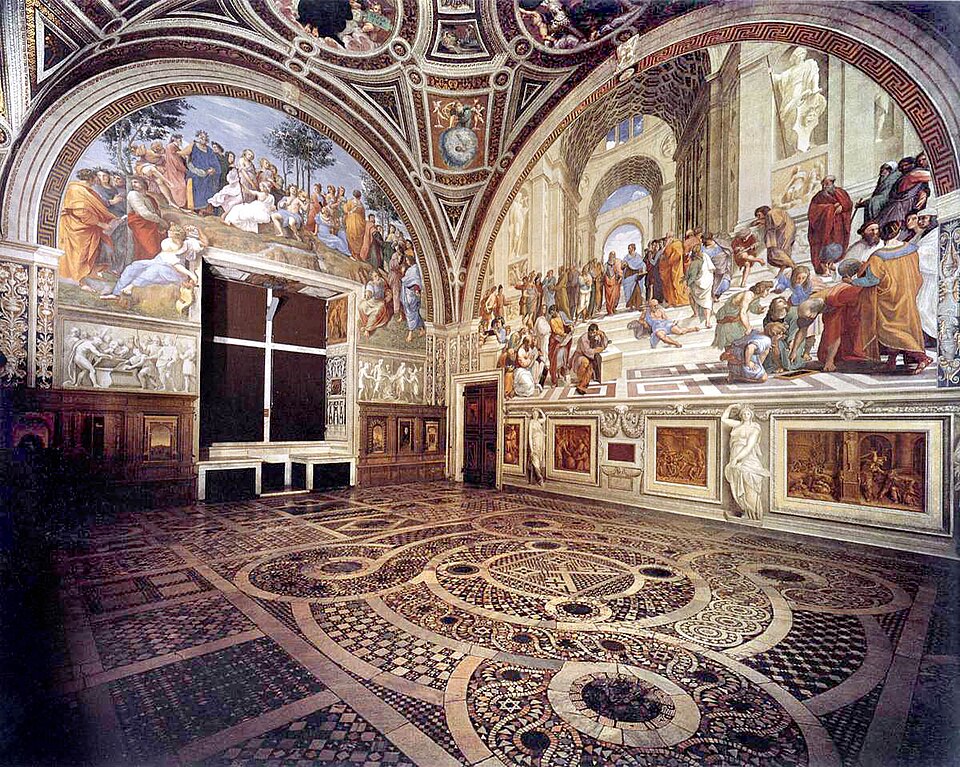
In 1508 or 1509, Pope Julius II summoned a relatively young artist named Raphael, freshly arrived from Urbino, to redecorate a suite of rooms in the Apostolic Palace. Julius had a pointed reason for the commission: the rooms sat directly above the Borgia Apartment, the lavish quarters of his despised predecessor, Pope Alexander VI. By covering these upper rooms in new frescoes, Julius could quietly assert his own legacy over Alexander's, one floor above the other's glory.
The suite, now called the Stanze di Raffaello, occupies the second floor overlooking the south side of the Belvedere Courtyard. Moving from east to west, the four rooms are the Sala di Costantino, the Stanza di Eliodoro, the Stanza della Segnatura, and the Stanza dell'Incendio del Borgo — though this is not the order in which they were actually painted. Together with Michelangelo's Sistine Chapel ceiling, painted at the very same time just a short walk away, these rooms would come to define the High Renaissance in Rome.
Julius did not live to see the project finished. He died in 1513, by which point only two rooms had been frescoed. His successor, Pope Leo X, continued the commission, and after Raphael's own death in 1520, his workshop assistants — Gianfrancesco Penni, Giulio Romano, and Raffaellino del Colle — carried the work forward, finishing the largest chamber, the Sala di Costantino, without their master.
That final room, the largest of the four spaces in the suite, is dedicated to the triumph of Christianity over paganism, told through scenes from the life of the Roman Emperor Constantine. Because Raphael died before it began, these frescoes are considered less masterful than their neighbors — yet they carry their own sly flattery. Continuing a papal tradition, the painters gave Pope Sylvester the facial features of the reigning pontiff, Clement VII, in scenes including The Baptism of Constantine.
The Sala di Costantino tells its story in four scenes: The Vision of the Cross, where a great cross appears to Constantine before his battle with Maxentius, inscribed with the Greek words for 'By this, conquer'; The Battle of Milvian Bridge, depicting the clash of October 28, 312; The Baptism of Constantine, showing Pope Sylvester I baptizing the emperor in the Lateran Baptistery; and The Donation of Constantine, illustrating the emperor's supposed grant of Rome's territorial sovereignty to the Papacy, a legend built on documents later revealed as forgeries.
More from Art

The Painting With No Foreground
A single robed figure stares out at an empty grey sea — and the emptiness itself became a scandal. When it was unveiled in Berlin in 1810, no one knew quite what to do with it.

The Painter Who Chased the Light
For a few purple minutes each evening, an American exile knelt in an English garden and raced the dying sun to paint two little girls lighting lanterns. It took him two years to finish.

When a President Became a God
Look straight up inside the U.S. Capitol dome and you will find George Washington enthroned among the clouds, surrounded by goddesses — the founding father transformed into myth.

Marble Brought Back to Life
A corpse asleep, a wing barely brushing her skin — and marble somehow learns to breathe. This is the moment Antonio Canova dared to carve.

The World Turned Upside Down
Look closely at a sixteenth-century Flemish village and you'll find a man biting a pillar, another carrying daylight in a basket, and a wife slipping a blue cloak over her husband's shoulders. Every gesture is a joke — if you know the language.

The Girl in the Glass Case
She stood two-thirds life size, dressed in a real tutu and human hair — and the critics who saw her in 1881 recoiled as if she were something obscene.