The Saint Who Would Not Look Away
A tower crumbles, demons swarm the sky, and a lone man keeps pointing toward a small crucifix that no one else in the picture will see. Hieronymus Bosch built an entire world to test one man's faith — and left us guessing at half of it.
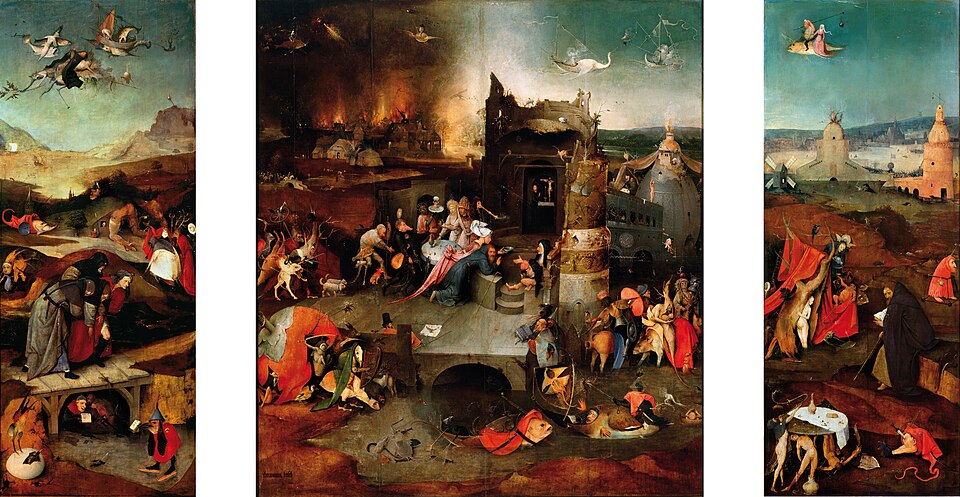
Around 1501, in the workshop of Hieronymus Bosch, three wooden panels came together to form a hinged altarpiece: the Triptych of the Temptation of St. Anthony. Painted in oil, the center panel measures 131.5 by 119 centimeters, flanked by two narrower wings of 131.5 by 53 centimeters each. For centuries it has hung far from its likely origins, now resting in the Museu Nacional de Arte Antiga in Lisbon, where visitors lean close to decode its swarming details.
The subject was already old when Bosch painted it. St. Anthony the Great, one of the Desert Fathers of Egypt in the late third and early fourth centuries, had long fascinated Christian artists as the embodiment of temptation resisted. Bosch drew on Athanasius of Alexandria's Life of St. Anthony, popularized in Flanders by Pieter van Os, and on Jacopo da Varazze's Golden Legend, weaving their accounts into a phantasmagoria entirely his own.
The left panel shows Anthony's legendary flight and fall, dragged down from the sky by a mob of demons. Below, his grotto — or perhaps a brothel — is carved into a hillside shaped like a crouching man, its entrance formed grotesquely from the figure's backside. A procession of impious figures, led by a demon in holy vestments and a deer, moves toward it. In the foreground, an exhausted Anthony is held up by a monk and a layman; tradition has long identified that layman as Bosch himself. Beneath a bridge crossing a frozen lake, three figures appear, one a monk reading a letter, while a demon bird on skates carries in its beak a cartouche reading 'fat' — possibly a jab at the era's simony scandals.
The central panel is the heart of the work: Anthony in contemplation, one hand blessing, the other pointing toward his small cell inside a ruined tower, where a miniature Christ gestures at the Crucifix. It is a quiet counterpoint to the profane mass being celebrated nearby by demons and a black-skinned priestess, who holds a vessel containing a toad clutching an egg — emblems of witchcraft and luxury. A black-robed singer with a pig's face wears a little owl, a symbol of heresy, on his head, while a crippled man approaches to receive communion. Anthony looks outward, pointing toward Christ, yet no one else in the panel looks where he points.
In the background, a city burns — a traditional symbol of Anthony's protection against ergotism and fire, the very afflictions the monks of the Order of St. Anthony devoted themselves to treating. Sufferers of St. Anthony's fire experienced burning sensations and hallucinations, and scholars have long suspected that Bosch's visions of monstrous violence and altered perception echo the era's understanding of that disease.
More from Art

The Painting With No Foreground
A single robed figure stares out at an empty grey sea — and the emptiness itself became a scandal. When it was unveiled in Berlin in 1810, no one knew quite what to do with it.

The Painter Who Chased the Light
For a few purple minutes each evening, an American exile knelt in an English garden and raced the dying sun to paint two little girls lighting lanterns. It took him two years to finish.

When a President Became a God
Look straight up inside the U.S. Capitol dome and you will find George Washington enthroned among the clouds, surrounded by goddesses — the founding father transformed into myth.

Marble Brought Back to Life
A corpse asleep, a wing barely brushing her skin — and marble somehow learns to breathe. This is the moment Antonio Canova dared to carve.

The World Turned Upside Down
Look closely at a sixteenth-century Flemish village and you'll find a man biting a pillar, another carrying daylight in a basket, and a wife slipping a blue cloak over her husband's shoulders. Every gesture is a joke — if you know the language.

The Girl in the Glass Case
She stood two-thirds life size, dressed in a real tutu and human hair — and the critics who saw her in 1881 recoiled as if she were something obscene.