The Scandal That Became a Masterpiece
A canvas of naked dancers and cadmium fire nearly ended a career in 1906 — instead it helped invent modern art.
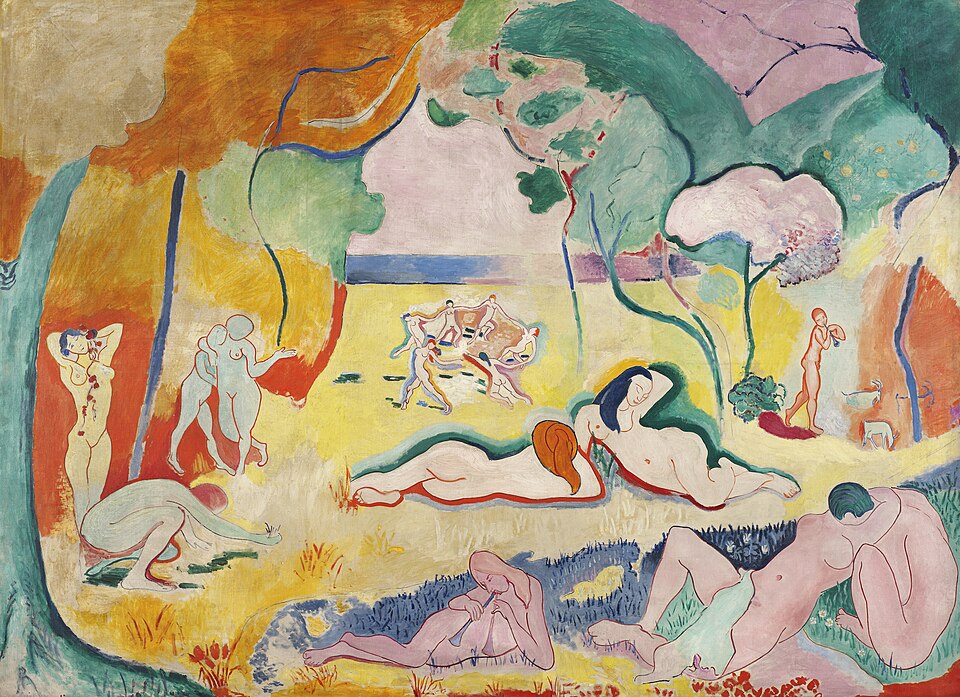
When Henri Matisse unveiled Le bonheur de vivre at the Salon des Indépendants in 1906, the room did not greet it with admiration. Visitors saw nude men and women cavorting, playing music, and dancing across a landscape saturated in unnatural, vivid color, and many recoiled. The painting's spatial distortions and its riot of cadmium hues struck contemporary eyes as an affront to painting itself.
The outrage was not merely aesthetic. Some critics worried aloud that this canvas signaled nothing less than the end of French painting. Paul Signac, the Pointillist painter who had previously purchased some of Matisse's earlier work, wrote scathingly that Matisse 'seems to me to have gone to the dogs,' saying he had surrounded some strange characters with a line as thick as a thumb and covered the whole thing with flat, well-defined tints that, however pure, seemed disgusting to him.
Matisse had reasons to push further into color and distortion. The painting appears to have been his considered response to the hostility his Fauvist work had already met at the Salon d'Automne in 1905. Rather than retreat, he prepared extensively, producing many preparatory sketches of the figures and a full cartoon of the composition before committing it to the monumental canvas.
Art historians have traced possible roots of the composition to older sources. James Cuno and Thomas Puttfarken pointed to Agostino Carracci's engraving of Reciproco Amore, itself based on a painting by the sixteenth-century Flemish painter Paolo Fiammingo. The engraving's pastoral fantasy and its circle of dancers in the background bear striking resemblance to Matisse's central grouping — a grouping that would resurface years later in his 1909–10 painting The Dance. Since the 1980s, though, scholars have debated how much weight to give such source-hunting, arguing it risks overshadowing Matisse's own transformation of the tradition.
Not everyone recoiled from the shock. Pablo Picasso, in an effort to outdo Matisse in terms of shock value, immediately began work on his watershed Les Demoiselles d'Avignon — a response that, according to Barnes Foundation associate curator Martha Lucy, 'irritated' Matisse. Two of modernism's foundational works, then, emerged in direct dialogue with one another, born from rivalry as much as from vision.
More from Art

The Painting With No Foreground
A single robed figure stares out at an empty grey sea — and the emptiness itself became a scandal. When it was unveiled in Berlin in 1810, no one knew quite what to do with it.

The Painter Who Chased the Light
For a few purple minutes each evening, an American exile knelt in an English garden and raced the dying sun to paint two little girls lighting lanterns. It took him two years to finish.

When a President Became a God
Look straight up inside the U.S. Capitol dome and you will find George Washington enthroned among the clouds, surrounded by goddesses — the founding father transformed into myth.

Marble Brought Back to Life
A corpse asleep, a wing barely brushing her skin — and marble somehow learns to breathe. This is the moment Antonio Canova dared to carve.

The World Turned Upside Down
Look closely at a sixteenth-century Flemish village and you'll find a man biting a pillar, another carrying daylight in a basket, and a wife slipping a blue cloak over her husband's shoulders. Every gesture is a joke — if you know the language.

The Girl in the Glass Case
She stood two-thirds life size, dressed in a real tutu and human hair — and the critics who saw her in 1881 recoiled as if she were something obscene.