The Scream Frozen in Marble
For centuries it lay buried beneath Rome, a priest and his sons locked forever in a serpent's coils. When workmen finally uncovered it in 1506, even Michelangelo came running.
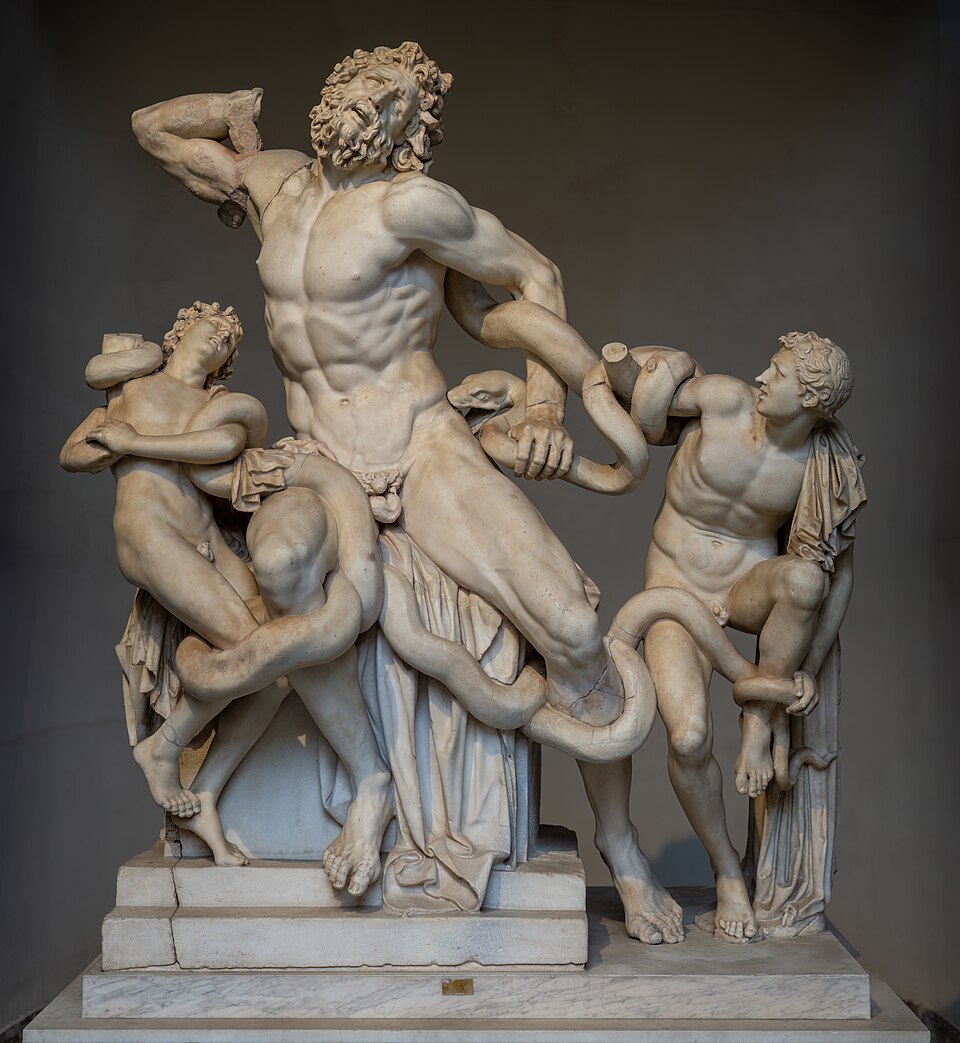
In February 1506, diggers working in a vineyard near the ruins of Nero's Domus Aurea in Rome struck something extraordinary: a marble group of three men entwined by serpents, their faces twisted in agony. Word spread quickly through the city, and Pope Julius II, recognizing its importance at once, arranged for the sculpture to be secured and put on public display. It has remained on view in the Vatican ever since, now housed in the Museo Pio-Clementino.
The statue depicts the Trojan priest Laocoön and his two sons, Antiphantes and Thymbraeus, being attacked by sea serpents. The figures are nearly life-sized, and the whole group stands just over two meters tall, carved with such anatomical intensity that it has been called the prototypical icon of human agony in Western art. Unlike the suffering shown in Christian depictions of martyrdom, there is no hint of redemption here — only raw, physical torment, visible even in the impossible strain of Laocoön's bulging eyebrows.
The story behind the sculpture comes from the Greek Epic Cycle of the Trojan War, though Homer himself never mentions it. Sophocles wrote a now-lost tragedy on the subject, and other Greek writers told the tale with notable variations. The most famous version survives in Virgil's Aeneid, written between 29 and 19 BC, where Laocoön is a priest of Poseidon killed alongside his sons after striking the Trojan Horse with a spear to expose the trick hidden inside it. In an older account by Sophocles, Laocoön was a priest of Apollo who had broken his vow of celibacy by marrying; there, only his sons die, while he is left alive to suffer. Other versions link his death to a sexual act in Poseidon's temple. Each telling carries a different moral — punishment for wrongdoing, or punishment for being right.
The Roman writer Pliny the Elder, the chief ancient authority on art, praised the work in his Natural History as superior to any other painting or bronze statue he knew. He recorded that it stood in the palace of Emperor Titus and attributed it to three sculptors from the island of Rhodes — Agesander, Athenodoros, and Polydorus — carved, he claimed, from a single block of marble. Pliny gave no date, and scholars still debate when the group was actually made, with estimates ranging from 200 BC to the 70s AD. Its style belongs to the Hellenistic 'Pergamene baroque,' the dramatic sculptural tradition that also produced the Pergamon Altar, though whether the Laocoön is an original or a later Roman copy of an earlier bronze remains unresolved.
When the statue emerged from the earth in 1506, it was missing Laocoön's right arm, along with fragments of the serpents and one hand from each son. In 1510, with the Pope's permission, a competition was organized among sculptors to propose a restoration, judged by Raphael himself. The winning arm, created by Michelangelo's student Giovanni Antonio Montorsoli, remained attached for centuries. Later restorers — Agostino Cornacchini in 1725–27 and Antonio Canova in 1816 — made further adjustments, until a newly discovered ancient arm fragment in the 1980s allowed conservators to reassemble the group more faithfully, removing the old restored hands in the process.
More from Art

The Painting With No Foreground
A single robed figure stares out at an empty grey sea — and the emptiness itself became a scandal. When it was unveiled in Berlin in 1810, no one knew quite what to do with it.

The Painter Who Chased the Light
For a few purple minutes each evening, an American exile knelt in an English garden and raced the dying sun to paint two little girls lighting lanterns. It took him two years to finish.

When a President Became a God
Look straight up inside the U.S. Capitol dome and you will find George Washington enthroned among the clouds, surrounded by goddesses — the founding father transformed into myth.

Marble Brought Back to Life
A corpse asleep, a wing barely brushing her skin — and marble somehow learns to breathe. This is the moment Antonio Canova dared to carve.

The World Turned Upside Down
Look closely at a sixteenth-century Flemish village and you'll find a man biting a pillar, another carrying daylight in a basket, and a wife slipping a blue cloak over her husband's shoulders. Every gesture is a joke — if you know the language.

The Girl in the Glass Case
She stood two-thirds life size, dressed in a real tutu and human hair — and the critics who saw her in 1881 recoiled as if she were something obscene.