The Sculptor Who Made Marble Move
A 24-year-old carver abandoned one masterpiece mid-chisel to begin another — and in doing so, reinvented what a statue could do.
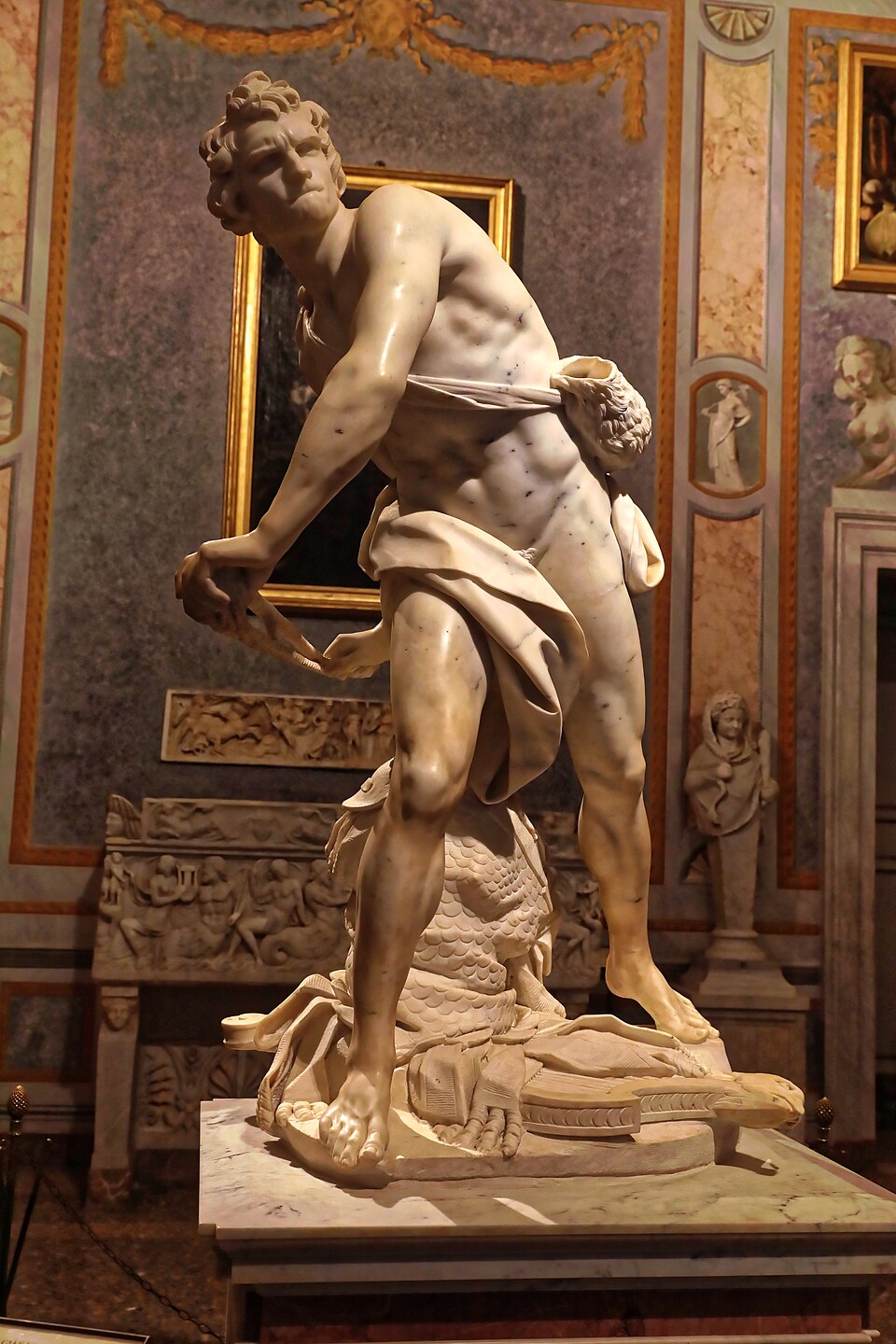
In 1623, inside the workshops commissioned by Cardinal Scipione Borghese, a young sculptor named Gian Lorenzo Bernini was deep into carving Apollo and Daphne when, for reasons no record explains, he simply stopped. He turned instead to a new subject: David, the shepherd boy of the Old Testament, poised to hurl the stone that would fell the giant Goliath. Payment records show Bernini began work by mid-1623, and his contemporary biographer Filippo Baldinucci claims he finished the entire life-size marble in seven months — work that stretched from 1623 into 1624.
The timing mattered. This would be Scipione Borghese's final commission for Bernini. And even before the statue was complete, Bernini's friend and protector Maffeo Barberini was elevated to the papacy as Urban VIII — a shift that would soon redirect the sculptor's fortunes toward Rome's grandest stage.
The scene Bernini chose comes straight from the First Book of Samuel: the Israelites and Philistines at war, their conflict to be settled by single combat between champions. David, dressed as a simple shepherd, has just closed the distance with Goliath. At his feet lies the ornate armor of King Saul — offered to David for battle, then discarded because it was too large and unfamiliar, leaving him freer to fight in his own clothes. Beside the armor sits his harp, the traditional emblem of David the Psalmist.
David had long fascinated Renaissance sculptors. Donatello tackled the subject in the 1440s, Verrocchio in the 1470s, and Michelangelo in his towering 1501–1504 masterpiece. Each found a different moment to freeze. Michelangelo showed David before the fight, coiled with unspent tension. Bernini made a far bolder choice: he captured David mid-throw, stone already leaving the sling.
This was almost unheard of. Throwing figures were exceedingly rare in sculpture since antiquity. Bernini likely drew inspiration from unexpected places — the Hellenistic Borghese Gladiator, whose twisting attack pose echoes David's sling-swing, and Annibale Carracci's fresco of the Cyclops Polyphemus hurling a boulder, a work Bernini would have known well from the Galleria Farnese, and whose painter he ranked fourth among the greatest of all time. Some scholars also suggest Bernini absorbed Leonardo da Vinci's writings on depicting a body in the act of throwing, matching the theorized alignment of foot, weight, and shoulder almost precisely.
More from Art

The Painting With No Foreground
A single robed figure stares out at an empty grey sea — and the emptiness itself became a scandal. When it was unveiled in Berlin in 1810, no one knew quite what to do with it.

The Painter Who Chased the Light
For a few purple minutes each evening, an American exile knelt in an English garden and raced the dying sun to paint two little girls lighting lanterns. It took him two years to finish.

When a President Became a God
Look straight up inside the U.S. Capitol dome and you will find George Washington enthroned among the clouds, surrounded by goddesses — the founding father transformed into myth.

Marble Brought Back to Life
A corpse asleep, a wing barely brushing her skin — and marble somehow learns to breathe. This is the moment Antonio Canova dared to carve.

The World Turned Upside Down
Look closely at a sixteenth-century Flemish village and you'll find a man biting a pillar, another carrying daylight in a basket, and a wife slipping a blue cloak over her husband's shoulders. Every gesture is a joke — if you know the language.

The Girl in the Glass Case
She stood two-thirds life size, dressed in a real tutu and human hair — and the critics who saw her in 1881 recoiled as if she were something obscene.