The Sculpture That Fooled a Thousand Glances
From one angle, a sleeping goddess. From the other, something no ancient viewer expected to see carved in marble — and it has been startling people for two thousand years.
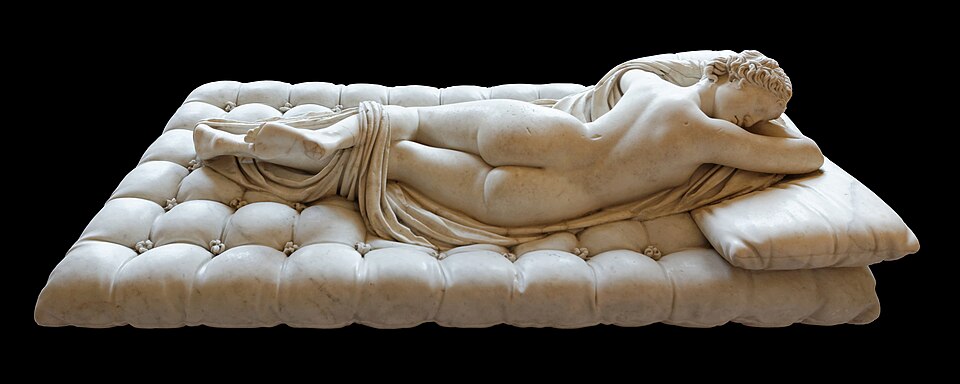
In 1618, workers digging near Santa Maria della Vittoria in Rome — close to the Baths of Diocletian and within the old bounds of the Gardens of Sallust — struck marble. What emerged from the earth was a life-size reclining figure, its back turned in the classic pose of a sleeping Venus, soft curves inviting a familiar gaze. Only on walking around it did the truth appear: this was Hermaphroditus, child of Hermes and Aphrodite, rendered with both male and female anatomy, caught in the vulnerable stillness of sleep.
The figure was likely unearthed during the digging of the church's foundations, or perhaps while planting espaliers nearby — an almost accidental resurrection of a body that had lain hidden for over a millennium. It found its way quickly to a man who collected such wonders obsessively: Cardinal Scipione Borghese, nephew of Pope Paul V and one of the great art patrons of the Roman Baroque.
Borghese didn't just display the statue — he transformed its presentation. He commissioned his own protégé, a young sculptor already dazzling Rome with his virtuosity, Gian Lorenzo Bernini, to carve a mattress for the figure to rest upon. Bernini finished the buttoned marble mattress in 1620, for a fee of sixty scudi. The illusion is startling: hard stone rendered soft, dimpled, yielding beneath a body that seems, impossibly, to sink into it. It's likely Scipione gave the sculpture an entire room of Villa Borghese to itself, a private chamber built around a single, ambiguous body.
The form itself was not new to antiquity. Scholars trace its lineage to portrayals of Venus and other female nudes, blended with feminized Hellenistic images of Dionysus. The subject was popular enough in the Hellenistic period and in Rome that many versions survive — this one is thought to be a good early Imperial Roman copy of a lost bronze original by the later of two Hellenistic sculptors named Polycles, working around 155 BC, whose work was noted by Pliny in his Natural History.
The statue stayed in Roman hands for nearly two centuries, but history caught up with the Borghese family. When Napoleon's France absorbed Rome, art became currency. In 1807, Prince Camillo Borghese — married to Napoleon's sister Pauline Bonaparte and squeezed by French taxation — sold the sculpture along with other treasures. By 1809 it had crossed into France and entered the Louvre, where it remains today.
More from Art

The Painting With No Foreground
A single robed figure stares out at an empty grey sea — and the emptiness itself became a scandal. When it was unveiled in Berlin in 1810, no one knew quite what to do with it.

The Painter Who Chased the Light
For a few purple minutes each evening, an American exile knelt in an English garden and raced the dying sun to paint two little girls lighting lanterns. It took him two years to finish.

When a President Became a God
Look straight up inside the U.S. Capitol dome and you will find George Washington enthroned among the clouds, surrounded by goddesses — the founding father transformed into myth.

Marble Brought Back to Life
A corpse asleep, a wing barely brushing her skin — and marble somehow learns to breathe. This is the moment Antonio Canova dared to carve.

The World Turned Upside Down
Look closely at a sixteenth-century Flemish village and you'll find a man biting a pillar, another carrying daylight in a basket, and a wife slipping a blue cloak over her husband's shoulders. Every gesture is a joke — if you know the language.

The Girl in the Glass Case
She stood two-thirds life size, dressed in a real tutu and human hair — and the critics who saw her in 1881 recoiled as if she were something obscene.