The Sea That Swallowed the Dead
A blood-red sky, a fleeing ship, and one severed leg still shackled in the churning water — Turner's masterpiece was born from a court case about drowned human cargo.
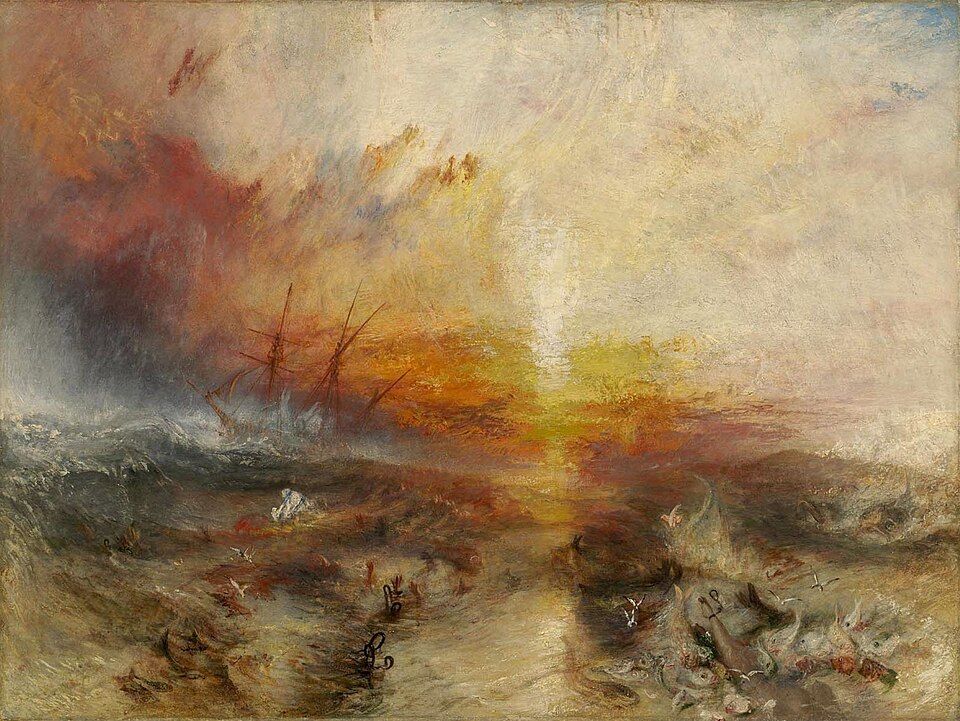
In 1840, at the Royal Academy of Arts in London, visitors stopped before a canvas that seemed, at first glance, to be nothing more than a spectacular sunset over a storm-lashed sea. The sky burned deep red, a typhoon gathering on the horizon, and a ship — its masts stained the same crimson as the clouds — sailed away into the distance. Only on closer inspection did the horror emerge: in the foreground, a single dark-skinned leg jutted from the water, an iron chain still locked around its ankle, surrounded by a frenzy of seagulls and fish tearing at what remained of a human body.
The painting, originally titled Slavers Throwing overboard the Dead and Dying—Typhon coming on, was the work of J. M. W. Turner, already one of Britain's most celebrated landscape painters. Born in London in 1775, Turner had entered the Royal Academy at fourteen and trained further under Dr. Thomas Monro, refining the bold, atmospheric use of colour that would define his career. But this canvas, exhibited in 1840 and now known simply as The Slave Ship, was something different: a landscape weaponized as moral testimony.
Turner's inspiration reached back to 1781 and the case of the slave ship Zong. Bound for Jamaica with a dwindling supply of drinking water, the Zong's captain had ordered 132 enslaved people thrown overboard — not out of desperation alone, but because insurance would cover slaves lost at sea, while those who died of natural causes were not covered. The resulting trial, though ultimately inconclusive, drew intense public attention and became a pivotal moment in Britain's abolitionist movement. Turner likely learned of the incident through the second edition of Thomas Clarkson's The History and Abolition of the Slave Trade, published in 1839, just a year before he painted the scene.//
Turner was no detached observer of these debates. His liberal sympathies had long aligned him with the era's anti-slavery societies — the Society for the Mitigation and Gradual Abolition of Slavery Throughout the British Dominions, active from 1823 to 1838, and the British and Foreign Anti-Slavery Society, founded in 1839. As early as 1828, he had dedicated an engraving of his painting The Deluge to the abolitionist John Joshua Proby, signaling where his convictions lay. By the time he painted The Slave Ship, he was also likely aware of the Amistad rebellion and its widely reported American court case, another slavery-related drama that had gripped international attention.
The timing of the painting's first exhibition was no accident. In 1840, London hosted two major international anti-slavery conventions: the General Anti-Slavery Society and the Society for the Extinction of the Slave Trade and the Civilization of Africa. Turner's decision to unveil his grim maritime vision at exactly this moment transformed it from a historical reflection into what many read as a political call to action — a reminder that while Britain had abolished slavery in its own empire by 1833, the trade persisted elsewhere in the world.
More from Art

The Painting With No Foreground
A single robed figure stares out at an empty grey sea — and the emptiness itself became a scandal. When it was unveiled in Berlin in 1810, no one knew quite what to do with it.

The Painter Who Chased the Light
For a few purple minutes each evening, an American exile knelt in an English garden and raced the dying sun to paint two little girls lighting lanterns. It took him two years to finish.

When a President Became a God
Look straight up inside the U.S. Capitol dome and you will find George Washington enthroned among the clouds, surrounded by goddesses — the founding father transformed into myth.

Marble Brought Back to Life
A corpse asleep, a wing barely brushing her skin — and marble somehow learns to breathe. This is the moment Antonio Canova dared to carve.

The World Turned Upside Down
Look closely at a sixteenth-century Flemish village and you'll find a man biting a pillar, another carrying daylight in a basket, and a wife slipping a blue cloak over her husband's shoulders. Every gesture is a joke — if you know the language.

The Girl in the Glass Case
She stood two-thirds life size, dressed in a real tutu and human hair — and the critics who saw her in 1881 recoiled as if she were something obscene.