The Severed Head That Looked Like the Painter
A young man holds up a dripping, severed head — and the face on that head belongs to the artist himself. Why would Caravaggio paint his own execution?
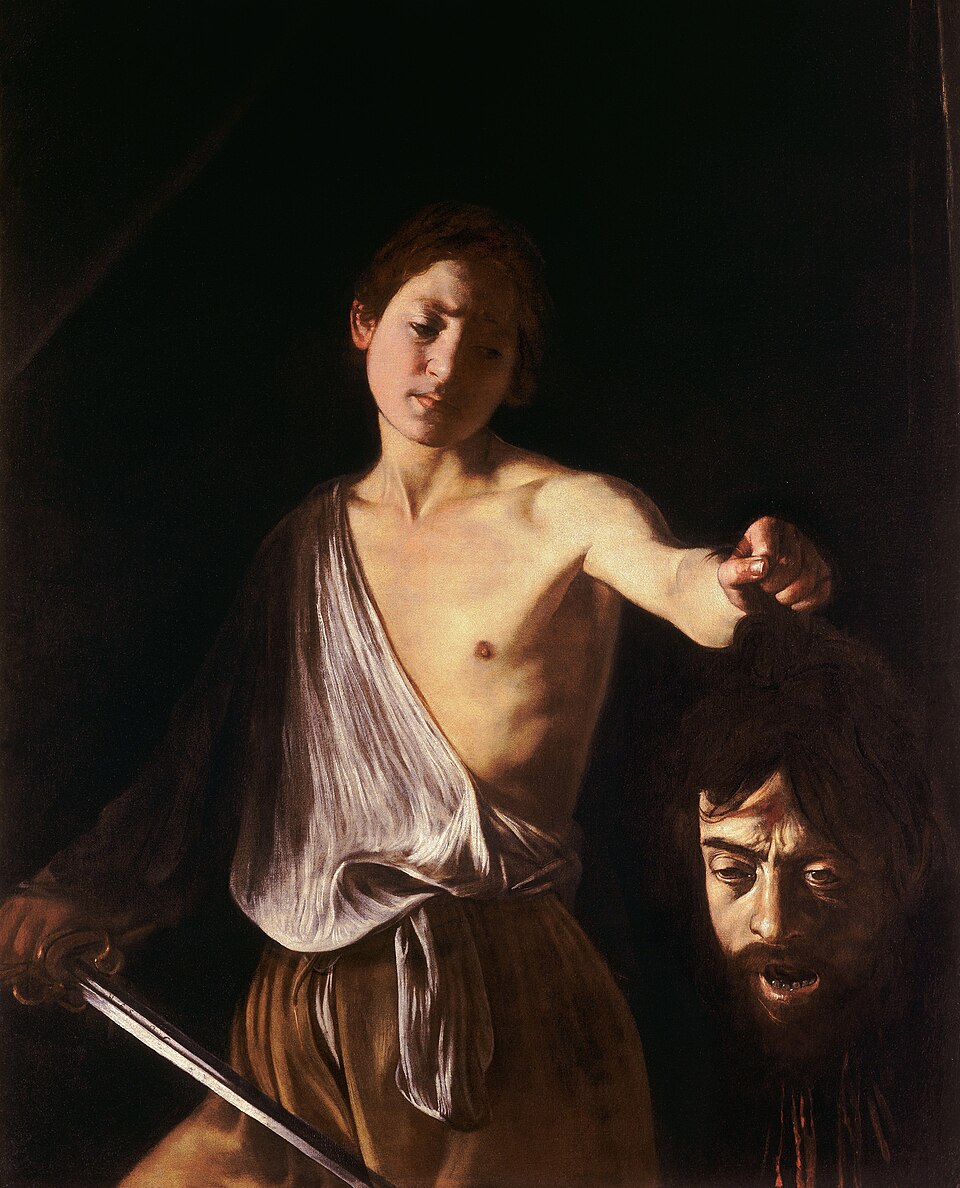
In the Galleria Borghese in Rome hangs a small, unsettling canvas: a boy extending his arm, gripping a man's head by the hair, blood still trickling from the neck. It is David with the Head of Goliath, painted by Caravaggio, and dated by most recent scholars to around 1605, though some have placed it as late as 1609–1610. By 1650 it belonged to Cardinal Scipione Borghese, and it remains in his gallery today.
Caravaggio returned to this biblical subject more than once. An earlier version, painted around 1600, hangs in the Museo del Prado in Madrid, and another, on poplar panel from around 1607, is in Vienna's Kunsthistorisches Museum. For the Rome painting, his immediate model was a work by a follower of Giorgione from around 1510 — but where that earlier picture rested Goliath's head on a ledge, Caravaggio let it dangle, dripping, from David's fist, sharpening the drama considerably.
Look closely at the sword in David's hand and you find an inscription: H-AS OS, believed to abbreviate the Latin humilitas occidit superbiam — 'humility kills pride.' Yet the picture resists any simple moral triumph. David's face is not jubilant but sorrowful, his expression mingling sadness and compassion, gazing at his victim with something closer to grief than victory.
That strangeness deepens when you learn who the figures are. Goliath's face is Caravaggio's own. The model for David has long been identified as 'his own little Caravaggio' — most plausibly Cecco del Caravaggio, the artist's studio assistant in Rome years earlier, once recorded as the boy 'who lay with him.' No independent portrait of Cecco survives, so the identification can't be proven, but scholars have noted the sword's suggestive upward angle between David's legs, echoing the diagonal line linking his gaze to his victim — a detail that seems to point toward an intimacy between the two men.
An alternative reading, drawn from a portrait of Caravaggio by Ottavio Leoni, suggests the painting might be a double self-portrait: a young Caravaggio wistfully holding the severed head of his older self, reflecting on how his own wild, riotous youth had destroyed the life of the mature man he became.
More from Art

The Painting With No Foreground
A single robed figure stares out at an empty grey sea — and the emptiness itself became a scandal. When it was unveiled in Berlin in 1810, no one knew quite what to do with it.

The Painter Who Chased the Light
For a few purple minutes each evening, an American exile knelt in an English garden and raced the dying sun to paint two little girls lighting lanterns. It took him two years to finish.

When a President Became a God
Look straight up inside the U.S. Capitol dome and you will find George Washington enthroned among the clouds, surrounded by goddesses — the founding father transformed into myth.

Marble Brought Back to Life
A corpse asleep, a wing barely brushing her skin — and marble somehow learns to breathe. This is the moment Antonio Canova dared to carve.

The World Turned Upside Down
Look closely at a sixteenth-century Flemish village and you'll find a man biting a pillar, another carrying daylight in a basket, and a wife slipping a blue cloak over her husband's shoulders. Every gesture is a joke — if you know the language.

The Girl in the Glass Case
She stood two-thirds life size, dressed in a real tutu and human hair — and the critics who saw her in 1881 recoiled as if she were something obscene.