The Shark That Ate the Art World
A dead fish suspended in a tank became one of the most expensive artworks of its era — and it took a second shark to keep the idea alive.
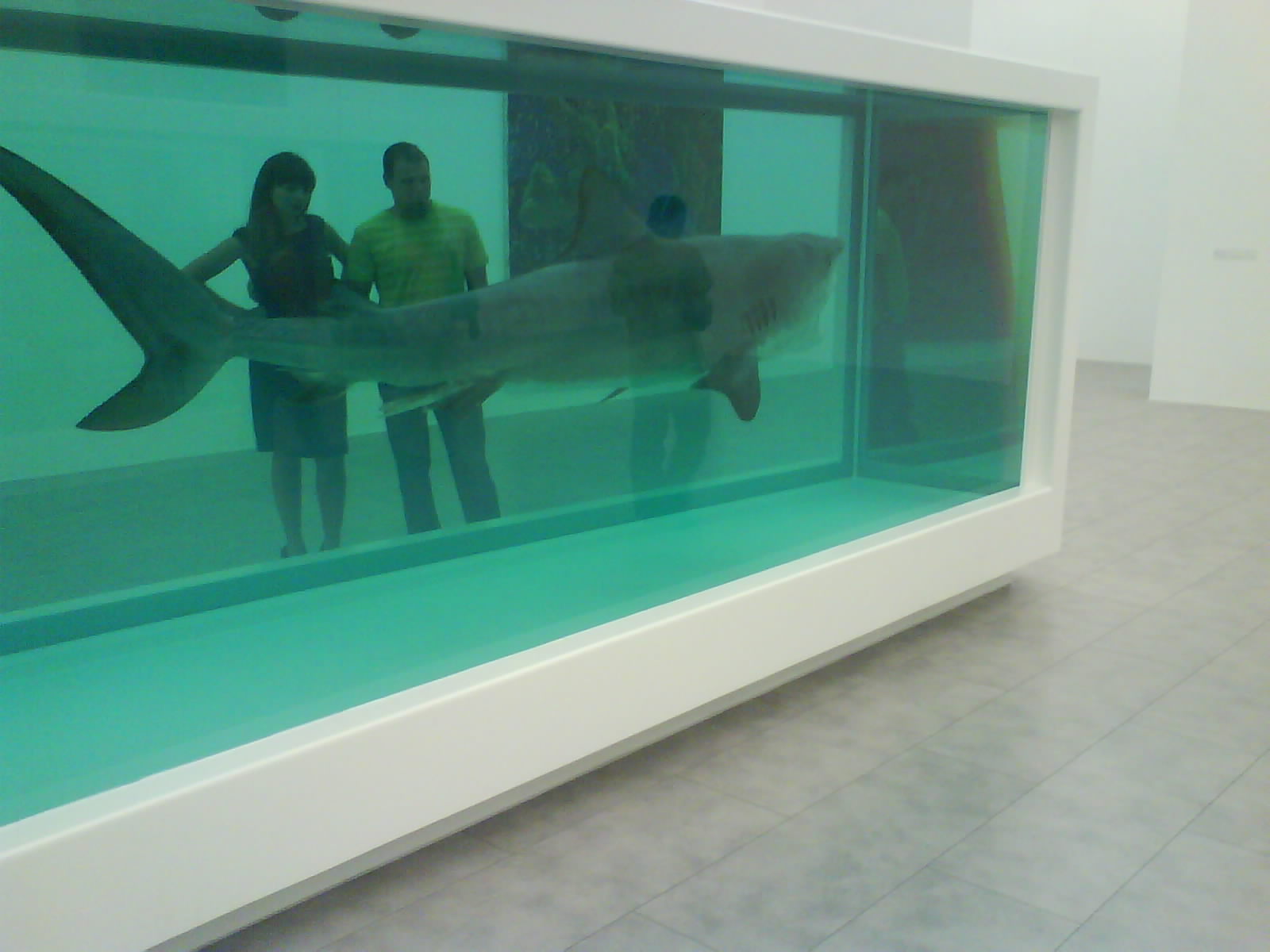
In 1991, Charles Saatchi told a young, largely unknown artist named Damien Hirst that he would fund whatever piece Hirst wanted to make. Hirst's answer was audacious: he wanted a shark, something 'big enough to eat you.' A fisherman off Hervey Bay in Queensland, Australia, was commissioned to catch one, and the resulting 14-foot tiger shark cost £6,000. The total production of the work came to £50,000 — glass, steel, a five percent formaldehyde solution, and a carcass suspended mid-swim inside a vitrine.
The money for shipping the shark from Australia came, almost by accident, from Doris Lockhart, Saatchi's ex-wife and an art collector in her own right. Hirst had only asked her for a loan; she gave him the funds outright, and in return he let her choose any piece from his studio, which turned out to be a work called The Only Way Is Up.
The finished piece, titled The Physical Impossibility of Death in the Mind of Someone Living, debuted in 1992 at the Saatchi Gallery in St John's Wood, north London, as part of the first Young British Artists exhibition. The tabloid Sun mocked it with the headline '£50,000 for fish without chips.' Hirst was nominated for the Turner Prize that year but lost to Grenville Davey. Still, the shark, alongside his other work A Thousand Years, cemented him as the face of a defiant new British art scene.
By the early 1990s, the shark itself was falling apart. Its preservation had been poor, and the fluid around it grew murky — a problem Hirst partly blamed on bleach added by the gallery. In 1993, in a strange twist, the gallery skinned the shark and stretched its hide over a fiberglass mold, turning it from a preserved carcass into something closer to taxidermy. Hirst was unhappy with the result: 'It didn't look as frightening,' he said. 'You could tell it wasn't real. It had no weight.'
In 2004, Saatchi sold the piece to hedge fund manager Steven A. Cohen for a sum widely reported as at least $8 million, though one book title suggests the true figure was closer to $12 million. When Hirst learned the sale was happening, he made an unusual offer: replace the deteriorating shark entirely. Cohen agreed to fund it, calling the cost — including roughly $100,000 for the formaldehyde process alone — 'inconsequential.'
More from Art

The Painting With No Foreground
A single robed figure stares out at an empty grey sea — and the emptiness itself became a scandal. When it was unveiled in Berlin in 1810, no one knew quite what to do with it.

The Painter Who Chased the Light
For a few purple minutes each evening, an American exile knelt in an English garden and raced the dying sun to paint two little girls lighting lanterns. It took him two years to finish.

When a President Became a God
Look straight up inside the U.S. Capitol dome and you will find George Washington enthroned among the clouds, surrounded by goddesses — the founding father transformed into myth.

Marble Brought Back to Life
A corpse asleep, a wing barely brushing her skin — and marble somehow learns to breathe. This is the moment Antonio Canova dared to carve.

The World Turned Upside Down
Look closely at a sixteenth-century Flemish village and you'll find a man biting a pillar, another carrying daylight in a basket, and a wife slipping a blue cloak over her husband's shoulders. Every gesture is a joke — if you know the language.

The Girl in the Glass Case
She stood two-thirds life size, dressed in a real tutu and human hair — and the critics who saw her in 1881 recoiled as if she were something obscene.