The Skeleton That Smoked Back at the Academy
A grinning skull with a cigarette clenched between its teeth — was it a joke, a warning, or a young painter's private rebellion?
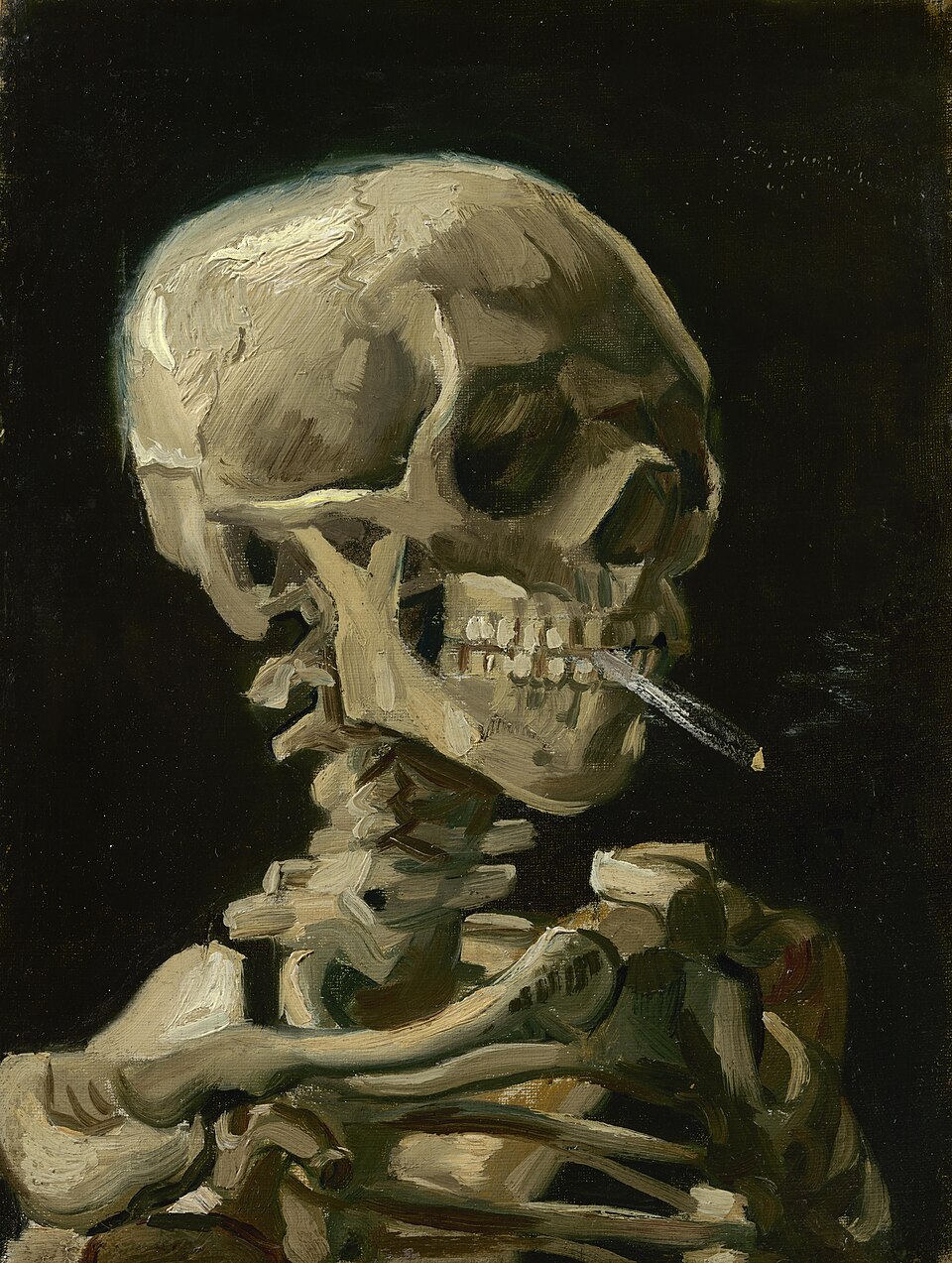
In the winter of 1885–86, a struggling art student sat in the classrooms of the Royal Academy of Fine Arts in Antwerp, bored out of his mind. His name was Vincent van Gogh, and he would later say the academic training there taught him nothing at all. Yet from that dull, dutiful period came a small, strange painting that has outlived every lecture he sat through: Skull of a Skeleton with Burning Cigarette.
The work is tiny — just 32 by 24.5 centimetres of oil on canvas — but its image is unforgettable. A human skull, jaw slightly open, holds a lit cigarette between its teeth, smoke curling upward as if the dead could still take a drag. It is undated, but most historians place it firmly in that Antwerp winter, when van Gogh was drowning in the rigid conventions of academic art.
At the time, formal training required students to master the study of skeletons before they were ever allowed to draw a living human model. It was considered essential groundwork for understanding anatomy. Van Gogh, restless and unimpressed by this method, seems to have turned the exercise into satire — painting not a diagram for study but a skeleton with a very human vice.
This wasn't the only skeleton to appear in his Antwerp sketchbooks. Around the same time, he drew a 'Hanging skeleton and cat,' another irreverent take on the macabre props of art school. Skulls would return to his work again in 1887–88, in two more paintings and a drawing — but these handful of pieces remain the only instances in his entire career where he used the skull as a subject.
Scholars have long read the painting as a vanitas, a memento mori — a reminder of mortality — fitting for an artist whose own health was fragile at the time. Some see echoes of the eerie compositions of the 17th-century Dutch painter Hercules Seghers, or the darkly satirical prints of his Belgian contemporary Félicien Rops, both of whom worked with images of death and decay.
More from Art

The Painting With No Foreground
A single robed figure stares out at an empty grey sea — and the emptiness itself became a scandal. When it was unveiled in Berlin in 1810, no one knew quite what to do with it.

The Painter Who Chased the Light
For a few purple minutes each evening, an American exile knelt in an English garden and raced the dying sun to paint two little girls lighting lanterns. It took him two years to finish.

When a President Became a God
Look straight up inside the U.S. Capitol dome and you will find George Washington enthroned among the clouds, surrounded by goddesses — the founding father transformed into myth.

Marble Brought Back to Life
A corpse asleep, a wing barely brushing her skin — and marble somehow learns to breathe. This is the moment Antonio Canova dared to carve.

The World Turned Upside Down
Look closely at a sixteenth-century Flemish village and you'll find a man biting a pillar, another carrying daylight in a basket, and a wife slipping a blue cloak over her husband's shoulders. Every gesture is a joke — if you know the language.

The Girl in the Glass Case
She stood two-thirds life size, dressed in a real tutu and human hair — and the critics who saw her in 1881 recoiled as if she were something obscene.