The Skull That Fooled the World
For decades it was called Aztec magic carved by ancient hands — but the truth behind the crystal skulls was hiding in plain sight, in a jeweler's workshop in Germany.
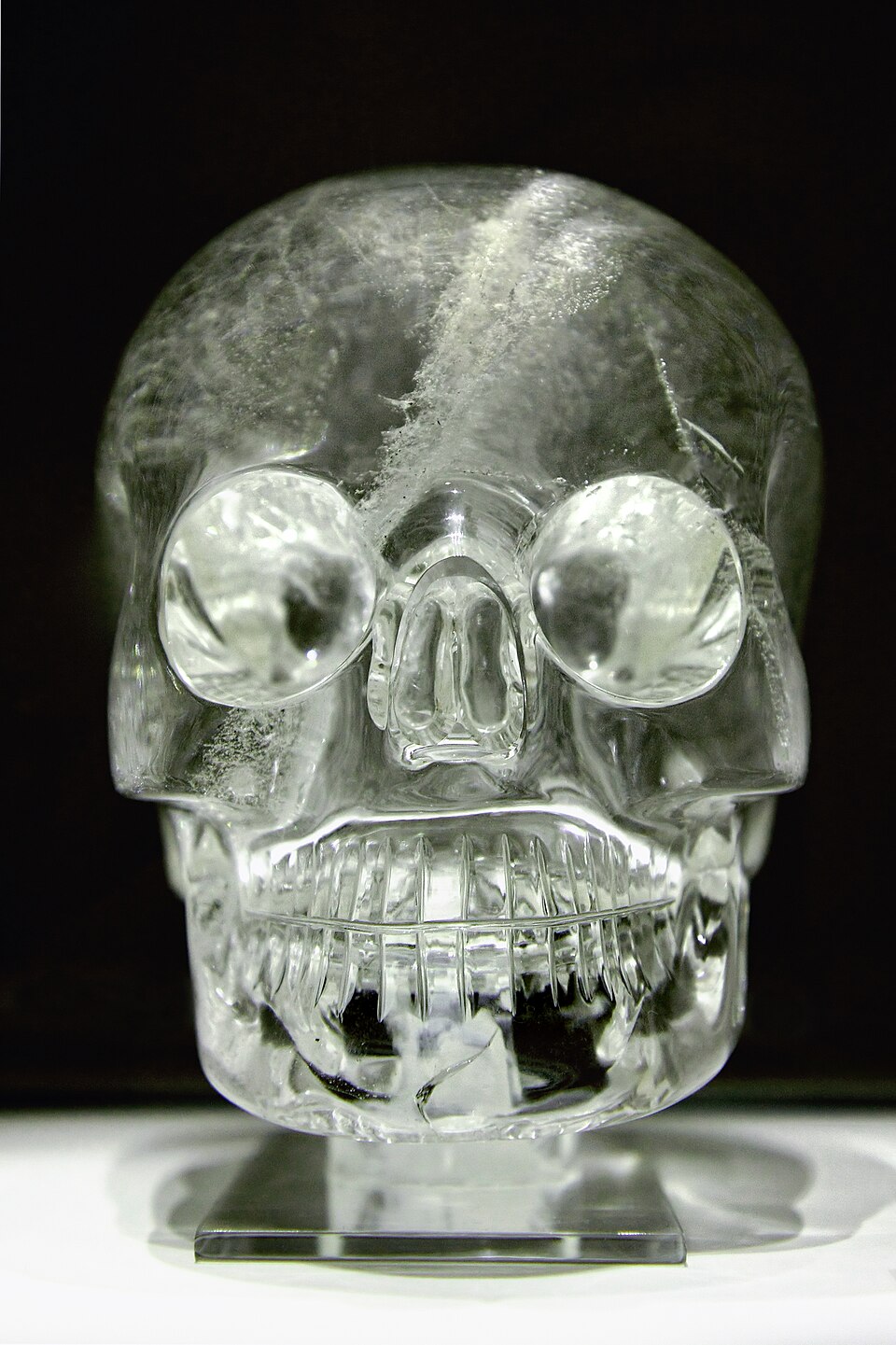
In the late nineteenth century, a Paris antiquities shop belonging to a dealer named Eugène Boban began quietly offering something extraordinary: human skulls carved entirely from clear quartz. Boban had opened his business in 1870 and had spent years operating in Mexico City between 1860 and 1880, and he presented these skulls as relics of the Aztec or Maya world, objects of deep pre-Columbian mystery. He reportedly tried to sell one to Mexico's own national museum as an Aztec artifact, but was turned down.
The timing was no accident. By 1886, the trade in fake Mexican antiquities had grown so brazen that Smithsonian archaeologist William Henry Holmes wrote an article for the journal Science titled 'The Trade in Spurious Mexican Antiquities.' Boban sold most of his collection, including three crystal skulls, to the ethnographer Alphonse Pinart, who donated them to Paris's Trocadéro Museum, later renamed the Musée de l'Homme. Other pieces of his stock traveled further, crossing the Atlantic into the hands of American buyers.
One skull passed from Boban's Paris shop to New York, where it was bought by a collector named George H. Sisson. In 1887 it was exhibited at a meeting of the American Association for the Advancement of Science by George F. Kunz. Eventually it was auctioned and purchased by Tiffany & Co., which sold it at cost to the British Museum in 1897 — where it remains today, cataloged plainly as 'probably European, 19th century AD.'
The most famous of all these objects, though, emerged decades later under far more romantic circumstances. In 1924, Anna Mitchell-Hedges — adopted daughter of the British adventurer and writer F. A. Mitchell-Hedges — claimed to have discovered a crystal skull, later the subject of a 1990 documentary called Crystal Skull of Lubaantun. Unlike the others, it had a separate, movable lower jaw, and Smithsonian researchers who examined it described it as nearly a replica of the British Museum's specimen.
But replicas of what, exactly? Scientific scrutiny at the British Museum in 1967, 1996, and 2004 found something the myths never anticipated: the fine lines marking the teeth had been carved with jeweler's rotary tools, technology that did not exist before the nineteenth century. Chlorite inclusions inside the quartz revealed the stone itself came from Brazil or Madagascar — sources utterly unreachable to pre-Columbian Mesoamerica.
More from Art

The Painting With No Foreground
A single robed figure stares out at an empty grey sea — and the emptiness itself became a scandal. When it was unveiled in Berlin in 1810, no one knew quite what to do with it.

The Painter Who Chased the Light
For a few purple minutes each evening, an American exile knelt in an English garden and raced the dying sun to paint two little girls lighting lanterns. It took him two years to finish.

When a President Became a God
Look straight up inside the U.S. Capitol dome and you will find George Washington enthroned among the clouds, surrounded by goddesses — the founding father transformed into myth.

Marble Brought Back to Life
A corpse asleep, a wing barely brushing her skin — and marble somehow learns to breathe. This is the moment Antonio Canova dared to carve.

The World Turned Upside Down
Look closely at a sixteenth-century Flemish village and you'll find a man biting a pillar, another carrying daylight in a basket, and a wife slipping a blue cloak over her husband's shoulders. Every gesture is a joke — if you know the language.

The Girl in the Glass Case
She stood two-thirds life size, dressed in a real tutu and human hair — and the critics who saw her in 1881 recoiled as if she were something obscene.