The Skull You Can Only See Sideways
Two richly dressed men stand amid globes, lutes and sundials — and at their feet floats a smear of grey that only becomes a skull if you dare to look at it from the wrong angle.
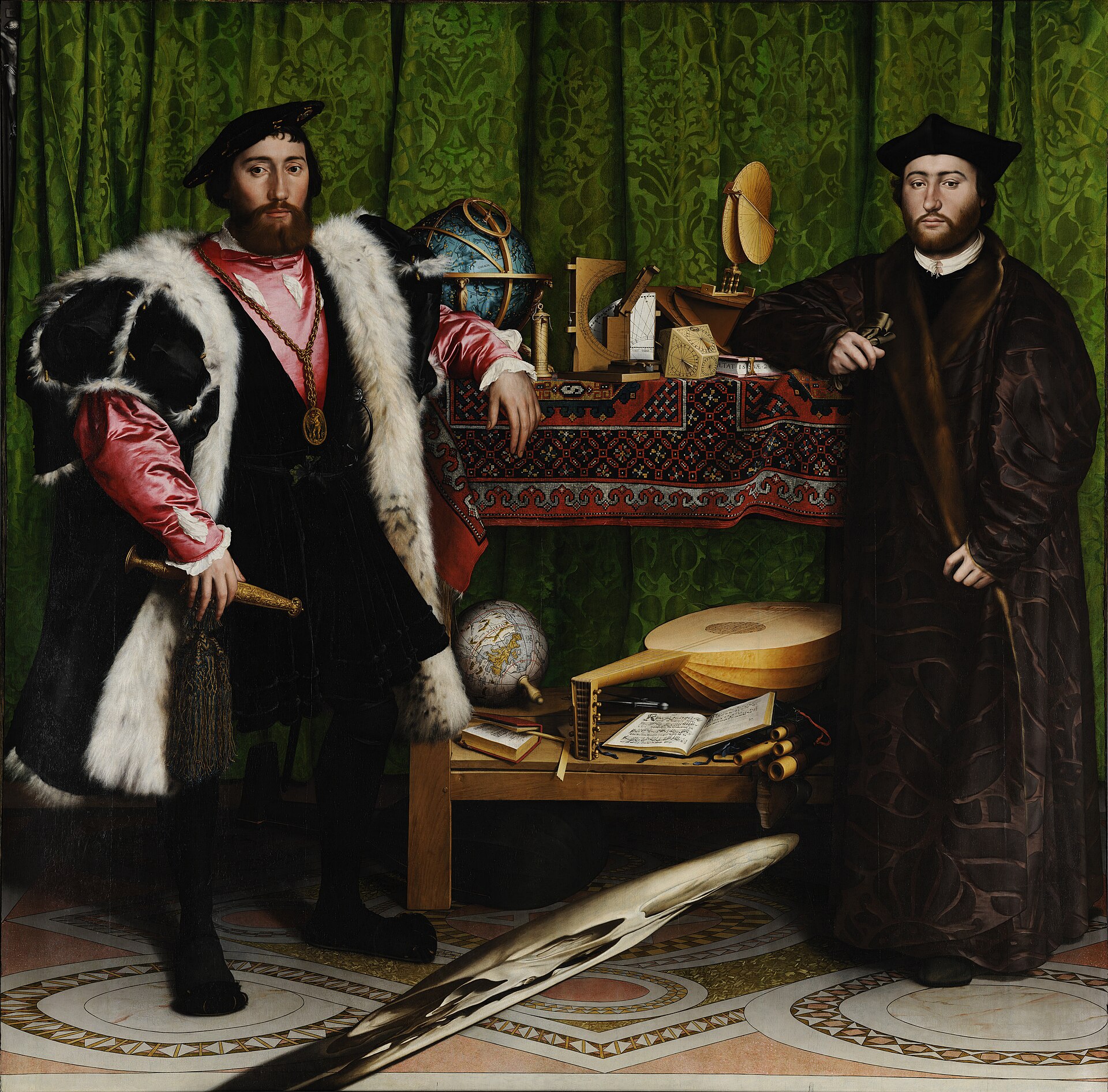
Hans Holbein the Younger painted two men standing on either side of a table crowded with objects, in the Tudor period, the same year Elizabeth I was born. The man on the left, dressed in secular finery, is Jean de Dinteville, the French ambassador to the Tudor court. On the right, in clerical robes, stands Georges de Selve, the Bishop of Lavaur, who like Dinteville had served on diplomatic missions of his own. It is this shared role that gives the painting its name: The Ambassadors.
Some historians, including biographer Franny Moyle, have speculated that Anne Boleyn, then Queen of England, may have commissioned the work as a gift for Dinteville. If true, it would tie this elaborate double portrait directly to the turbulence of the Tudor court at the very moment of Elizabeth's birth.
What sets The Ambassadors apart from an ordinary portrait is the astonishing still life crowded onto the table between the two men. On the upper shelf sit instruments for measuring time and the heavens: two globes, a shepherd's dial, a quadrant, a torquetum, and a polyhedral sundial, all resting on a richly patterned Anatolian textile now known as a 'Holbein carpet'. Several of these instruments carry associations with Rome, the seat of the Pope.
On the lower shelf, the mood shifts. A lute lies with one string visibly broken — a traditional symbol of discord — beside a hymnal composed by Martin Luther, open to display songs on the Commandments and the Holy Spirit. Scholars disagree about whether this arrangement signals religious conflict between Catholic and Protestant Europe, or a more hopeful sense of harmony between law and grace. The floor beneath the men's feet reproduces the Cosmati pavement from Westminster Abbey, a detail some connect to the coronation of Anne Boleyn, which took place on that very spot.
Far less noticed, tucked into the upper left corner and half-hidden by a curtain, is a small carving of Christ on the crucifix — a quiet religious anchor amid all the worldly instruments and learning on display.
More from Art

The Painting With No Foreground
A single robed figure stares out at an empty grey sea — and the emptiness itself became a scandal. When it was unveiled in Berlin in 1810, no one knew quite what to do with it.

The Painter Who Chased the Light
For a few purple minutes each evening, an American exile knelt in an English garden and raced the dying sun to paint two little girls lighting lanterns. It took him two years to finish.

When a President Became a God
Look straight up inside the U.S. Capitol dome and you will find George Washington enthroned among the clouds, surrounded by goddesses — the founding father transformed into myth.

Marble Brought Back to Life
A corpse asleep, a wing barely brushing her skin — and marble somehow learns to breathe. This is the moment Antonio Canova dared to carve.

The World Turned Upside Down
Look closely at a sixteenth-century Flemish village and you'll find a man biting a pillar, another carrying daylight in a basket, and a wife slipping a blue cloak over her husband's shoulders. Every gesture is a joke — if you know the language.

The Girl in the Glass Case
She stood two-thirds life size, dressed in a real tutu and human hair — and the critics who saw her in 1881 recoiled as if she were something obscene.