The Slave Who Would Not Finish Dying
He looks less like a man in chains than a man waking from sleep — and for five hundred years, no one has agreed on what he is actually feeling.
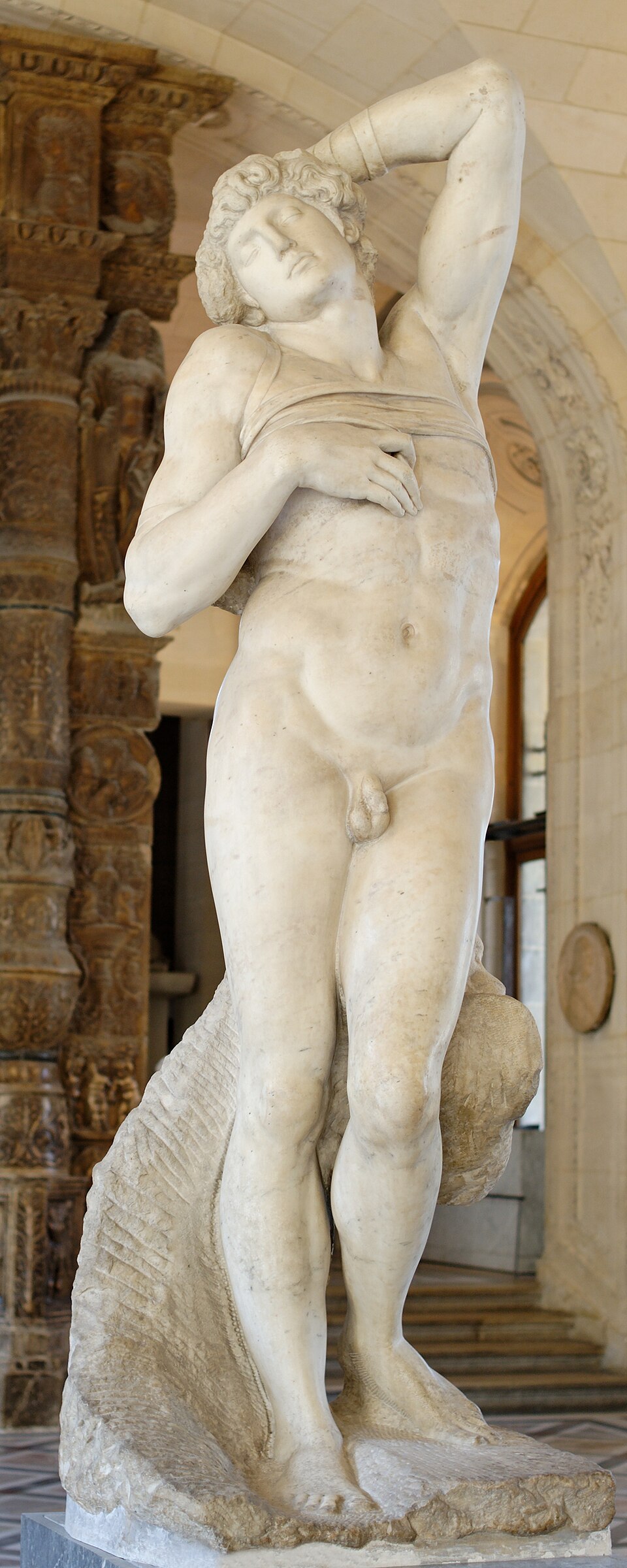
In a quiet gallery of the Louvre stands a marble figure just over seven feet tall, his torso loosely bound, his head tilted back as if surrendering to something unseen. He is called the Dying Slave, yet he does not look sick or broken. His body is healthy, idealized, almost serene. This contradiction between name and appearance has haunted viewers since the sculpture was carved by Michelangelo between 1513 and 1515.
The work was never meant to stand alone. It was created as part of the second design phase for the tomb of Pope Julius II, one of the most ambitious and endlessly revised commissions of Michelangelo's career. Alongside it, Michelangelo carved a companion piece, the Rebellious Slave. Scholars have long debated exactly where these two figures were meant to stand. Erwin Panofsky believed they were paired together at the lower left corner of the monument. Charles de Tolnay, studying a surviving 1513 drawing, argued instead that the Dying Slave was intended for a more central position, with the Rebellious Slave possibly placed elsewhere entirely — not as its pendant, but as an independent figure.
As the tomb project evolved across decades, so did the role of these slaves. Plans from 1516 and 1542 show Michelangelo placing the two figures in niches flanking his statue of Moses. But he eventually reconsidered even this, proposing to replace them with figures of Rachel and Leah instead. By the 1540s, the slaves had vanished from the tomb's final design altogether — cut, quite literally, from the story they had been carved to tell.
Of the larger series of captives Michelangelo originally envisioned, only two were ever brought close to completion: the Dying Slave and the Rebellious Slave. Others, including the Young Slave, the Bearded Slave, the Awakening Slave, and the Atlas Slave, were left unfinished, their forms still half-trapped inside blocks of raw marble — an accidental metaphor that later viewers could not resist reading into.
Once the tomb plans changed, the sculptures left Michelangelo's hands entirely. Around 1546, in a gesture of gratitude for hospitality shown to him during illness, Michelangelo gave both the Dying Slave and the Rebellious Slave to Ruberto Strozzi. From there, the statues embarked on a long European journey, passing through the hands of King Francis I and later Anne de Montmorency, who installed them at the Château d'Écouen. They were later moved again, to the Château de Richelieu, before arriving in Paris by the late eighteenth century, where the French state acquired them during the revolutionary period. They have remained in the Louvre ever since.
More from Art

The Painting With No Foreground
A single robed figure stares out at an empty grey sea — and the emptiness itself became a scandal. When it was unveiled in Berlin in 1810, no one knew quite what to do with it.

The Painter Who Chased the Light
For a few purple minutes each evening, an American exile knelt in an English garden and raced the dying sun to paint two little girls lighting lanterns. It took him two years to finish.

When a President Became a God
Look straight up inside the U.S. Capitol dome and you will find George Washington enthroned among the clouds, surrounded by goddesses — the founding father transformed into myth.

Marble Brought Back to Life
A corpse asleep, a wing barely brushing her skin — and marble somehow learns to breathe. This is the moment Antonio Canova dared to carve.

The World Turned Upside Down
Look closely at a sixteenth-century Flemish village and you'll find a man biting a pillar, another carrying daylight in a basket, and a wife slipping a blue cloak over her husband's shoulders. Every gesture is a joke — if you know the language.

The Girl in the Glass Case
She stood two-thirds life size, dressed in a real tutu and human hair — and the critics who saw her in 1881 recoiled as if she were something obscene.