The Smile in the Dark: Leonardo's Final Painting
A figure grins out of pure blackness, one finger pointed at heaven — and art historians still argue over what, exactly, he's laughing at.
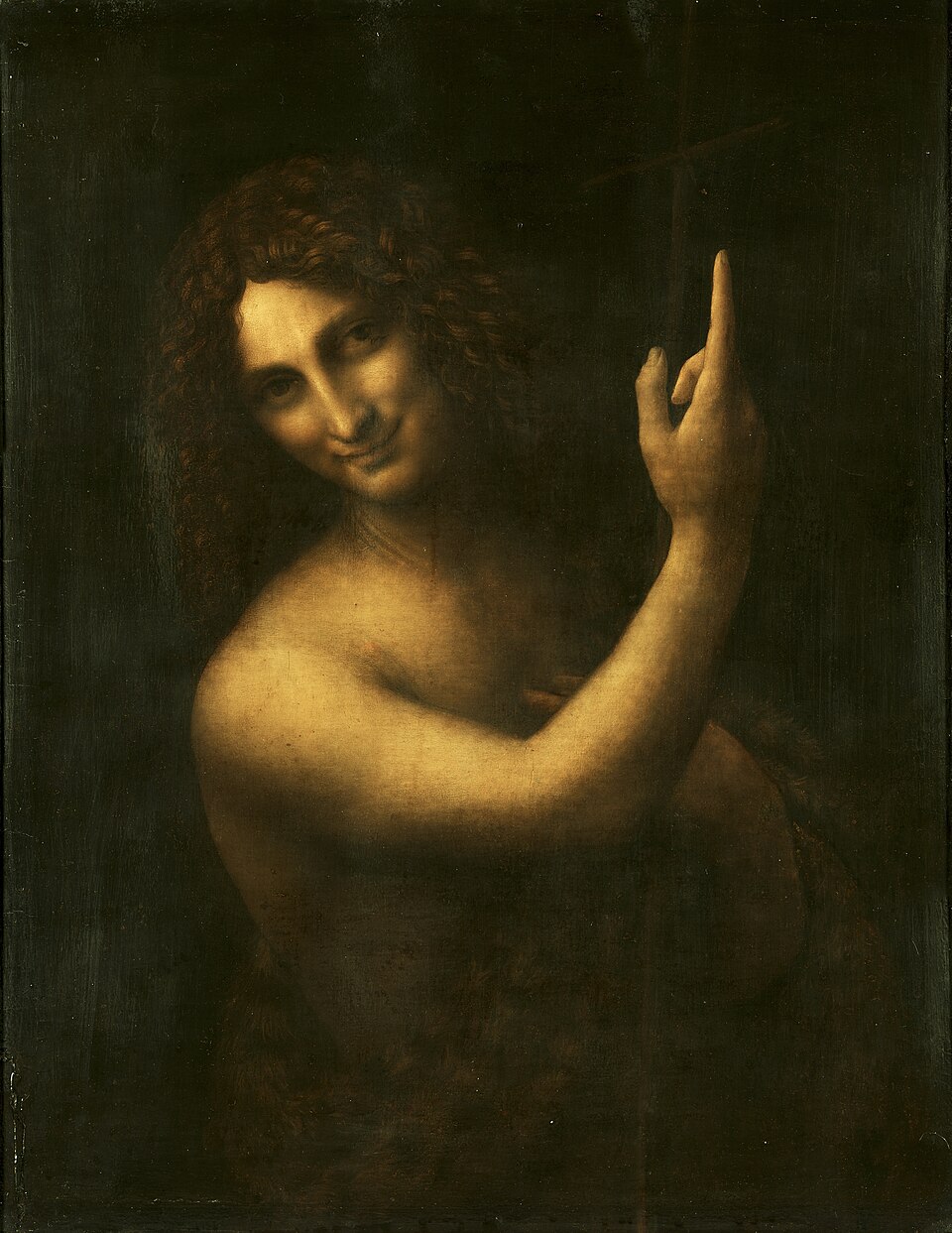
In the gloom of a walnut panel, a face emerges as if surfacing from black water. Curling hair, a knowing smile, a hand raised toward the unseen sky — this is Saint John the Baptist, and it is widely believed to be Leonardo da Vinci's last painting, likely completed between 1513 and 1516. There is no wilderness, no camel-hair robe of the ascetic prophet familiar from centuries of religious art. There is only the man, plucked from darkness by light, and the eerie, private amusement playing across his mouth.
Leonardo painted the work in oil on a walnut panel measuring just 69 by 57 centimeters, small enough to feel intimate, almost confessional. He used chiaroscuro to let John's form seem to rise out of shadow, and sfumato — his signature technique of blurred, smoky transitions — to soften every edge of flesh. The German art historian Frank Zöllner observed that this soft shading gives John's skin an almost androgynous delicacy, and that the technique itself carries the picture's religious weight. In his left hand, John holds a simple reed cross; his right hand points upward, a gesture Leonardo had also given to Saint Anne in his Burlington House Cartoon.
The smile is the painting's great riddle. It recalls the Mona Lisa's — enigmatic, unreadable, faintly unsettling. The critic Kenneth Clark thought Leonardo's John embodied 'the eternal question mark, the enigma of creation,' and wrote of the unease the painting stirs in viewers. The scholar Paul Barolsky went further, describing John emerging from the darkness in almost shockingly immediate relation to the viewer, and noting that the figure's grace carries 'a disturbingly erotic charge' even as it conveys a spiritual meaning about the fullness of divine grace. It's worth noting that the model for this John, as for Leonardo's Bacchus and other related figures, was his longtime companion and assistant Salaì.
Exactly when Leonardo began the work remains disputed. We know it existed by 17 October 1517, because the traveler Antonio de Beatis recorded seeing it in Leonardo's workshop at Clos Lucé, giving scholars a firm latest date. Tradition places its creation in 1513–1516, when Leonardo's sfumato technique is thought to have reached its peak. But some experts have pointed to a similar rendering of John's hand in a pupil's drawing in the Codex Atlanticus, suggesting the painting may have been started as early as 1509. Adding to the puzzle, the pose closely echoes a sculpture of Saint John made after 1510 for the Florence Baptistery by Giovanni Francesco Rustici — a sculptor Leonardo is thought to have advised, raising the possibility that the two artists influenced one another's imagining of the saint.
The painting's journey across Europe reads like a chain of royal exchanges. By 1542 it belonged to the French king Francis I, part of his collection at Fontainebleau. In 1625, King Charles I of England acquired it from Louis XIII of France in a trade — Charles gave up a Titian painting, the Holy Family with a shepherd, and Hans Holbein's Portrait of Erasmus in return. When Charles's collection was sold off in 1649, following his execution, the painting passed to the banker Eberhard Jabach, then briefly to Cardinal Mazarin. By 1661 it had returned once more to French royal hands, this time those of Louis XIV. After the French Revolution swept away the monarchy, the painting entered the Louvre, where it has remained ever since — apart from a loan, in November 2022, to Louvre Abu Dhabi for two years to mark that museum's fifth anniversary.
More from Art

The Painting With No Foreground
A single robed figure stares out at an empty grey sea — and the emptiness itself became a scandal. When it was unveiled in Berlin in 1810, no one knew quite what to do with it.

The Painter Who Chased the Light
For a few purple minutes each evening, an American exile knelt in an English garden and raced the dying sun to paint two little girls lighting lanterns. It took him two years to finish.

When a President Became a God
Look straight up inside the U.S. Capitol dome and you will find George Washington enthroned among the clouds, surrounded by goddesses — the founding father transformed into myth.

Marble Brought Back to Life
A corpse asleep, a wing barely brushing her skin — and marble somehow learns to breathe. This is the moment Antonio Canova dared to carve.

The World Turned Upside Down
Look closely at a sixteenth-century Flemish village and you'll find a man biting a pillar, another carrying daylight in a basket, and a wife slipping a blue cloak over her husband's shoulders. Every gesture is a joke — if you know the language.

The Girl in the Glass Case
She stood two-thirds life size, dressed in a real tutu and human hair — and the critics who saw her in 1881 recoiled as if she were something obscene.