The Song on the Battlefield: How the Bhagavad Gita Was Born
Two armies stand ready to slaughter each other, and in the space between them, a warrior lays down his bow and asks a question that has echoed for over two thousand years.
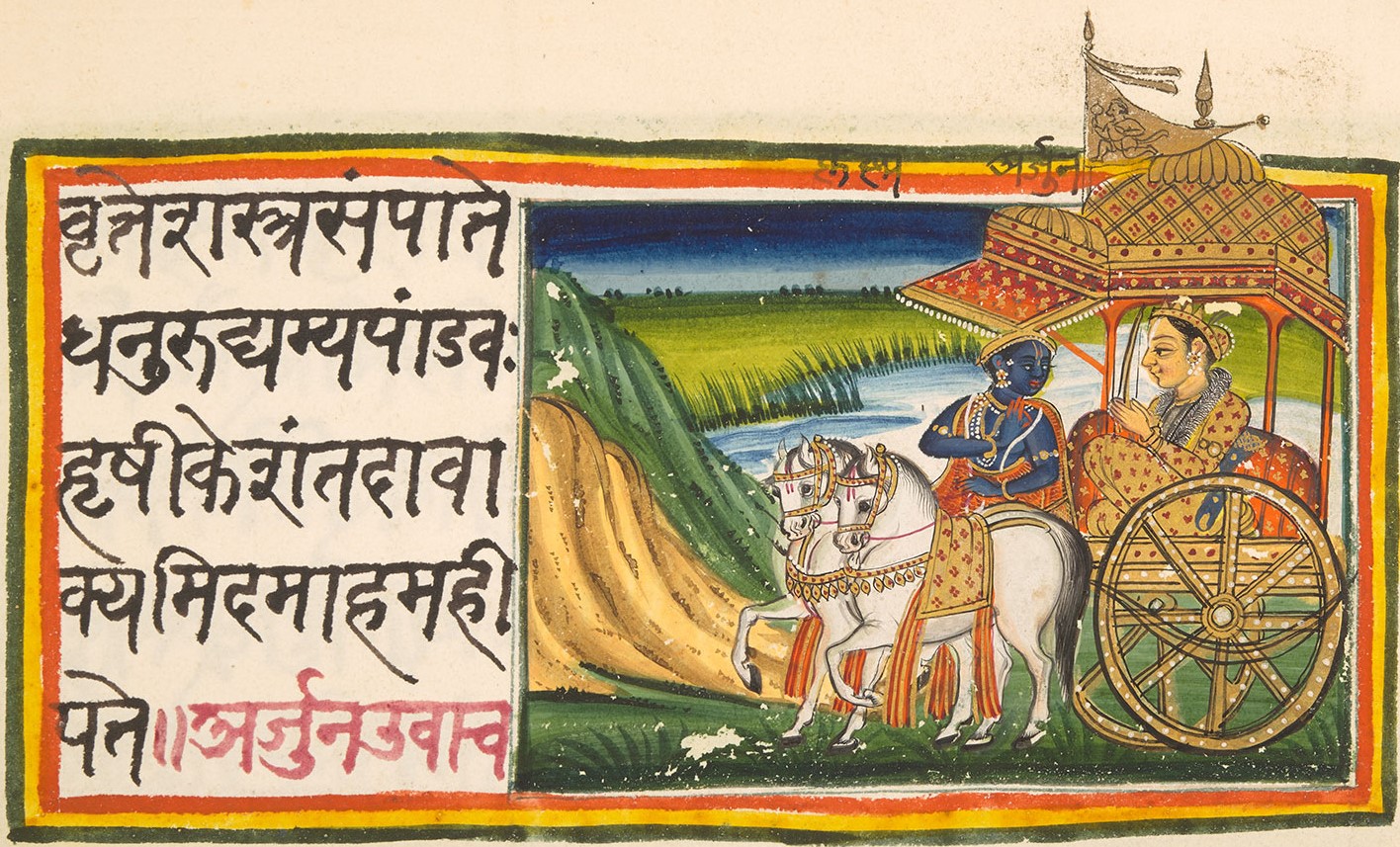
On the plain of Kurukshetra, chariots wait in rows, horses stamp, and cousins prepare to kill cousins. Arjuna, a Pandava prince, looks across the field at kinsmen he is about to fight and is overcome. He cannot bring himself to raise his weapon against family, teachers, and friends arrayed on the enemy side. It is in this moment of paralysis, not in some quiet temple, that the Bhagavad Gita begins — a dialogue between Arjuna and his charioteer, Krishna, an avatar of Vishnu.
The Gita itself is compact: roughly seven hundred verses, embedded within the much larger Mahabharata, the longest poem in the world. Scholars generally date its composition to the second or first century BCE, though estimates range from as early as 400–500 BCE to as late as the first century CE. Its language — a form later than Vedic Sanskrit but earlier than fully classical Sanskrit — helps anchor it to this transitional period, an era, as historian Arthur Basham noted, when the ethics of war were being publicly questioned and renunciation was gaining popularity, likely following the rise of Buddhism and Jainism.
Traditionally attributed to the sage Veda Vyasa, the text is regarded by historians as a composite work, woven together by multiple hands over time, drawing on the Upanishads and Samkhya yoga philosophy. Structurally, each chapter closes with a phrase tying it to the Upanishads, and the Gita is sometimes called the 'Upanishad of the Upanishads' for how it distills their ideas into a single dramatic scene.
At the heart of the text is Arjuna's dilemma: how can one act rightly when action itself causes harm? Krishna's answer is not to retreat from duty but to fulfill it — while releasing attachment to the results. A warrior must fight because it is his dharma, his rightful role, but he should not consider himself the ultimate agent of the act; instead, all action should be offered up to God, an idea rooted in bhakti, or devotion.
The Gita weaves together three major strands of Indian religious thought: dharma, or duty; jnana and yoga, rooted in Samkhya philosophy; and bhakti, devotional surrender. This synthesis is part of why the text holds such unusual pan-Hindu influence — central to Vedanta and Vaishnava traditions alike, and referenced by thinkers across sectarian lines even when they classify it differently within their traditions.
More from Mythology

The Doctor Who Sang a Nation Into Being
A country doctor rode into the forests of Karelia armed with nothing but a notebook — and rode out with the soul of a nation.

The Boat That Carried the Sun
Every sunset, the ancient Egyptians believed, the sun climbed into a boat and sailed straight into the realm of the dead — only to fight a monstrous serpent before dawn could return.

The Wild Man of the Snows
At 21,000 feet, a colonel found tracks in the snow that he blamed on a wolf — but his guides knew better, and gave the world a name that would echo for a century.

The Knight Who Went Mad for Love: Orlando Furioso
A hero so devoted to duty he was Charlemagne's greatest paladin loses his mind—not to a sword wound, but to heartbreak. To cure him, a friend must ride a flying horse to the Moon.

The Book That Turned the World Into Myth
A poet condemned to exile spent his final years in Rome finishing a poem that would outlive empires—a poem about nothing standing still, not gods, not lovers, not even the shape of a man.

Paradise Lost: Milton's Rebel Angel
A blind poet, dictating verses in the dark, dared to explain the ways of God to men — and in doing so, made Hell's ruler unforgettable.