The Space Between Two Fingers
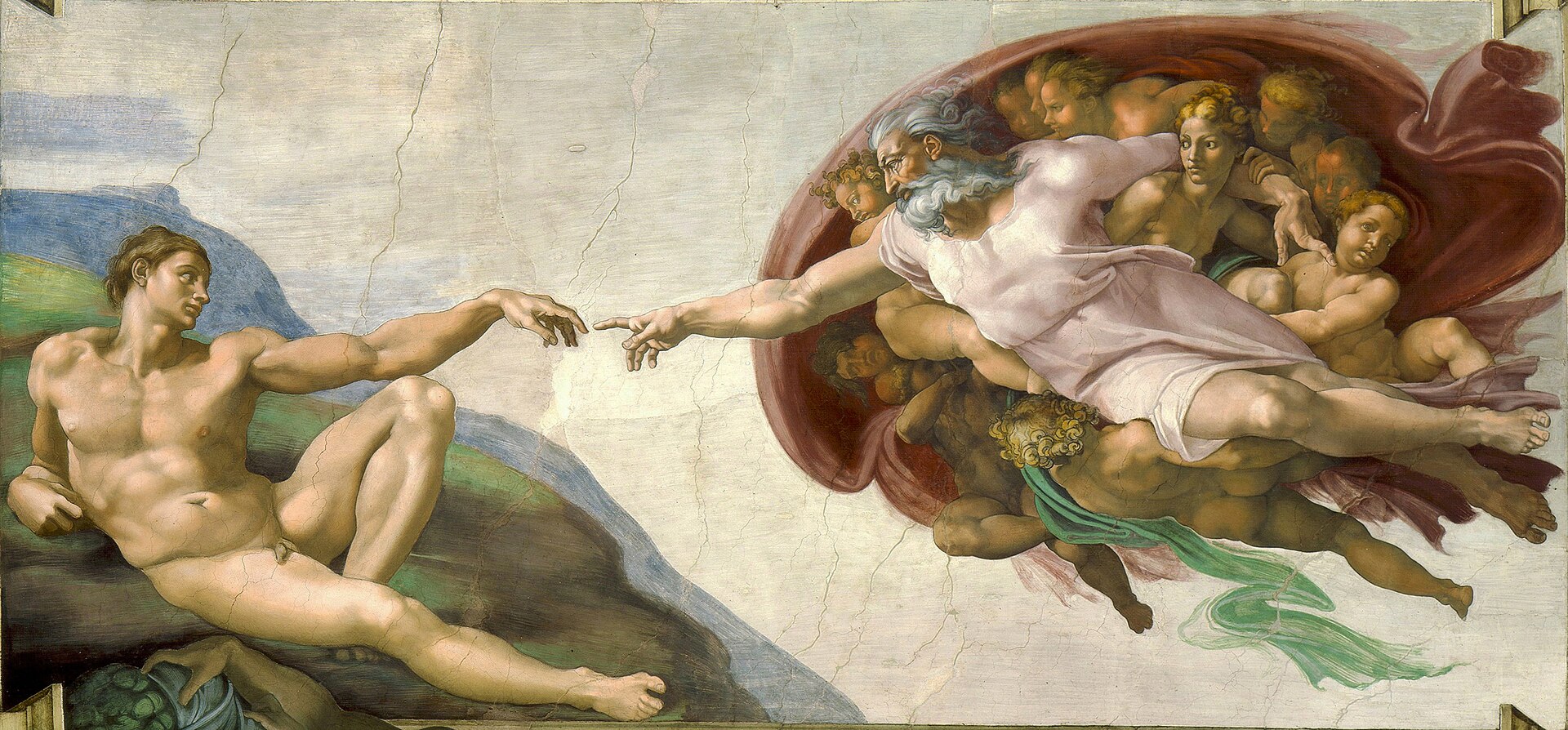
On a scaffold high above the Sistine Chapel floor, Michelangelo painted a gap barely three-quarters of an inch wide — and it became one of the most studied distances in art history.
In 1505, Pope Julius II summoned Michelangelo back to Rome with an ambitious commission: a tomb of forty statues, to be finished within five years. That project would occupy the artist for four decades and remain, by his own judgment, unfinished — though it eventually produced the celebrated Moses, completed in 1516, now housed in the Church of San Pietro in Vincoli. Two other statues meant for the tomb, known as the Heroic Captive (or Rebellious Slave) and the Dying Captive (or Dying Slave), ended up in the Louvre.
While the tomb dragged on, Julius pulled Michelangelo into another task entirely: painting the ceiling of the Sistine Chapel. According to the account of Michelangelo's biographer Condivi, the architect Bramante, jealous of Michelangelo's tomb commission, urged the Pope to assign him a medium he had little experience in — fresco — hoping he would fail. Michelangelo took the job anyway, and it consumed roughly four years, from 1508 to 1512.
He had originally been asked simply to paint the Twelve Apostles on the ceiling's triangular pendentives and fill the rest with ornament. Michelangelo convinced the Pope to let him do something far more ambitious: a scheme depicting Creation, the Fall of Man, the promise of salvation through the prophets, and the genealogy of Christ. The finished ceiling spans roughly 45 by 128 feet — more than 500 square meters — and contains over 300 figures, among them seven Old Testament prophets (Joël, Ezekiel, Jonah, Daniel, Jeremiah, Zechariah, and Isaiah) and five Sibyls from the classical world (Erythraean, Delphic, Libyan, Cumaean, and Persian).
At the heart of this vast scheme sits The Creation of Adam, the fourth panel chronologically in the Genesis sequence. God appears as an elderly, white-bearded man wrapped in a swirling cloak, His right arm outstretched toward Adam, who lies naked on the lower left, already formed but still lifeless. Adam's left arm mirrors God's gesture, echoing the biblical line 'Let us make humankind in our image, according to our likeness.' Scholars have traced Michelangelo's composition partly to a medieval hymn, 'Veni Creator Spiritus,' which calls upon the 'finger of the paternal right hand' to grant speech to the faithful.
Between God's finger and Adam's, Michelangelo left a gap of just three-quarters of an inch — 1.9 centimeters. Some scholars read this small void as a deliberate statement: the unattainability of divine perfection by man, life not yet quite transmitted.
More from Art

The Painting With No Foreground
A single robed figure stares out at an empty grey sea — and the emptiness itself became a scandal. When it was unveiled in Berlin in 1810, no one knew quite what to do with it.

The Painter Who Chased the Light
For a few purple minutes each evening, an American exile knelt in an English garden and raced the dying sun to paint two little girls lighting lanterns. It took him two years to finish.

When a President Became a God
Look straight up inside the U.S. Capitol dome and you will find George Washington enthroned among the clouds, surrounded by goddesses — the founding father transformed into myth.

Marble Brought Back to Life
A corpse asleep, a wing barely brushing her skin — and marble somehow learns to breathe. This is the moment Antonio Canova dared to carve.

The World Turned Upside Down
Look closely at a sixteenth-century Flemish village and you'll find a man biting a pillar, another carrying daylight in a basket, and a wife slipping a blue cloak over her husband's shoulders. Every gesture is a joke — if you know the language.

The Girl in the Glass Case
She stood two-thirds life size, dressed in a real tutu and human hair — and the critics who saw her in 1881 recoiled as if she were something obscene.