The Spear-Bearer's Lost Perfection
A bronze warrior once stood as living mathematics — proof that beauty could be measured, calculated, and cast in metal. He vanished centuries ago, yet his shadow never left.
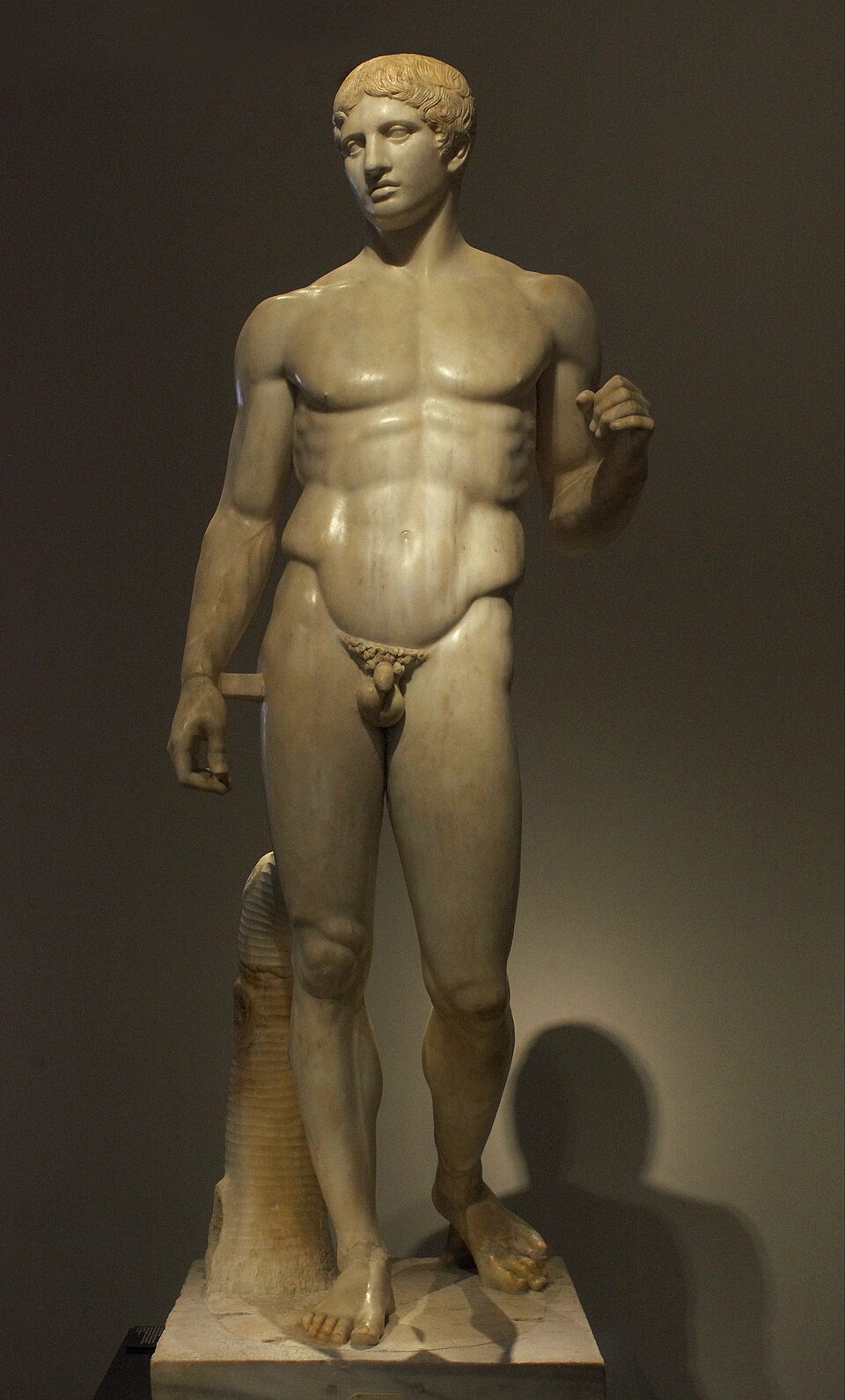
Around 440 BC, in the workshops of Argos, the sculptor Polykleitos cast a bronze statue of a muscular young warrior, his left shoulder braced to carry a spear that has long since disappeared. The figure was called the Doryphoros, Greek for 'Spear-Bearer.' It was not merely a portrait of an athlete but an argument made solid: a demonstration of a written treatise Polykleitos composed, called the Kanon, or 'Canon,' meaning measure or rule.
In that treatise, now lost like the statue itself, Polykleitos set out what he believed were the perfectly harmonious proportions of the human body. The Doryphoros was his proof in bronze. Centuries later, the Greek physician and writer Galen described how the philosopher Chrysippos framed beauty not in the proportion of any single part, but in the commensurability of all parts to one another — finger to finger, fingers to palm, palm to wrist, wrist to forearm, forearm to upper arm, and so on, exactly as laid out in Polykleitos' Canon. Scholars today believe Polykleitos may have based his entire system on a single module, perhaps the length of the last section of the little finger, scaling every other measurement from that unit.
The result was a figure with a head-to-body ratio of one to seven, muscular yet caught in an instant of natural, unforced motion. The head turns slightly to the right. The pose captures the moment just after a static stance, as if the man had begun to step forward, his limbs and torso responding fully to that shift in weight.
This is the statue's true innovation: contrapposto, visible most clearly in the tilt of the pelvis. The right leg is straight and bears the body's full weight, the right hip raised, the right side of the torso contracted. The left leg, unburdened, allows the left hip to drop, stretching the torso subtly on that side. The left shoulder is tensed and slightly lifted to bear the (now-vanished) spear, the arm bent to hold it steady. The right arm, meanwhile, hangs freely at his side — likely the earliest surviving example in sculpture of a truly free-hanging arm, unsupported by any load.
But the original bronze is gone. Like nearly every bronze statue by a known Greek sculptor, it did not survive antiquity, nor did Polykleitos' written Canon. What remains are Roman marble copies of varying quality, made centuries after the fact, that carry the form forward without ever fully capturing its lightness. Because marble cannot bear its own weight the way tensile bronze can, the copies needed additions: a tree stump propped behind one leg, a strut braced beneath the right hand and forearm — solutions never required by the original.
More from Art

The Painting With No Foreground
A single robed figure stares out at an empty grey sea — and the emptiness itself became a scandal. When it was unveiled in Berlin in 1810, no one knew quite what to do with it.

The Painter Who Chased the Light
For a few purple minutes each evening, an American exile knelt in an English garden and raced the dying sun to paint two little girls lighting lanterns. It took him two years to finish.

When a President Became a God
Look straight up inside the U.S. Capitol dome and you will find George Washington enthroned among the clouds, surrounded by goddesses — the founding father transformed into myth.

Marble Brought Back to Life
A corpse asleep, a wing barely brushing her skin — and marble somehow learns to breathe. This is the moment Antonio Canova dared to carve.

The World Turned Upside Down
Look closely at a sixteenth-century Flemish village and you'll find a man biting a pillar, another carrying daylight in a basket, and a wife slipping a blue cloak over her husband's shoulders. Every gesture is a joke — if you know the language.

The Girl in the Glass Case
She stood two-thirds life size, dressed in a real tutu and human hair — and the critics who saw her in 1881 recoiled as if she were something obscene.