The Speed and Shadow of Luca Giordano's Entombment
A teenager barely out of his apprenticeship painted one of the era's most electrifying visions of death and grief — and then, astonishingly, painted it again, and again.
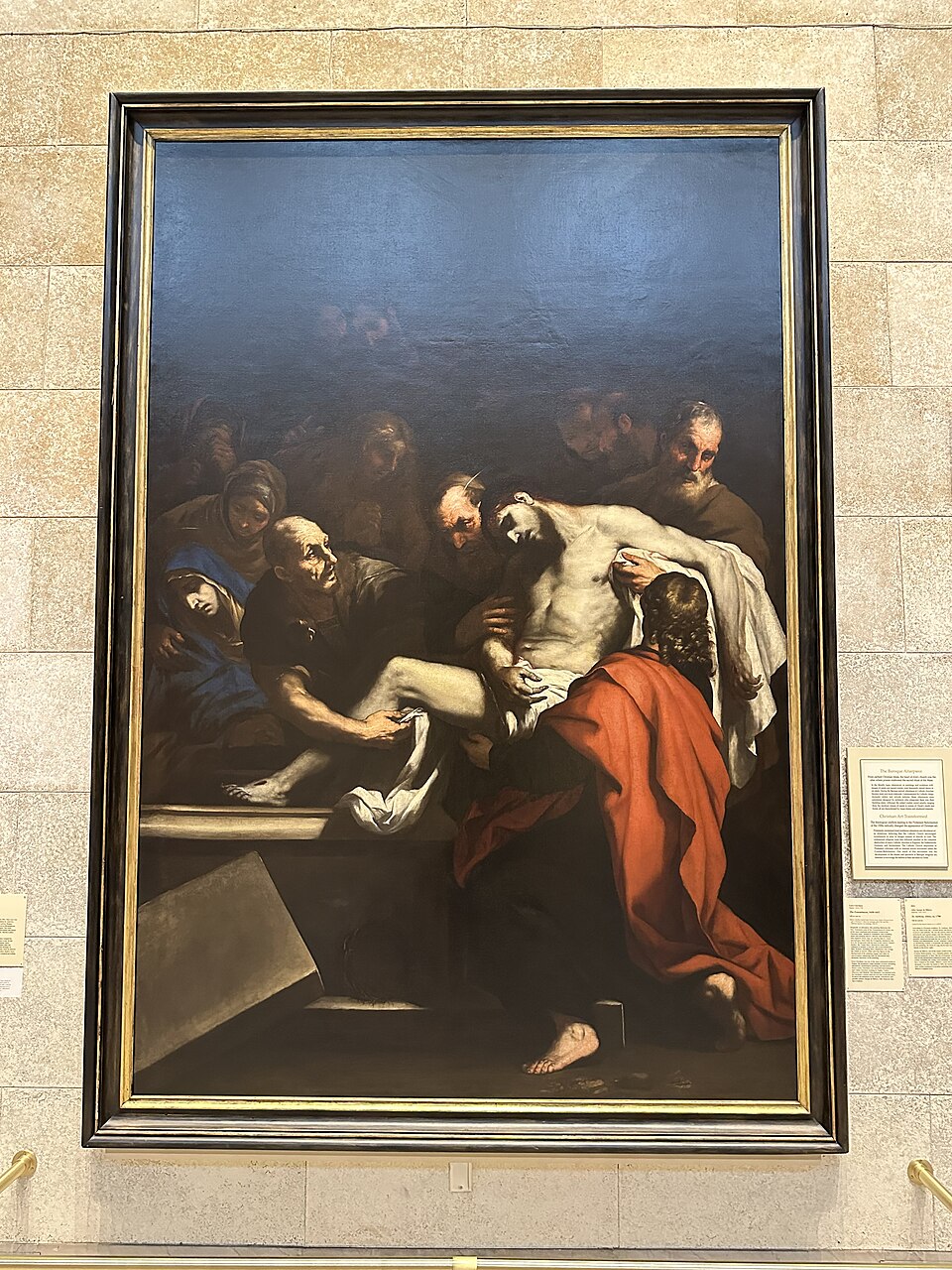
Sometime around 1650, in a Naples still buzzing with the memory of Caravaggio and the presence of Jusepe de Ribera, a teenage painter named Luca Giordano set to work on a scene as old as Christian art itself: the entombment of Jesus Christ. He was in his late teens, barely more than a boy, yet the painting he produced carries none of the hesitation one might expect from an early work. It shows Joseph of Arimathea bracing Christ's body from behind while Nicodemus lowers the legs into a stone sepulcher, the composition arranged along a steep diagonal, the viewpoint low, almost as though the viewer kneels beside the tomb.
Around this central act of burial, Giordano placed the mourners tradition demanded. John the Evangelist stands wrapped in red. Mary, Christ's mother, is dressed in a warm blue, her grief plain, the Holy Women gathered close to console her. Further back, more grieving figures fill the shadows, faces caught in half-light, adding depth to a scene already thick with sorrow.
Giordano was still very young when he made this, but he was not without guidance. His father Antonio was a painter, and Luca is believed to have trained first under the Spanish master Ribera, or one of Ribera's circle, in Naples. Ribera's own debt to Caravaggio runs through the painting like a current — the dramatic use of shadow, the unflinching physicality of Christ's tortured feet pushed into the foreground, the ordinary, unidealized face of the dead man rendered without softening.
When Ribera died in 1651, Giordano left Naples to widen his education, traveling to Rome, Florence, and Venice. In Venice he found something new to absorb: the luminosity of the great sixteenth-century masters, their handling of light, color, and movement. Traces of Rubens, too, surface in the vivid reddish flesh-tones, deep reds, bluish-greens, and touches of yellow that run through his garments, and in the fluid, almost seamless transitions between tones that would become a signature of his mature style.
Giordano earned the nickname 'Luca fa presto' — Luca the speedy — for the astonishing pace at which he worked throughout his career, one of the busiest and most celebrated painters in seventeenth-century Naples. Yet speed never meant carelessness. His method was rooted in a theory of painting drawn from four canonical modes — sfumato, unione, chiaroscuro, and cangiante — concepts that shaped the aesthetics of the Seicento. Woven through all of it was his Catholic faith, giving even his fastest work a distinct spiritual charge.
More from Art

The Painting With No Foreground
A single robed figure stares out at an empty grey sea — and the emptiness itself became a scandal. When it was unveiled in Berlin in 1810, no one knew quite what to do with it.

The Painter Who Chased the Light
For a few purple minutes each evening, an American exile knelt in an English garden and raced the dying sun to paint two little girls lighting lanterns. It took him two years to finish.

When a President Became a God
Look straight up inside the U.S. Capitol dome and you will find George Washington enthroned among the clouds, surrounded by goddesses — the founding father transformed into myth.

Marble Brought Back to Life
A corpse asleep, a wing barely brushing her skin — and marble somehow learns to breathe. This is the moment Antonio Canova dared to carve.

The World Turned Upside Down
Look closely at a sixteenth-century Flemish village and you'll find a man biting a pillar, another carrying daylight in a basket, and a wife slipping a blue cloak over her husband's shoulders. Every gesture is a joke — if you know the language.

The Girl in the Glass Case
She stood two-thirds life size, dressed in a real tutu and human hair — and the critics who saw her in 1881 recoiled as if she were something obscene.