The Stacks Outside His Door
Two canvases weren't enough. Soon a wheelbarrow could barely keep up with the light.
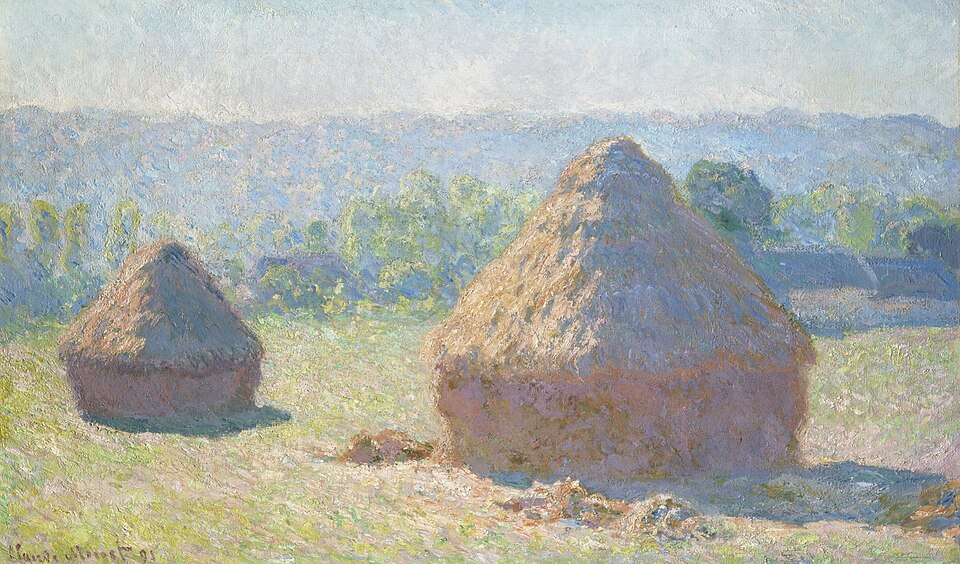
In the late summer of 1890, Claude Monet stood in a field just outside his home in Giverny, watching sunlight shift across a row of grain stacks belonging to his farmer-neighbor, Monsieur Quéruel. He had settled in Giverny in 1883, and for the next forty years, nearly everything he painted lay within three kilometers of his garden. The stacks were simply there, outside his door, ten to twenty feet tall, round-topped and thatched in the Norman style, storing wheat, barley, or oats until threshing machines could make their rounds from village to village.
At first Monet asked his stepdaughter, Blanche Hoschedé, to bring him two canvases — one for sunny weather, one for overcast. It didn't take long for him to realize that two canvases could never hold the restless variety of light he saw. Blanche began wheeling out as many canvases as her wheelbarrow could carry, and Monet's days turned into a shuttle between easels, working on whichever canvas most closely matched the moment's atmosphere before it slipped away.
This wasn't Monet's first attempt at painting a single subject under changing light. But by 1890 his ambitions had matured: he wasn't just chasing fleeting effects, he was building color harmonies that gave him a freer, richer use of paint. Critics of the day dismissed the haystack as a dull, unimaginative subject, but those close to Monet insisted his choices were never careless — every subject was the result of deliberate thought.
The series most art historians consider the true 'Haystacks' comprises twenty-five canvases, cataloged as Wildenstein numbers 1266 to 1290, begun near the end of summer 1890 and continued into the following spring. Monet had experimented with the subject earlier too — five paintings from the 1888 harvest, and a precursor called Haystack Near Giverny, painted in 1884 and now held at the Pushkin Museum. Earlier still, stacks had appeared as minor details in his broader landscapes.
The stacks in the paintings are often called haystacks in English, but that's something of a misnomer. What they held was mostly wheat, destined for bread, not hay for animal feed. Straw or hay was simply used as a thatched covering to protect the grain from rain and damp until threshing time. Because the traveling threshing machines might not reach a village until well into the next year, the same stack could stand through summer, autumn, winter, and spring — giving Monet an entire calendar of light to work with on a single, unmoving form.
More from Art

The Painting With No Foreground
A single robed figure stares out at an empty grey sea — and the emptiness itself became a scandal. When it was unveiled in Berlin in 1810, no one knew quite what to do with it.

The Painter Who Chased the Light
For a few purple minutes each evening, an American exile knelt in an English garden and raced the dying sun to paint two little girls lighting lanterns. It took him two years to finish.

When a President Became a God
Look straight up inside the U.S. Capitol dome and you will find George Washington enthroned among the clouds, surrounded by goddesses — the founding father transformed into myth.

Marble Brought Back to Life
A corpse asleep, a wing barely brushing her skin — and marble somehow learns to breathe. This is the moment Antonio Canova dared to carve.

The World Turned Upside Down
Look closely at a sixteenth-century Flemish village and you'll find a man biting a pillar, another carrying daylight in a basket, and a wife slipping a blue cloak over her husband's shoulders. Every gesture is a joke — if you know the language.

The Girl in the Glass Case
She stood two-thirds life size, dressed in a real tutu and human hair — and the critics who saw her in 1881 recoiled as if she were something obscene.