The Stone That Caught a God
A dead man's arm brushes bare rock, and in that small collision an entire century of religious art changes direction.
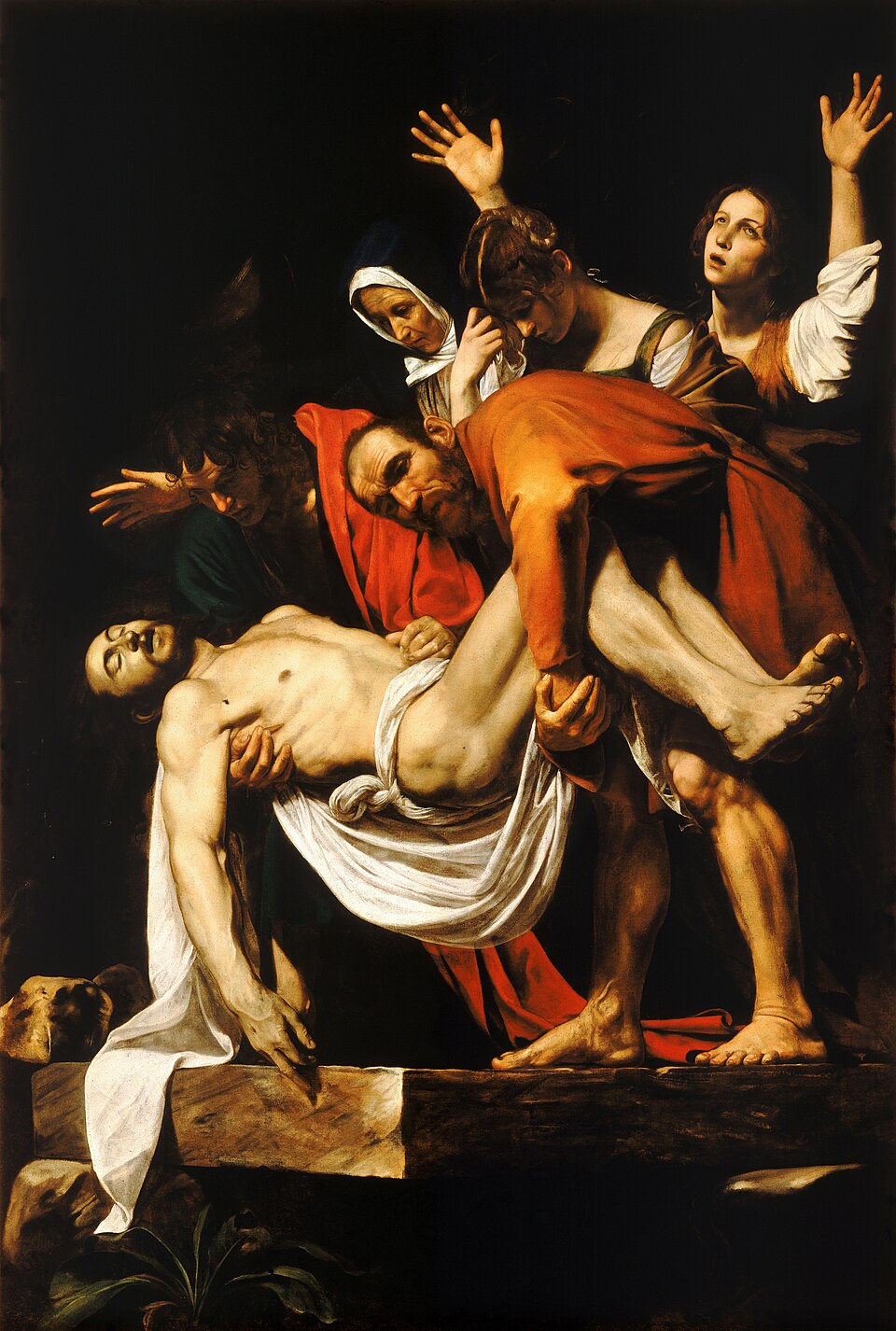
In 1602, in a chapel tucked into the right nave of Rome's Chiesa Nuova, a commission took shape that would outlast every argument about how faith should look. The church, Santa Maria in Vallicella, had been granted to the newly formed Oratory by Pope Gregory XIII in 1575, and its rebuilding came with a plan: every altar dedicated to a mystery of the Virgin, moving from the Presentation to the Coronation around the nave. One of these, the Capella della Pietà, held a privileged status — indulgences, the right to celebrate Mass — thanks to its founder, Pietro Vittrice, a friend of the pope and follower of Filippo Neri.
Vittrice died in March 1600, leaving 1,000 scudi for the chapel's upkeep. The space was built in 1602, and it was his nephew and heir, Girolamo Vittrice, who paid for what would become Caravaggio's Entombment of Christ, painted around 1603–1604. By September 1604 a document already called the chapel 'new,' with the painting installed. The connection was not accidental: Girolamo had married Orinzia di Lucio Orsi in August 1586, sister of Caravaggio's friend Prospero Orsi, threading the painter into a family whose descendants would later gift another Caravaggio — the Fortune Teller — to a pope.
What resulted was no scene of transfiguration. Caravaggio painted mourning as descent — a diagonal cascade of bodies sliding from hysteria toward silence, from Mary of Clopas's raised arms down to the bare stone slab beneath Christ's corpse. Unlike the bloodied, tortured Christs of Spanish devotional art, this body is bloodless, heavy, and startlingly muscular — a laborer's frame, thick-limbed and veined, not the thin, bony Christ tradition usually offered.
Two men bear the weight. John the Evangelist, young and cloaked in red, supports Christ's side, his arm inadvertently pressing open the wound. Nicodemus, given the face of Michelangelo, grips the legs, feet braced against the slab's edge. Between them the body holds an eerie stability even as their own postures strain and twist — Caravaggio balancing dignity against exertion.
Above and behind, three women embody grief differently. Mary of Cleophas throws her arms toward heaven. Mary Magdalene, centered, dries her eyes with a white handkerchief, her face kept in shadow. And the Virgin, defying centuries of convention that painted her eternally young, appears here as an old woman in a nun's robes, her hand hovering just above her dead son's head as if she still might touch him. Andrew Graham-Dixon has suggested the two Marys were modeled on Fillide Melandroni, a woman who appears repeatedly across Caravaggio's canvases, then about twenty-two years old.
More from Art

The Painting With No Foreground
A single robed figure stares out at an empty grey sea — and the emptiness itself became a scandal. When it was unveiled in Berlin in 1810, no one knew quite what to do with it.

The Painter Who Chased the Light
For a few purple minutes each evening, an American exile knelt in an English garden and raced the dying sun to paint two little girls lighting lanterns. It took him two years to finish.

When a President Became a God
Look straight up inside the U.S. Capitol dome and you will find George Washington enthroned among the clouds, surrounded by goddesses — the founding father transformed into myth.

Marble Brought Back to Life
A corpse asleep, a wing barely brushing her skin — and marble somehow learns to breathe. This is the moment Antonio Canova dared to carve.

The World Turned Upside Down
Look closely at a sixteenth-century Flemish village and you'll find a man biting a pillar, another carrying daylight in a basket, and a wife slipping a blue cloak over her husband's shoulders. Every gesture is a joke — if you know the language.

The Girl in the Glass Case
She stood two-thirds life size, dressed in a real tutu and human hair — and the critics who saw her in 1881 recoiled as if she were something obscene.