The Storm That Turned to Stone
On a battlefield along the Danube, surrounded and dying of thirst, a Roman legion was saved — or so the story goes — by a sudden storm. Rome carved that miracle into 130 feet of marble.
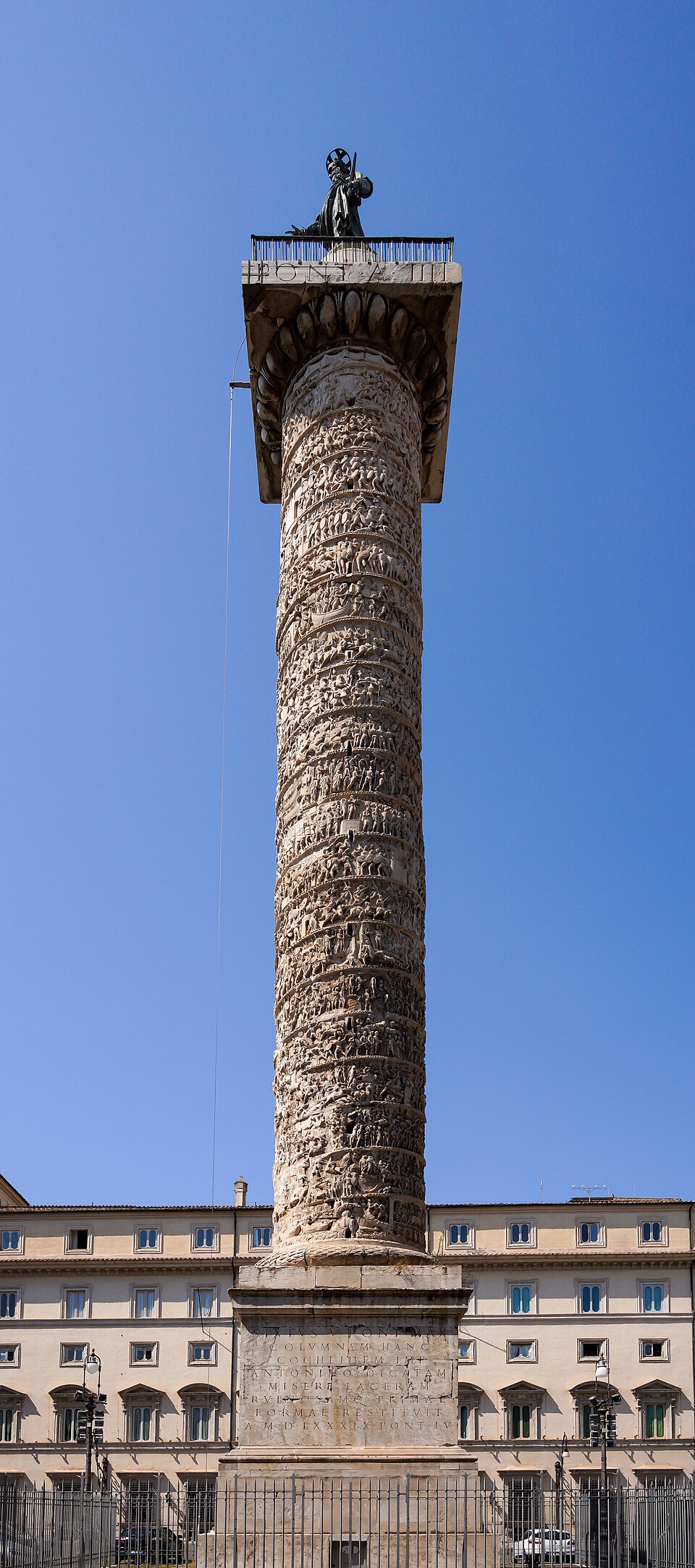
In Piazza Colonna, in the heart of Rome, a white marble column rises 39.7 meters into the sky, its surface wound with a spiraling ribbon of carved figures 112 meters long. This is the Column of Marcus Aurelius, and though it has stood on the same patch of the old Campus Martius since antiquity, its story begins not in peace but in war — the grinding, decade-long Marcomannic Wars that Marcus Aurelius fought against Germanic and Sarmatian tribes north of the Danube, from 169 AD until his death in 180.
Construction likely began after the emperor's death, and the monument was finally completed around 193 AD under Septimius Severus. Its makers modeled it deliberately on Trajan's Column, built decades earlier, and Romans nicknamed it Columna Centenaria and Columna Cochlis — 'snail column' — for its size and shape. It was raised along the Via Flaminia, the great road leading soldiers and travelers in and out of the city, so that anyone marching past could draw strength from the sight of it.
The column's shaft rises 29.6 meters above a 10.1-meter base that itself once stood on a 3-meter platform. The whole structure consists of 27 or 28 blocks of Carrara marble in total, each roughly 3.7 meters in diameter, quarried at Luna north of Pisa and hollowed out even before leaving the quarry, so that a staircase of 190 to 200 steps could wind up through the column's interior to a platform at the top. Narrow slits cut into the relief let daylight filter down onto those climbing stairs — the same trick used in Trajan's Column before it.
The frieze itself spirals upward 21 times, telling the story of the Danubian campaigns beginning with the army's crossing of the river into what is now the Czech Republic and Hungary. Scholars still argue over the exact chronological order of the scenes, but the general narrative is unmistakable: villages burning, women and children captured, men killed, the emperor standing above it all as master of the chaos.
One scene in particular carried enormous symbolic weight for the Romans — the so-called rain miracle in the territory of the Quadi. The historian Cassius Dio recorded the episode: Roman troops, surrounded, exhausted, and dying of thirst under a scorching sun, were suddenly saved when clouds gathered and a violent rain broke over them, a deliverance he attributed to divine intervention. Christians would later claim the miracle for their own God, while Roman propaganda credited it to an Egyptian magician named Harnuphis and the will of the gods above.
More from Art

The Painting With No Foreground
A single robed figure stares out at an empty grey sea — and the emptiness itself became a scandal. When it was unveiled in Berlin in 1810, no one knew quite what to do with it.

The Painter Who Chased the Light
For a few purple minutes each evening, an American exile knelt in an English garden and raced the dying sun to paint two little girls lighting lanterns. It took him two years to finish.

When a President Became a God
Look straight up inside the U.S. Capitol dome and you will find George Washington enthroned among the clouds, surrounded by goddesses — the founding father transformed into myth.

Marble Brought Back to Life
A corpse asleep, a wing barely brushing her skin — and marble somehow learns to breathe. This is the moment Antonio Canova dared to carve.

The World Turned Upside Down
Look closely at a sixteenth-century Flemish village and you'll find a man biting a pillar, another carrying daylight in a basket, and a wife slipping a blue cloak over her husband's shoulders. Every gesture is a joke — if you know the language.

The Girl in the Glass Case
She stood two-thirds life size, dressed in a real tutu and human hair — and the critics who saw her in 1881 recoiled as if she were something obscene.