The Tenth Muse's Silence
Nearly 10,000 lines of poetry, and almost all of it gone — what remains of Sappho is a scatter of broken words that somehow still burn.
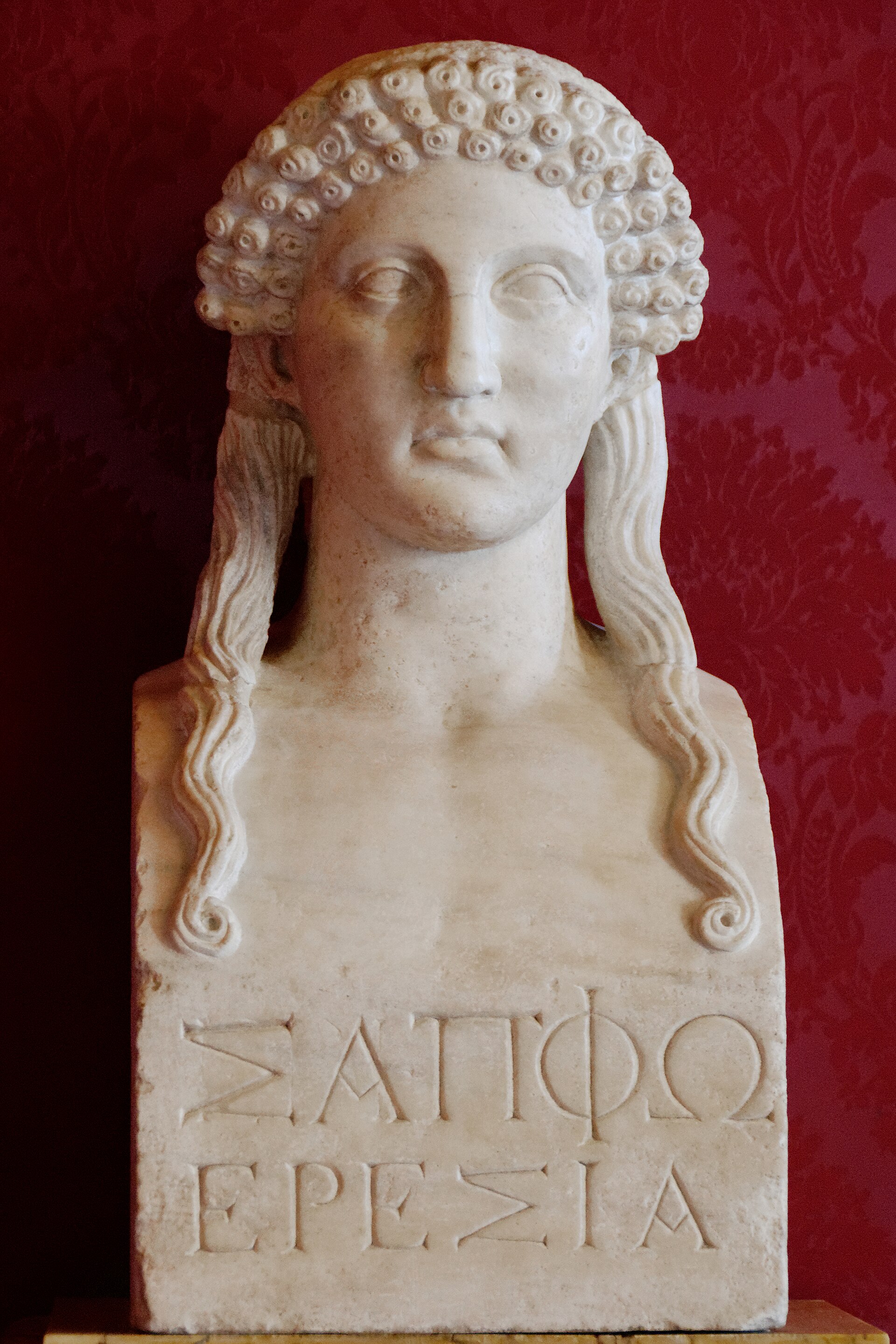
Around 630 BC, on the island of Lesbos, a girl was born into a wealthy family whose parents' names not even her contemporaries could agree on. She would grow up to be called the Tenth Muse, a title reserved by the ancients for someone they considered nearly divine in her craft. Her name, in her own poetry, was written Psappho. Centuries later the world would know her simply as Sappho, and her island's name would give the English language the word lesbian, her own the word sapphic.
What we know of her life comes almost entirely from fragments — of poems, and of memory. Ancient sources claimed she had three brothers, Charaxos, Larichos, and Eurygios; two of them surfaced unexpectedly in 2014, when the so-called Brothers Poem was discovered, confirming names that had drifted through commentary for two thousand years. She is thought to have had a daughter, traditionally called Cleïs, mentioned in two of her surviving fragments. Her father's name is recorded ten different ways across antiquity — a proliferation that suggests he was never actually named in her verse, and that scholars simply guessed.
The earliest full biography of Sappho was written some eight centuries after she lived, in the late second or early third century AD. The next major account, the Suda, is a Byzantine encyclopedia from the tenth century. Closer to her own time, Herodotus in the fifth century BC mentioned her brother Charaxos and his relationship with the Egyptian courtesan Rhodopis. Everything else — her sexuality, her appearance, her loves — was pieced together by ancient writers who assumed her poems were autobiographical, mixed with local legend and, some scholars suspect, borrowings from Athenian comedy.
Sappho was, by every ancient account, prolific: she is thought to have composed around 10,000 lines. She wrote for both solo and choral performance, and while she was best known for poetry of love and longing, her surviving fragments also touch on family and religion. Scholars still debate why she wrote at all — whether she held some educational or religious role on Lesbos, or composed for the symposium, the drinking party where lyric poetry was sung. Her language was praised in antiquity for its clarity, her images for their vividness and immediacy.
And yet almost none of it survives. Only one poem, the Ode to Aphrodite, exists complete. Everything else is fragment — torn papyrus, quoted lines, echoes in other writers' works. Three epigrams once attributed to her turned out, on closer inspection, to be later Hellenistic imitations, poets centuries on trying to write like her because so little of the real thing remained even then.
More from Art

The Painting With No Foreground
A single robed figure stares out at an empty grey sea — and the emptiness itself became a scandal. When it was unveiled in Berlin in 1810, no one knew quite what to do with it.

The Painter Who Chased the Light
For a few purple minutes each evening, an American exile knelt in an English garden and raced the dying sun to paint two little girls lighting lanterns. It took him two years to finish.

When a President Became a God
Look straight up inside the U.S. Capitol dome and you will find George Washington enthroned among the clouds, surrounded by goddesses — the founding father transformed into myth.

Marble Brought Back to Life
A corpse asleep, a wing barely brushing her skin — and marble somehow learns to breathe. This is the moment Antonio Canova dared to carve.

The World Turned Upside Down
Look closely at a sixteenth-century Flemish village and you'll find a man biting a pillar, another carrying daylight in a basket, and a wife slipping a blue cloak over her husband's shoulders. Every gesture is a joke — if you know the language.

The Girl in the Glass Case
She stood two-thirds life size, dressed in a real tutu and human hair — and the critics who saw her in 1881 recoiled as if she were something obscene.