The Throne That Floats on Bronze Clouds
For 157 years it stayed hidden inside a golden cage of Bernini's making — until one autumn afternoon in 2024, it came out into the light.
In 1867, a wooden chair, cracked by cuts and gnawed by worms, was lifted into view inside St. Peter's Basilica and photographed and displayed for veneration for what would be the last time in a century and a half. Rimmed with carved ivory and fitted with metal rings so it could once be carried like a sedia gestatoria, it looked like nothing more than an old, battered seat. But tradition held that this was the chair used by the Apostle Peter himself as Bishop of Rome, the first Pope, and so it was treated not as furniture but as a relic of the Church's own foundation.
The object's documented history begins centuries after Peter's death. In 875, the Roman Emperor Charles the Bald gave the wooden throne to Pope John VIII. It was studied repeatedly afterward, most recently between 1968 and 1974, when it was removed from Bernini's altar. Researchers concluded it was a single chair rather than two combined, covered in some kind of upholstery, and that its oldest timbers dated no earlier than the 6th century — long before Charles the Bald, but long after Peter.
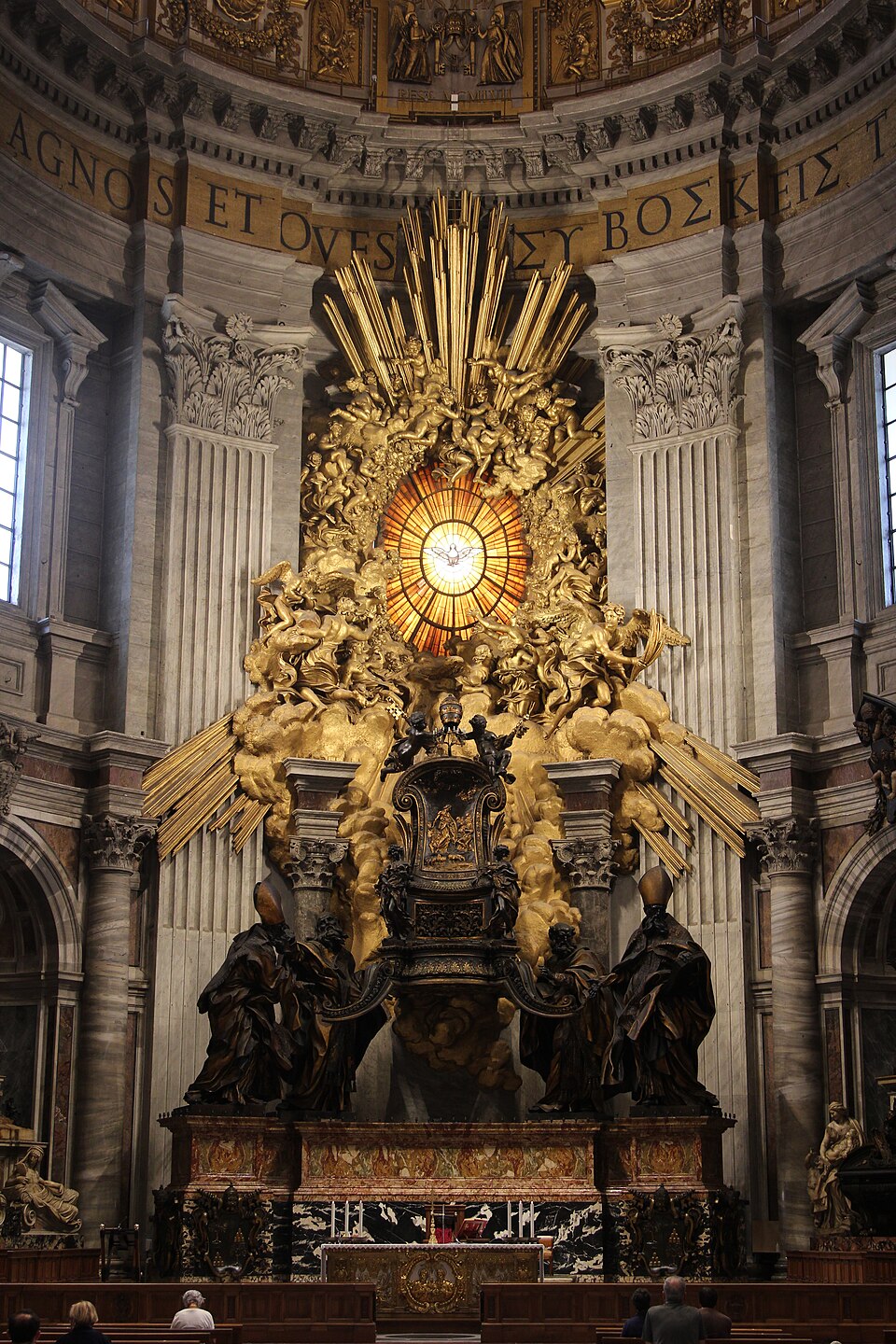
Whatever its true age, the chair's fame rests as much on its casing as its wood. Between 1647 and 1653, Gian Lorenzo Bernini built an extraordinary gilt bronze reliquary shaped, medieval-fashion, like an enormous version of the chair it protects. Unlike real furniture of its era, Bernini's cathedra is made entirely of swirling scroll-work enclosing a relief of Christ instructing Peter to tend his sheep. A bronze cushion, rendered with startling realism, sits conspicuously empty — because the true seat lies hidden within.
Four towering bronze Doctors of the Church seem to bear the throne aloft on splayed struts: the Western saints Ambrose and Augustine of Hippo, mitered, on the outside, and the Eastern saints John Chrysostom and Athanasius, bare-headed, on the inside. Above, lit by a central tinted window through which light streams, gilded sunrays and sculpted clouds burst outward, so the whole ensemble appears to hover weightlessly over the altar in the basilica's apse — a fusion of sculpture, architecture and light typical of Bernini's Baroque imagination.
Inscribed in gold across the frieze, in both Latin and Greek, is Christ's charge to Peter: 'O Shepherd of the Church, you feed all Christ's lambs and sheep.' The altar beneath the chair is the second most important in the basilica, after only the papal altar under St. Peter's Baldachin, and together they stand as a visual argument for the authority of the Bishop of Rome as successor to Peter — an argument made in bronze, gold, and captured light rather than words.
More from Archaeology

The Bronze Disc That Rewrote the Sky
Two looters with a metal detector dug up something illegal, invisible in value, and older than Stonehenge's final stones — a map of the heavens buried for over three thousand years.

The Faceless Women of the Ice Age
Long before writing, before cities, before the wheel, someone carved a woman's body into stone and ivory — and left no name, no face, no explanation.

The Pebble That Might Be Human
A palm-sized stone found on a Moroccan riverbank may be humanity's oldest attempt to see itself — or simply a trick of erosion.

The Crown That Vanished: Deshret and the Red Land
A crown worn by kings for three thousand years has never once been found in a tomb — not one. So where did it go?

The Face That Traveled Between Empires
A farm worker's shovel struck stone in 1897 and unearthed a face so striking it would be sold to France, seized as war booty, and finally traded back for a Velázquez.

The Boy in the Dark Tunnel
A schoolboy fell into black water inside an ancient tunnel and surfaced with his fingers brushing letters no one had noticed for 2,600 years.