The Tower That Leaned Toward Its Own City
A tower built to touch heaven, painted by a man who had walked among Rome's ruins — and who quietly showed it was already falling.
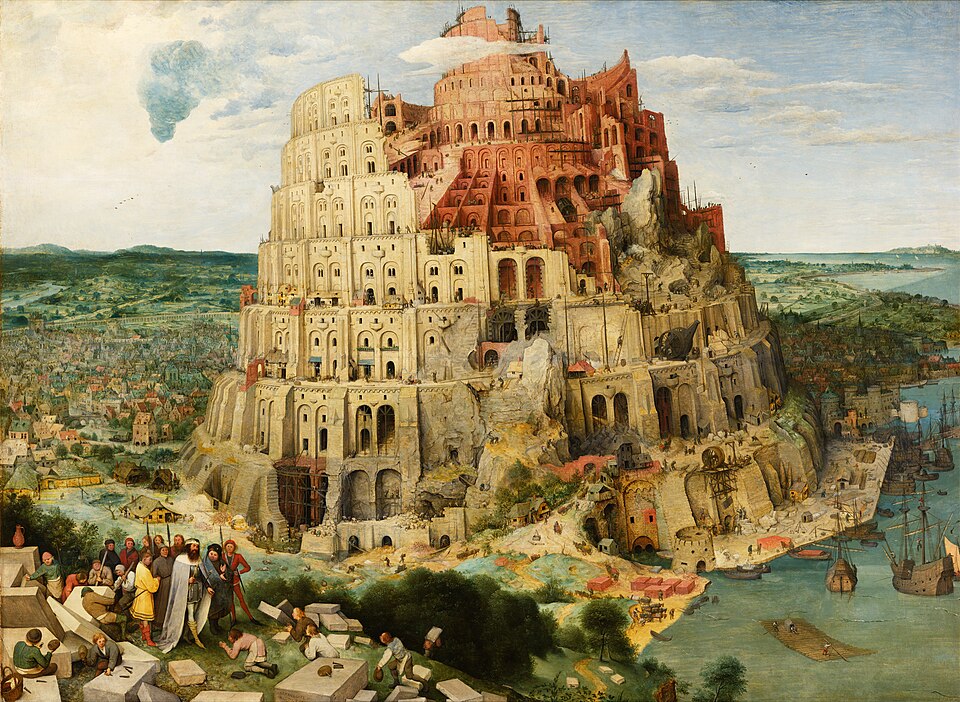
In the winter of 1552, a young Flemish painter named Pieter Bruegel the Elder stood amid the broken arches of the Roman Colosseum, sketching a monument to an empire that had once believed itself eternal. He would carry that image home to Antwerp, and years later it would resurface transformed into one of the most haunting structures ever committed to panel: the Tower of Babel.
Bruegel painted the subject on three occasions. The earliest, a miniature on ivory, was completed in 1552–1553 while he was in Rome, and it has been lost to history. What survive are two oil paintings on wood: the larger, dated 1563, now hangs in the Kunsthistorisches Museum Wien in Vienna and is known as the 'Great' Tower of Babel. The smaller, undated but widely believed to have been painted sometime after, resides in the Museum Boijmans Van Beuningen in Rotterdam, and is called the 'Little' Tower.
Both depict the same biblical episode from Genesis: humanity, still unified by a single language, resolves to build a city and a tower reaching into the heavens, so as to make a name for themselves and avoid being scattered across the earth. God responds by confusing their speech, splintering one people into many tongues who can no longer understand one another. Yet Bruegel's paintings dwell not on divine punishment but on the tower's construction itself — the cranes, ramps, scaffolds, and swarming laborers of a vast unfinished project.
The two panels share a composition, and X-rays reveal the Rotterdam version once resembled the Vienna painting even more closely before Bruegel reworked it. But they diverge in telling ways. The Vienna tower rises seven completed stories with an eighth under construction, its rounded arches and layered walls echoing the Colosseum directly, right down to details borrowed from engravings of Roman landmarks. In the foreground stands a king, widely presumed to be Nimrod, attended by kneeling subjects — a gesture toward the tale's ancient, oriental origins. The Rotterdam tower, by contrast, is even larger, its human figures reduced to near invisibility, and near its center a religious procession winds up the spiraling ramp beneath a red canopy, a detail read by some as pointed commentary on the Roman Catholic Church of Bruegel's own turbulent age.
That age mattered. Antwerp in the 1560s was a battleground of language and faith, caught between the Latin liturgy of Catholicism and the polyglot Protestant movements spreading through the Netherlands. In 1566, just three years after the Vienna panel's date, Antwerp would publish the famous Polyglot Bible in six languages — a scholarly landmark that gave the old story of scattered tongues fresh relevance. Rome itself, the Eternal City whose Caesars had believed their works would last forever, now lay partly in ruin, a standing lesson in the vanity of earthly ambition.
More from Art

The Painting With No Foreground
A single robed figure stares out at an empty grey sea — and the emptiness itself became a scandal. When it was unveiled in Berlin in 1810, no one knew quite what to do with it.

The Painter Who Chased the Light
For a few purple minutes each evening, an American exile knelt in an English garden and raced the dying sun to paint two little girls lighting lanterns. It took him two years to finish.

When a President Became a God
Look straight up inside the U.S. Capitol dome and you will find George Washington enthroned among the clouds, surrounded by goddesses — the founding father transformed into myth.

Marble Brought Back to Life
A corpse asleep, a wing barely brushing her skin — and marble somehow learns to breathe. This is the moment Antonio Canova dared to carve.

The World Turned Upside Down
Look closely at a sixteenth-century Flemish village and you'll find a man biting a pillar, another carrying daylight in a basket, and a wife slipping a blue cloak over her husband's shoulders. Every gesture is a joke — if you know the language.

The Girl in the Glass Case
She stood two-thirds life size, dressed in a real tutu and human hair — and the critics who saw her in 1881 recoiled as if she were something obscene.