The Turkey That Wasn't Meant to Be Eaten
A cook lowers a golden turkey onto a table crowded with neighbors and family — and no one is eating. That empty space at the center of the plate would become one of the most recognized images of American life.
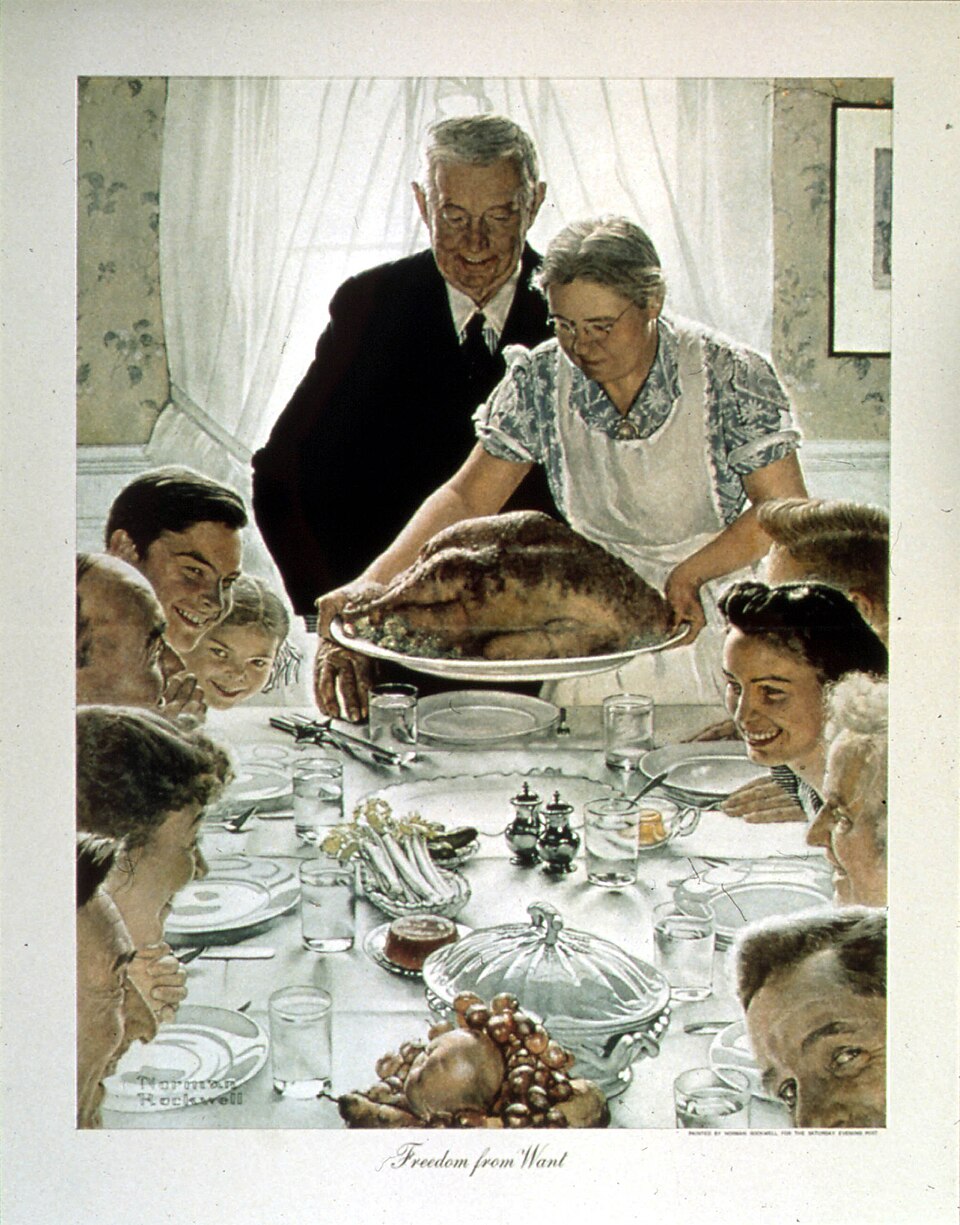
In November 1942, in the small town of Arlington, Vermont, Norman Rockwell asked his cook, Mrs. Thaddeus Wheaton, to bring a roasted turkey to the table on Thanksgiving Day. He photographed her mid-motion, setting the bird down before her husband, who stood at the end of the table. That single gesture, captured on the holiday itself, would become the seed of Freedom from Want, the third painting in Rockwell's Four Freedoms series.
The series had its roots in a speech, not a canvas. On January 6, 1941, President Franklin D. Roosevelt addressed the 77th Congress and articulated four freedoms he believed people everywhere deserved: freedom of speech, freedom of worship, freedom from want, and freedom from fear. The ideas were abstract to many Americans at the time, but the government seized on them to stir patriotic feeling as the country moved toward war.
Rockwell first tried to offer his services to the Office of War Information, sketching the Four Freedoms in charcoal by mid-June. He was turned away by an official who told him, 'The last war, you illustrators did the posters. This war, we're going to use fine arts men, real artists.' It was Ben Hibbs, editor of The Saturday Evening Post, who saw the value in Rockwell's concept and pushed him to finish the paintings quickly, warning that wartime printing restrictions might soon force the magazine to abandon full-color plates.
Rockwell worried that his painting didn't align closely enough with the essay commissioned to accompany it, written by Carlos Bulosan. Hibbs reassured him that the illustrations only needed to touch the same theme, not mirror each other exactly. That essay, when published, spoke to the socioeconomic hardships many Americans faced at home — a counterpoint to the painting's warmth that thrust Bulosan into public attention.
Every figure at the table was someone Rockwell knew personally — neighbors and family from Arlington, photographed individually in his studio and later painted into the composition. His wife Mary appears in the scene, as does his mother Nancy. The Wheatons, Lester Brush, Florence Lindsey, Jim Martin, Dan Walsh, Charles Lindsey, and the young Hoisington children, Bill and Shirley, filled out the nine adults and two children gathered around the meal.
More from Art

The Painting With No Foreground
A single robed figure stares out at an empty grey sea — and the emptiness itself became a scandal. When it was unveiled in Berlin in 1810, no one knew quite what to do with it.

The Painter Who Chased the Light
For a few purple minutes each evening, an American exile knelt in an English garden and raced the dying sun to paint two little girls lighting lanterns. It took him two years to finish.

When a President Became a God
Look straight up inside the U.S. Capitol dome and you will find George Washington enthroned among the clouds, surrounded by goddesses — the founding father transformed into myth.

Marble Brought Back to Life
A corpse asleep, a wing barely brushing her skin — and marble somehow learns to breathe. This is the moment Antonio Canova dared to carve.

The World Turned Upside Down
Look closely at a sixteenth-century Flemish village and you'll find a man biting a pillar, another carrying daylight in a basket, and a wife slipping a blue cloak over her husband's shoulders. Every gesture is a joke — if you know the language.

The Girl in the Glass Case
She stood two-thirds life size, dressed in a real tutu and human hair — and the critics who saw her in 1881 recoiled as if she were something obscene.