The Two Powerful Ones: Egypt's Double Crown
No one has ever held it in their hands — no example has survived the centuries — yet for three thousand years it sat atop the most powerful head in the ancient world. What was this crown that existed everywhere except in reality?
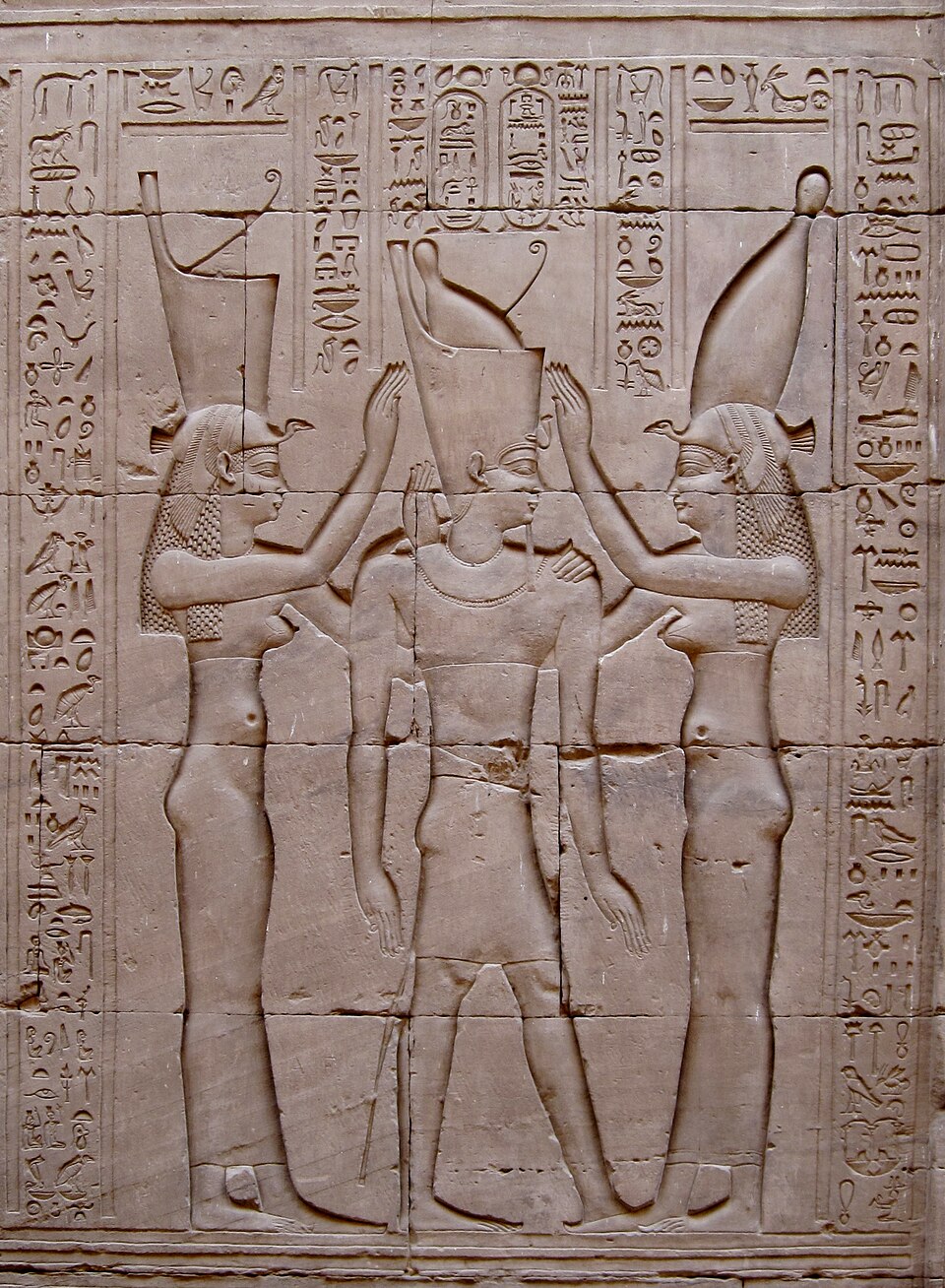
In the stone reliefs of ancient Egypt, a strange silhouette repeats itself: a tall white cone nested inside a red, flat-backed shape, rising from a pharaoh's brow like two crowns fused into one. This was the pschent, the double crown, and to the Egyptians who carved it into temple walls and painted it onto tomb ceilings, it was known simply as Pa-sekhemty — the Two Powerful Ones. The Greeks later borrowed the word, turning it into 'pschent,' the term by which it survives in our language today, even though Egypt itself vanished as a living civilization long before the word was fixed in Greek.
The crown was, in essence, a political statement rendered in fabric or leather and worn on the head of a living god-king. It fused two older, separate crowns: the White Hedjet Crown, associated with Upper Egypt in the south, and the Red Deshret Crown, associated with Lower Egypt in the north. To wear both at once was to declare, wordlessly and permanently, that the wearer ruled not a fragment of the Nile Valley but its entirety — a unified kingdom stretching from the cataracts to the delta.
The crown did not merely announce territorial control; it invoked divine protection. Fastened to its front were two animal emblems known as the Two Ladies. One was the uraeus, a rearing cobra poised to strike, representing Wadjet, the protective goddess of Lower Egypt. The other was a vulture, representing Nekhbet, the tutelary goddess of Upper Egypt. Together they flanked the pharaoh's forehead as guardians, their presence transforming the pschent from a mere symbol of political union into an emblem of sacred, protected kingship.
Tradition credits the invention of the pschent to Menes, the semi-legendary pharaoh of the First Dynasty long associated with the unification of Egypt. Yet the archaeological record complicates this tidy origin story. The earliest pharaoh actually known to have worn the Double Crown was Djet, also of the First Dynasty, whose Horus name appears in a rock inscription depicted wearing it — not Menes himself, at least not in surviving evidence.
The question of when Egypt's unification truly happened, and how the crown came to symbolize it, grows even murkier when historians examine the Palermo Stone, an ancient king list. It begins by naming Lower Egyptian rulers — figures now believed to have been mythological demigods rather than historical men — and shows them wearing only the Red Crown. The unification is marked in this record by the moment the Pschent is given to all First Dynasty pharaohs and their successors. Yet a rival source, the so-called Cairo fragment, contradicts this timeline entirely, depicting these same prehistoric rulers already wearing the full Double Crown, long before the supposed unification.
More from Archaeology

The Bronze Disc That Rewrote the Sky
Two looters with a metal detector dug up something illegal, invisible in value, and older than Stonehenge's final stones — a map of the heavens buried for over three thousand years.

The Faceless Women of the Ice Age
Long before writing, before cities, before the wheel, someone carved a woman's body into stone and ivory — and left no name, no face, no explanation.

The Pebble That Might Be Human
A palm-sized stone found on a Moroccan riverbank may be humanity's oldest attempt to see itself — or simply a trick of erosion.

The Crown That Vanished: Deshret and the Red Land
A crown worn by kings for three thousand years has never once been found in a tomb — not one. So where did it go?

The Face That Traveled Between Empires
A farm worker's shovel struck stone in 1897 and unearthed a face so striking it would be sold to France, seized as war booty, and finally traded back for a Velázquez.

The Boy in the Dark Tunnel
A schoolboy fell into black water inside an ancient tunnel and surfaced with his fingers brushing letters no one had noticed for 2,600 years.