The Unfinished Adoration: Leonardo's Ghost on a Wooden Panel
A brown, half-formed swirl of monks, horsemen and ruins has hung in the Uffizi for over three centuries — and for most of that time, almost no one asked why it was never finished.
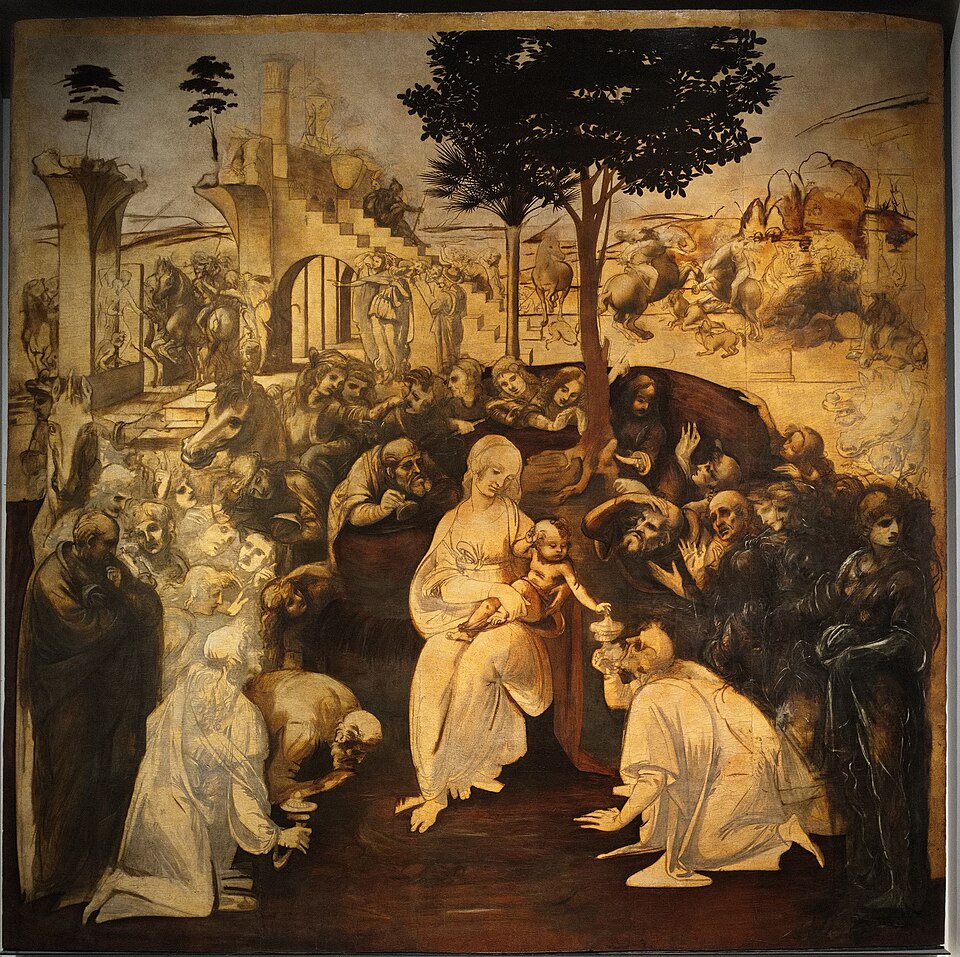
In 1481, the Augustinian monks of San Donato in Scopeto, on the outskirts of Florence, commissioned a young painter named Leonardo da Vinci to create an altarpiece depicting the Adoration of the Magi. He set to work with charcoal, ink and watercolor, building up an underdrawing of extraordinary ambition. Then, in 1482, he left for Milan — and the panel was abandoned, its paint layer never applied by his hand.
What survives is a composition unlike any conventional nativity scene. The Virgin and Child sit in the foreground, forming a triangle with the kneeling Magi, while behind them a dense semicircle of onlookers presses in — among them, on the far right, what many scholars believe is a self-portrait of Leonardo at about thirty. It is considered one of the most credible likenesses of the artist that exists.
The background is just as strange. On the left stand the ruins of a pagan building, with workmen apparently repairing it — likely a reference to the Basilica of Maxentius, which medieval legend claimed would stand only until a virgin gave birth, collapsing on the night of Christ's birth. On the right, men on horseback fight in a violent skirmish, sketched against a rocky landscape. A palm tree rises at the center, echoing the Song of Solomon's description of a woman 'stately as a palm tree' and doubling as a symbol of both Roman victory and Christian martyrdom. Beside it grows a carob tree, whose seeds were used to measure precious stones — a quiet nod to Christ as king of kings.
Leonardo drew heavily on Rogier van der Weyden's Entombment of Christ, borrowing its high horizon, raised viewpoint, and a central group poised before a rocky backdrop. Because the panel was never finished, the commission passed to Filippino Lippi, who painted another Adoration of the Magi as a substitute for the one Leonardo had left incomplete, completing it in 1496; it too now hangs in the Uffizi. Domenico Ghirlandaio painted a related version in 1488 for the Ospedale degli Innocenti, expanding on Leonardo's ideas.
For centuries, the panel — in the Uffizi since 1670 — was assumed to be simply an unfinished sketch overtaken by paint applied later by other hands. In 2002, art diagnostician Maurizio Seracini, a native Florentine who heads the diagnostics firm Editech, which he founded in Florence in 1977, was commissioned by the Uffizi to study the surface before any restoration. Using digital scans, thermography, ultrasound, ultraviolet and infrared imaging, he produced more than 2,400 detailed infrared records of the underdrawing.
More from Art

The Painting With No Foreground
A single robed figure stares out at an empty grey sea — and the emptiness itself became a scandal. When it was unveiled in Berlin in 1810, no one knew quite what to do with it.

The Painter Who Chased the Light
For a few purple minutes each evening, an American exile knelt in an English garden and raced the dying sun to paint two little girls lighting lanterns. It took him two years to finish.

When a President Became a God
Look straight up inside the U.S. Capitol dome and you will find George Washington enthroned among the clouds, surrounded by goddesses — the founding father transformed into myth.

Marble Brought Back to Life
A corpse asleep, a wing barely brushing her skin — and marble somehow learns to breathe. This is the moment Antonio Canova dared to carve.

The World Turned Upside Down
Look closely at a sixteenth-century Flemish village and you'll find a man biting a pillar, another carrying daylight in a basket, and a wife slipping a blue cloak over her husband's shoulders. Every gesture is a joke — if you know the language.

The Girl in the Glass Case
She stood two-thirds life size, dressed in a real tutu and human hair — and the critics who saw her in 1881 recoiled as if she were something obscene.