The Urinal That Broke Art in Two
In 1917 a man bought a plain porcelain urinal from a plumbing supply shop, signed it with a fake name, and asked the world to call it art. It worked.
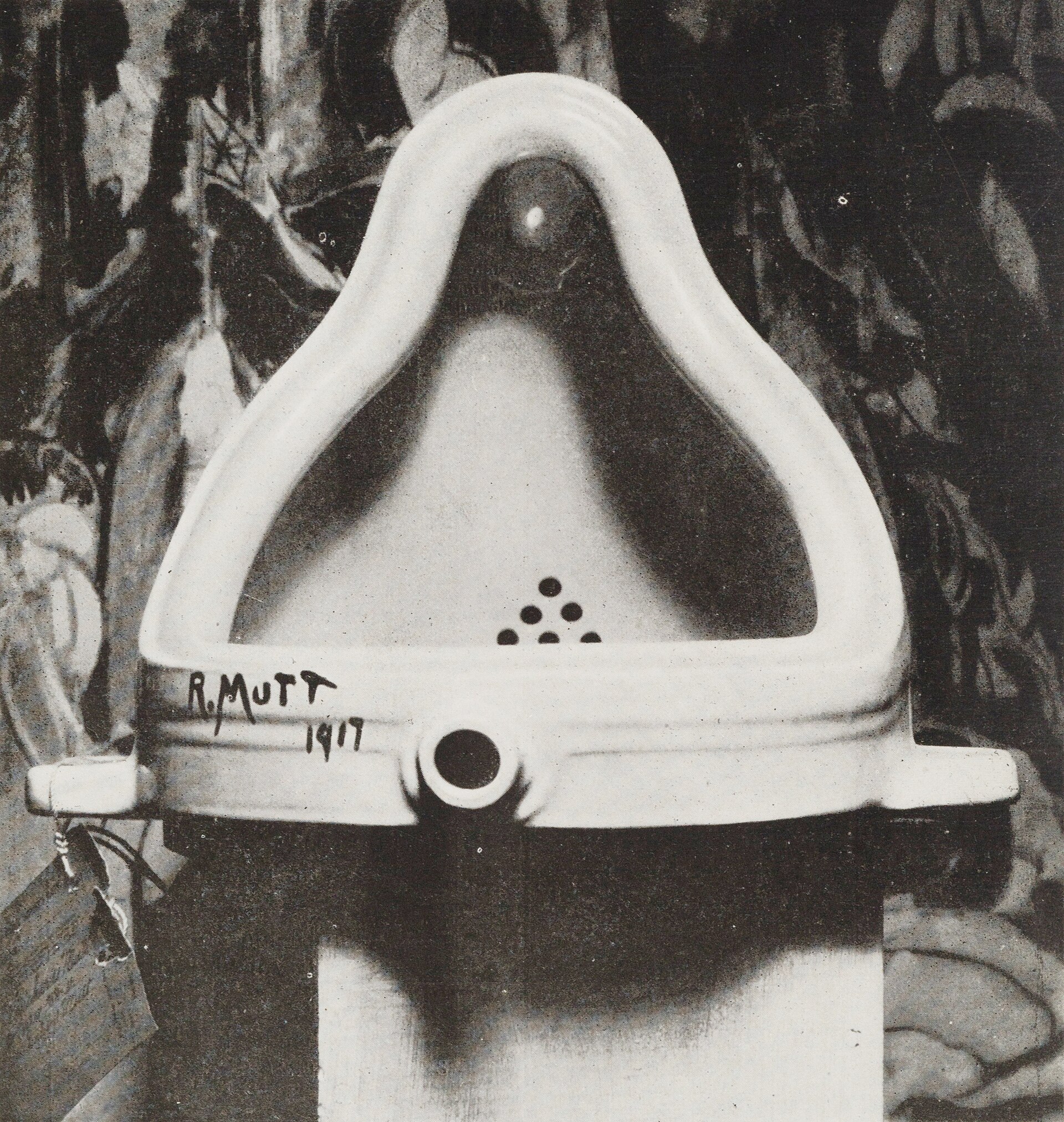
In the spring of 1917, Marcel Duchamp walked into the J. L. Mott Iron Works at 118 Fifth Avenue in New York with the painter Joseph Stella and the collector Walter Arensberg. What he bought there was nothing special: a standard Bedfordshire model urinal, the kind found in any plumbing catalogue of the era. He carried it back to his studio at 33 West 67th Street, reoriented it from the position it was meant to be used in — turning it upside down from its usual stance — and signed it 'R. Mutt 1917.'
The name was a small joke wrapped in misdirection. 'Mutt comes from Mott Works,' Duchamp later explained, 'but Mott was too close so I altered it to Mutt, after the daily cartoon strip Mutt and Jeff.' He added 'Richard' — French slang for moneybags — because, he said, it was 'not a bad name for a pissotière... the opposite of poverty.' The result was a title that sounded like an artist's name but concealed the real one entirely.
Duchamp submitted the piece, titled Fountain, to the inaugural exhibition of the Society of Independent Artists at the Grand Central Palace. He was, at the time, a board member of the Society — though he sent the work in under the Mutt pseudonym, so most of his colleagues had no idea it was his. The Society's own rules stated that any artist who paid the entry fee would be exhibited, so Fountain could not technically be rejected. It was instead simply hidden. As Duchamp put it decades later: 'It was simply suppressed... placed behind a partition and, for the duration of the exhibition, I didn't know where it was.'
Duchamp resigned from the board in protest and withdrew another work of his, a painting rumored to be titled Tulip Hysteria Co-ordinating, which — pointedly — may never have actually existed. After the show closed, Fountain resurfaced from behind its partition, and Duchamp retrieved it. Before it vanished for good, it was photographed at Alfred Stieglitz's studio, with Marsden Hartley's painting The Warriors visible in the background.
That photograph became the object's afterlife. It ran in the second issue of the Dada journal The Blind Man, alongside an editorial — possibly written by artist Beatrice Wood — titled 'The Richard Mutt Case.' Its argument would echo through the rest of the century: 'Whether Mr Mutt with his own hands made the fountain or not has no importance. He CHOSE it. He took an ordinary article of life, placed it so that its useful significance disappeared under the new title and point of view — created a new thought for that object.' The essay went further, insisting that plumbing and bridges were among the only art America had produced.
More from Art

The Painting With No Foreground
A single robed figure stares out at an empty grey sea — and the emptiness itself became a scandal. When it was unveiled in Berlin in 1810, no one knew quite what to do with it.

The Painter Who Chased the Light
For a few purple minutes each evening, an American exile knelt in an English garden and raced the dying sun to paint two little girls lighting lanterns. It took him two years to finish.

When a President Became a God
Look straight up inside the U.S. Capitol dome and you will find George Washington enthroned among the clouds, surrounded by goddesses — the founding father transformed into myth.

Marble Brought Back to Life
A corpse asleep, a wing barely brushing her skin — and marble somehow learns to breathe. This is the moment Antonio Canova dared to carve.

The World Turned Upside Down
Look closely at a sixteenth-century Flemish village and you'll find a man biting a pillar, another carrying daylight in a basket, and a wife slipping a blue cloak over her husband's shoulders. Every gesture is a joke — if you know the language.

The Girl in the Glass Case
She stood two-thirds life size, dressed in a real tutu and human hair — and the critics who saw her in 1881 recoiled as if she were something obscene.