The Vanishing Drawings of Botticelli's Dante
Ninety-two silverpoint drawings meant to illustrate every canto of the Divine Comedy vanished for centuries — then resurfaced, split between a Scottish duke's collection and the Vatican.
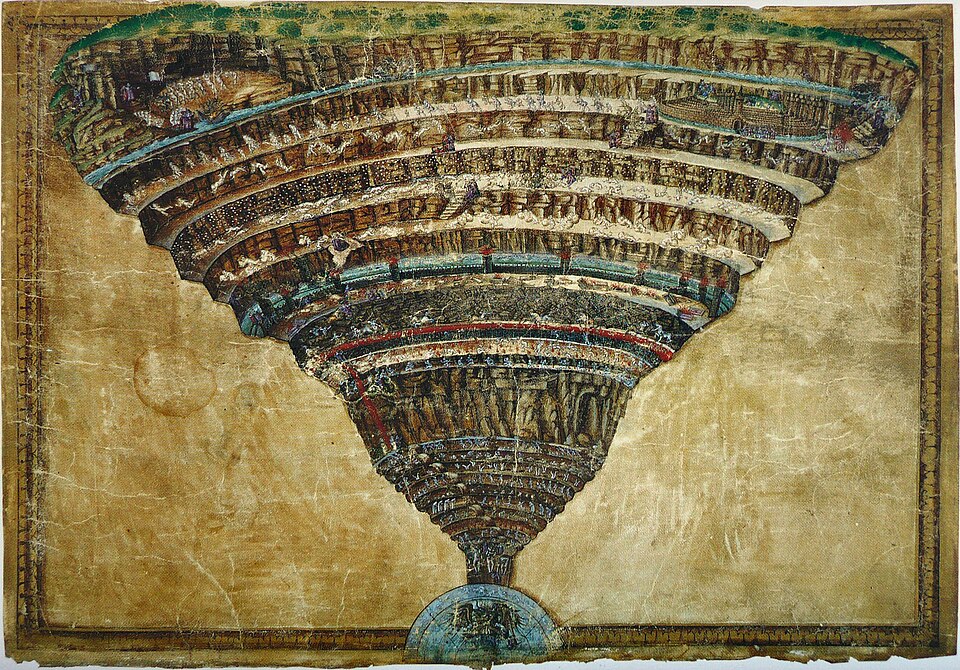
Sandro Botticelli, celebrated for the Birth of Venus and Primavera, took on a project unlike anything expected of a leading Renaissance painter: illustrating the entirety of Dante's Divine Comedy, canto by canto, in a manuscript of extraordinary ambition. Rather than depict a single moment per canto, as was customary, Botticelli attempted to render the whole thematic sequence of each canto in one full-page image, repeating figures like Dante, Virgil, and Beatrice multiple times within a single drawing. The result was 92 full-page pictures, most left as silverpoint drawings, some worked over in ink, and only four fully colored.
The manuscript's exact intended layout is uncertain, but scholars believe it was meant to open vertically, with the illustration page placed above the text page for each canto — implying a volume roughly 47 by 64 centimeters, a striking scale for a hand-drawn book.
Who commissioned this effort remains debated. It is often assumed that Lorenzo di Pierfrancesco de' Medici, an important patron of Botticelli, ordered the work, and the early writer known as the Anonimo Magliabecchiano claims Botticelli painted a Dante on parchment for Lorenzo. But scholar Ronald Lightbown has argued the drawings may instead have been made for Botticelli's own use and pleasure, a personal project rather than a commission.
Before this manuscript, Botticelli had already tried his hand at illustrating Dante for a printed edition. In 1481, Nicholo di Lorenzo della Magna published a Commedia in Florence with engraved illustrations based on Botticelli's designs, engraved by Baccio Baldini. The book left space for 100 engravings, one per canto, but only 19 were ever completed, and most surviving copies contain just the first two or three, printed directly on the page; the later ones were pasted in separately, suggesting the engraving process lagged badly behind the printing. Baldini, neither highly skilled nor experienced as an engraver, struggled to capture the delicacy of Botticelli's style. The project may also have been interrupted when Botticelli was summoned to Rome to help fresco the Sistine Chapel, likely away from July 1481 until as late as May 1482. Giorgio Vasari later wrote disapprovingly of the whole venture, describing Botticelli's absorption in commentary and illustration as leading to disorder in his life — though Vasari, writing in an age when printmaking mattered more, never seemed to take the project seriously.
The fate of the manuscript drawings themselves is a story of its own. They eventually disappeared from view, only to be rediscovered in the late nineteenth century. Gustav Friedrich Waagen identified a large portion in the collection of the Duke of Hamilton. A separate set of pages turned up in the Vatican Library, where they had traveled a different path: bound drawings once owned by Queen Christina of Sweden were purchased for the Vatican collection by Pope Alexander VIII after her death in Rome in 1689. Exactly when the manuscript was split apart is unknown.
More from Art

The Painting With No Foreground
A single robed figure stares out at an empty grey sea — and the emptiness itself became a scandal. When it was unveiled in Berlin in 1810, no one knew quite what to do with it.

The Painter Who Chased the Light
For a few purple minutes each evening, an American exile knelt in an English garden and raced the dying sun to paint two little girls lighting lanterns. It took him two years to finish.

When a President Became a God
Look straight up inside the U.S. Capitol dome and you will find George Washington enthroned among the clouds, surrounded by goddesses — the founding father transformed into myth.

Marble Brought Back to Life
A corpse asleep, a wing barely brushing her skin — and marble somehow learns to breathe. This is the moment Antonio Canova dared to carve.

The World Turned Upside Down
Look closely at a sixteenth-century Flemish village and you'll find a man biting a pillar, another carrying daylight in a basket, and a wife slipping a blue cloak over her husband's shoulders. Every gesture is a joke — if you know the language.

The Girl in the Glass Case
She stood two-thirds life size, dressed in a real tutu and human hair — and the critics who saw her in 1881 recoiled as if she were something obscene.