The Wall That Learned to Lie
For centuries a false chapel hid in plain sight on the wall of a Florentine church — and inside it, a dying young painter had already invented the future of Western art.
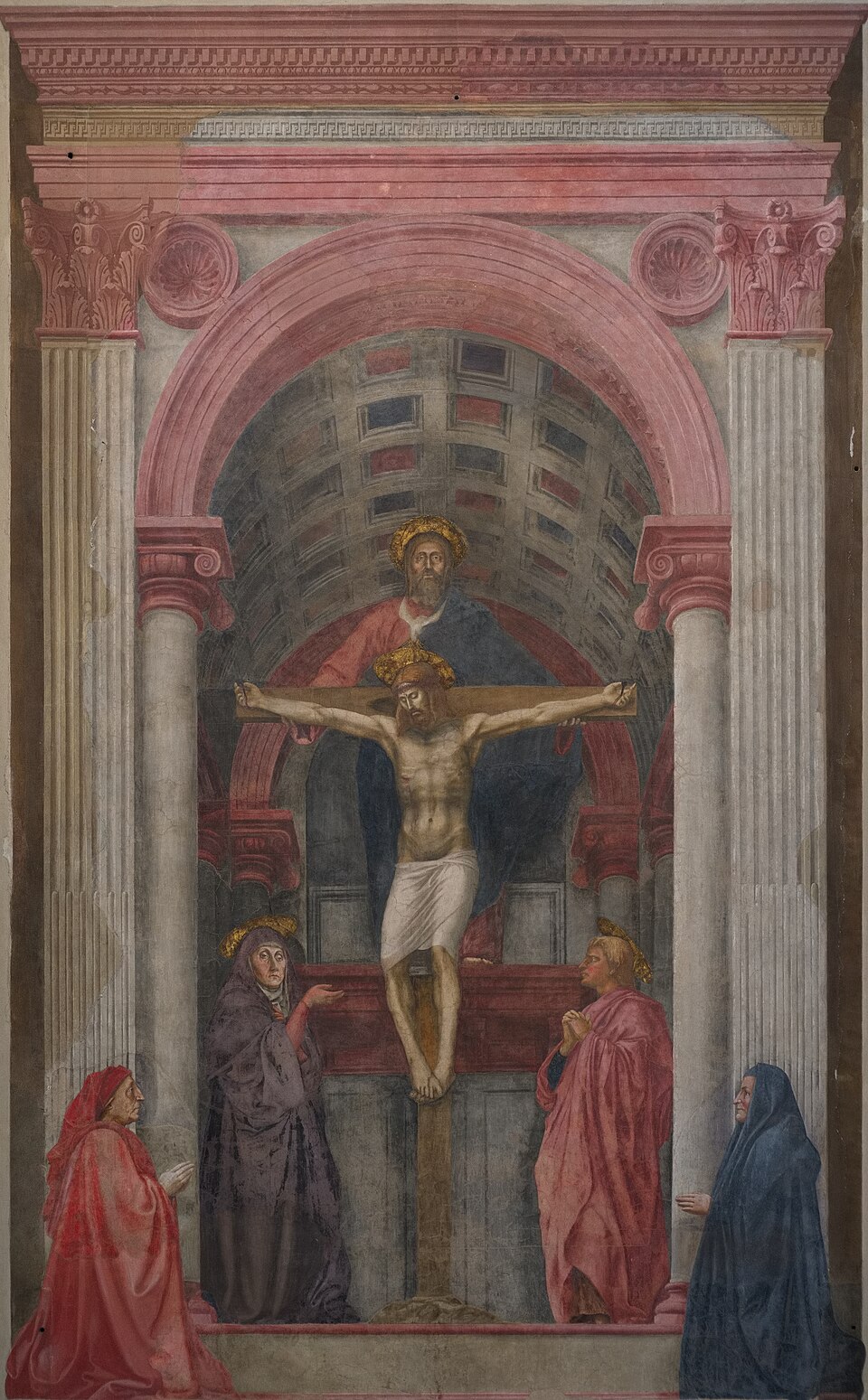
In the Dominican church of Santa Maria Novella in Florence, along the middle of the left aisle, there is a fresco that does not merely depict space — it seems to carve a hole into the wall itself. This is the Holy Trinity, painted by Masaccio sometime between 1425 and 1427. He died in late 1428, at twenty-six or just twenty-seven years old, leaving behind a small body of work. The Holy Trinity was among his last major commissions, and it is often cited as one of the first monumental Renaissance paintings to use linear perspective.
The fresco was carefully positioned in relation to the room as it existed at the time, particularly a former entrance-way that faced the painting directly, so that anyone walking in would be met by the illusion of depth at just the right angle. An altar was originally mounted as a shelf-ledge between the upper and lower sections of the fresco, projecting outward from the wall, deepening the trick of reality. The overall painting measures roughly 317 centimeters wide and 667 centimeters high, a proportion of about 2:1 between height and width, with the upper and lower sections themselves in a rough 3:1 ratio.
No contemporary documents survive naming whoever commissioned the work. Two donor figures kneel on either side of the painted archway, and their identities remain unconfirmed, though they were almost certainly Florentines of the era — either the patrons themselves or people close to them. Two families have been proposed: the Lenzi, and the Berti, a working-class family from the Santa Maria Novella quarter. Records discovered in 2012 show the Berti owned a tomb at the foot of the fresco. Other sources point to a Lenzi tomb near the altar bearing the inscription 'Domenico di Lenzo, et Suorum 1426,' with Domenico's recorded death falling, by later calendar conversion, on 19 January 1427 — leading some to suggest the donor portraits may be posthumous likenesses of him and his spouse.
There has long been speculation that Fra' Alessio Strozzi, a Dominican concerned with proper theological depiction, or Filippo Brunelleschi, the architect experimenting with linear perspective, may have advised Masaccio. Brunelleschi's perspective studies are widely believed to have inspired the fresco's construction. Yet no concrete evidence ties either man directly to the project.
Around 1568, Cosimo I, Duke of Florence, commissioned Giorgio Vasari to renovate Santa Maria Novella, including the chapel housing Masaccio's fresco. Vasari, who had already praised Masaccio in his Vite, chose not to destroy the older work. Instead, around 1570, he built a new altar and screen in front of it, leaving a small gap and effectively hiding and protecting the painting beneath his own new Madonna of the Rosary, later moved elsewhere in the church.
More from Art

The Painting With No Foreground
A single robed figure stares out at an empty grey sea — and the emptiness itself became a scandal. When it was unveiled in Berlin in 1810, no one knew quite what to do with it.

The Painter Who Chased the Light
For a few purple minutes each evening, an American exile knelt in an English garden and raced the dying sun to paint two little girls lighting lanterns. It took him two years to finish.

When a President Became a God
Look straight up inside the U.S. Capitol dome and you will find George Washington enthroned among the clouds, surrounded by goddesses — the founding father transformed into myth.

Marble Brought Back to Life
A corpse asleep, a wing barely brushing her skin — and marble somehow learns to breathe. This is the moment Antonio Canova dared to carve.

The World Turned Upside Down
Look closely at a sixteenth-century Flemish village and you'll find a man biting a pillar, another carrying daylight in a basket, and a wife slipping a blue cloak over her husband's shoulders. Every gesture is a joke — if you know the language.

The Girl in the Glass Case
She stood two-thirds life size, dressed in a real tutu and human hair — and the critics who saw her in 1881 recoiled as if she were something obscene.