The Wall That Would Not Stay Still
A duke wanted a mausoleum. A monk wanted his painter to finish. What Leonardo left on that refectory wall instead became one of the most fragile masterpieces ever made — falling apart almost from the moment it was finished.
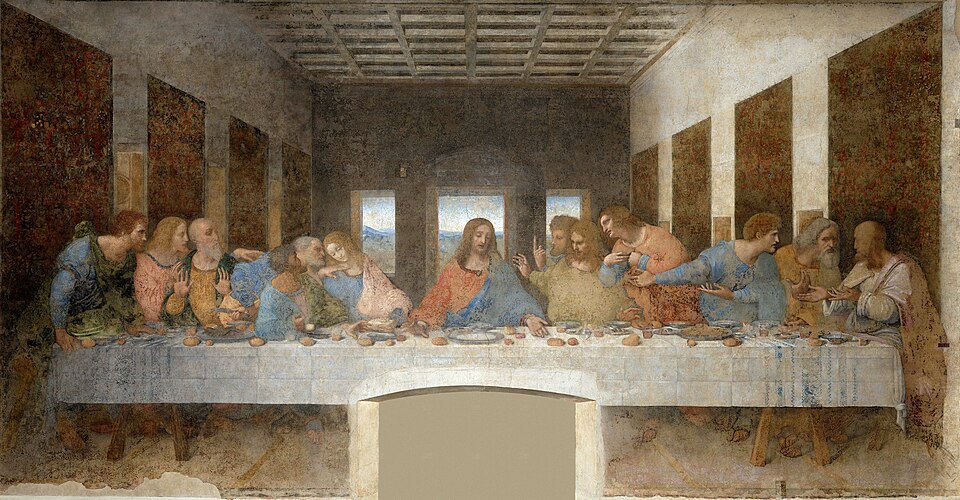
On the end wall of the dining hall at the monastery of Santa Maria delle Grazie in Milan, a mural nearly nine metres wide tells a single frozen moment: Jesus has just told his twelve apostles that one of them will betray him, and the table erupts in shock, anger, and denial. Leonardo da Vinci painted it between roughly 1495 and 1498, and it remains, alongside the Sala delle Asse, the largest work he ever completed.
The commission came from Ludovico Sforza, Duke of Milan and Leonardo's patron, who intended to remodel the church into a family mausoleum, possibly following plans associated with Donato Bramante. Those grand ambitions were never fully realized — only a smaller mortuary chapel was built beside the cloister — but the mural itself became the centerpiece of Sforza's vision. Even the lunettes above it, formed by the room's triple-arched ceiling, were painted with Sforza coats of arms.
Leonardo did not work steadily. The exact start date is unknown because the convent's records from that period were destroyed, but a 1497 document suggests the painting was nearly finished by then. A prior at the monastery grew impatient with the delays and complained. Leonardo's reply, as later recorded, was that he had been struggling to find the right villainous face for Judas — and warned that if he couldn't find one, he might simply use the prior's own features.
According to Gian Paolo Lomazzo, writing in 1557, Leonardo's friend Bernardo Zenale urged him to leave Christ's face unfinished, insisting it would be impossible to imagine anything lovelier or gentler than the faces already given to James the Greater and James the Less. Leonardo seems to have taken that advice.
What makes the mural especially fragile is the very material Leonardo chose. He preferred oil paint's slowness and flexibility, but true fresco — painted onto wet plaster in daily sections — didn't allow for the revisions or luminous chiaroscuro he wanted. So instead he used tempera on a wall sealed with gesso, pitch, and mastic, adding an undercoat of white lead beneath the paint. It was a technique described centuries earlier by Cennino Cennini, who had warned it was riskier than fresco and best reserved for finishing touches only.
More from Art

The Painting With No Foreground
A single robed figure stares out at an empty grey sea — and the emptiness itself became a scandal. When it was unveiled in Berlin in 1810, no one knew quite what to do with it.

The Painter Who Chased the Light
For a few purple minutes each evening, an American exile knelt in an English garden and raced the dying sun to paint two little girls lighting lanterns. It took him two years to finish.

When a President Became a God
Look straight up inside the U.S. Capitol dome and you will find George Washington enthroned among the clouds, surrounded by goddesses — the founding father transformed into myth.

Marble Brought Back to Life
A corpse asleep, a wing barely brushing her skin — and marble somehow learns to breathe. This is the moment Antonio Canova dared to carve.

The World Turned Upside Down
Look closely at a sixteenth-century Flemish village and you'll find a man biting a pillar, another carrying daylight in a basket, and a wife slipping a blue cloak over her husband's shoulders. Every gesture is a joke — if you know the language.

The Girl in the Glass Case
She stood two-thirds life size, dressed in a real tutu and human hair — and the critics who saw her in 1881 recoiled as if she were something obscene.