The Wall Where God Judged the World
Twenty-five years after he painted heaven on the ceiling, an aging Michelangelo turned to face the altar wall — and unleashed over 300 naked bodies into a storm of judgment.
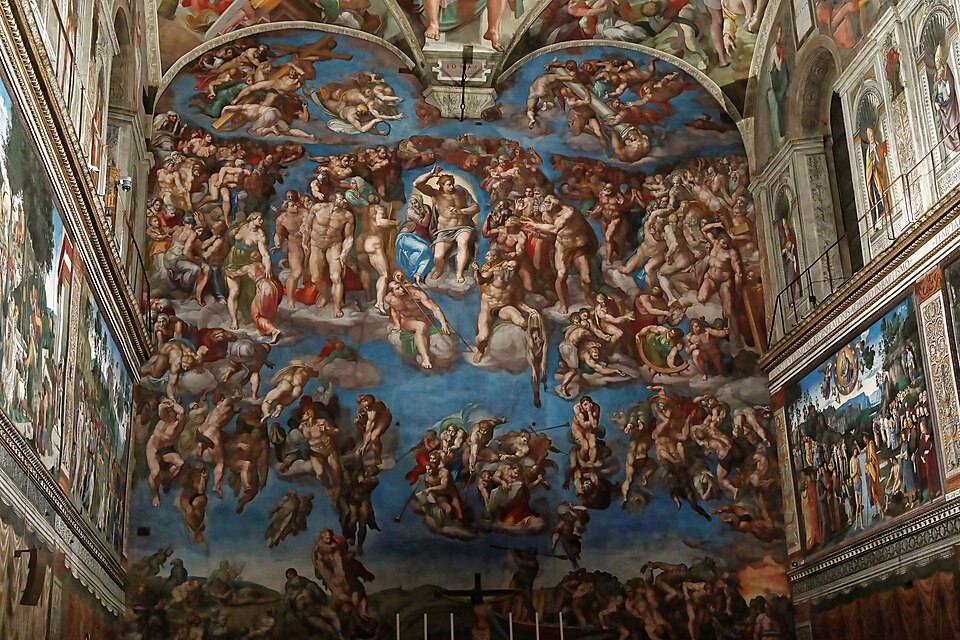
In 1535, workmen began preparing the altar wall of the Sistine Chapel for a new fresco. The man who would paint it, Michelangelo, had last worked in that room a quarter century earlier, lying on his back to finish the ceiling. Now nearly 67, he was being asked to return — this time to paint not creation, but the end of everything: the Second Coming of Christ and the final judgment of humanity.
The commission had originally come from Pope Clement VII, who envisioned a fresco on the Resurrection. But Clement died, and his successor, Pope Paul III, whose reforming instincts ran stronger, judged that the Last Judgment was the more fitting subject for the turbulent Rome of the 1530s. Michelangelo spent over four years on the work, from 1536 to 1541, producing a scene unlike any that had come before it.
At the center stands Christ, beardless and immensely muscular, his raised hand echoing the gesture of ostentatio vulnerum — the display of his crucifixion wounds. Scholars have traced his powerful form to antique sculptures of Hercules, Apollo, and Jupiter, particularly the Belvedere Apollo that Pope Julius II had brought to the Vatican. Beside him, the Virgin Mary looks away, toward the saved, her posture suggesting resignation rather than intercession — as if the moment for pleading on humanity's behalf has already passed.
Surrounding Christ are the saints, rendered on a scale nearly matching his own. John the Baptist stands to his left, Saint Peter to his right, holding the keys of Heaven as though offering them back, no longer needed. Other martyrs display the instruments of their suffering: Saint Bartholomew holds his own flayed skin, its sagging face long recognized as a self-portrait of Michelangelo himself. Saint Lawrence carries his gridiron, Saint Catherine a fragment of her breaking wheel, Saint Sebastian his arrows, Saint Blaise the iron combs that tore his flesh.
Below this celestial gathering, the dead claw their way from their graves. Following tradition, Michelangelo shows the saved ascending on the left, sometimes pulled upward by wingless angels, while the damned are driven toward the right. A menacing boatman, Charon, borrowed directly from Dante's Inferno, ferries condemned souls across to the gates of Hell, threatening them with his oar. There, the classical judge Minos — not Satan — oversees their admission to the underworld, another figure lifted straight from Dante's imagination.
More from Art

The Painting With No Foreground
A single robed figure stares out at an empty grey sea — and the emptiness itself became a scandal. When it was unveiled in Berlin in 1810, no one knew quite what to do with it.

The Painter Who Chased the Light
For a few purple minutes each evening, an American exile knelt in an English garden and raced the dying sun to paint two little girls lighting lanterns. It took him two years to finish.

When a President Became a God
Look straight up inside the U.S. Capitol dome and you will find George Washington enthroned among the clouds, surrounded by goddesses — the founding father transformed into myth.

Marble Brought Back to Life
A corpse asleep, a wing barely brushing her skin — and marble somehow learns to breathe. This is the moment Antonio Canova dared to carve.

The World Turned Upside Down
Look closely at a sixteenth-century Flemish village and you'll find a man biting a pillar, another carrying daylight in a basket, and a wife slipping a blue cloak over her husband's shoulders. Every gesture is a joke — if you know the language.

The Girl in the Glass Case
She stood two-thirds life size, dressed in a real tutu and human hair — and the critics who saw her in 1881 recoiled as if she were something obscene.