The Water That Would Not Let Him Go
A boy kneels by a pond to fill his jar with water, and seven pairs of eyes rise silently from beneath the lily pads to meet him.
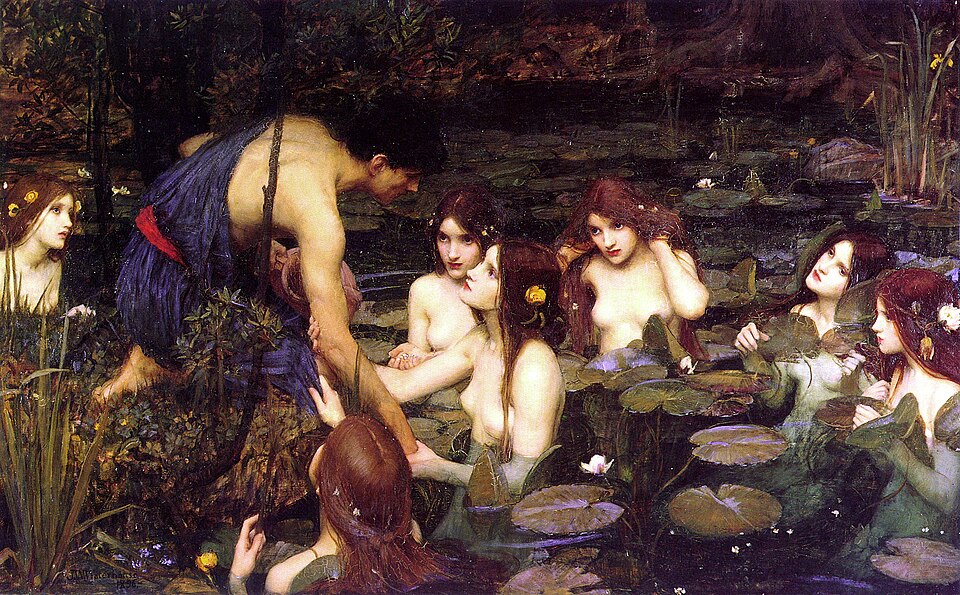
In 1896, John William Waterhouse set his brush to a story as old as Ovid: the tale of Hylas, son of Theiodamas, king of the Dryopians. After Hercules killed Hylas's father, the boy became his companion, and together they joined Jason's crew aboard the Argo in the quest for the Golden Fleece. It was an ordinary task that undid him — sent to fetch fresh water, Hylas came upon a quiet pond, and there the Naiads, the water nymphs who lived within it, drew him toward them and swallowed him into the depths.
Waterhouse's canvas, measuring 98.2 by 163.3 centimetres, freezes the instant before disappearance. Hylas kneels at the water's edge in a blue tunic cinched with a red sash, his wide-necked jar forgotten beside him, his profile shadowed and barely visible to the viewer. Around him, seven young nymphs rise from a glade thick with water lilies — among them an early painted appearance of the yellow Nuphar lutea — their bare skin pale against the dark, clear water, auburn hair threaded with white and yellow blossoms.
The nymphs share such similar features that art historians believe Waterhouse may have worked from only two models, multiplying and rearranging them across the canvas. Their intent is unmistakable: one nymph grips Hylas's wrist and elbow, another tugs at his tunic, a third extends a palm full of pearls, an offering meant to seal his fate. Waterhouse painted the scene from a slightly raised vantage point, mirroring Hylas's own downward gaze, so that no sky intrudes — only water, leaves, and the nymphs' faces turned toward him.
That compositional choice matters. By obscuring Hylas's expression and leaving out any trace of his bond with Hercules, Waterhouse shifts the story's weight away from the youth and onto the nymphs themselves — their allure, and the danger folded inside it. The painting is less about what Hylas feels than about what is being done to him, unseen and unheard.
Hylas was far from a novel subject in Waterhouse's Britain. William Etty had painted him in 1833, Henrietta Rae would return to him in 1910, and Waterhouse himself had already attempted the theme in 1893. He was drawn, too, to other doomed young men of Greek legend, later painting Narcissus in Echo and Narcissus in 1903, now held at the Walker Art Gallery in Liverpool. In 1896, a poem titled 'Hercules and Hylas' was published by Francis Burdett Thomas Coutts-Nevill. Some of Waterhouse's preparatory sketches survive today in Oxford's Ashmolean Museum.
More from Art

The Painting With No Foreground
A single robed figure stares out at an empty grey sea — and the emptiness itself became a scandal. When it was unveiled in Berlin in 1810, no one knew quite what to do with it.

The Painter Who Chased the Light
For a few purple minutes each evening, an American exile knelt in an English garden and raced the dying sun to paint two little girls lighting lanterns. It took him two years to finish.

When a President Became a God
Look straight up inside the U.S. Capitol dome and you will find George Washington enthroned among the clouds, surrounded by goddesses — the founding father transformed into myth.

Marble Brought Back to Life
A corpse asleep, a wing barely brushing her skin — and marble somehow learns to breathe. This is the moment Antonio Canova dared to carve.

The World Turned Upside Down
Look closely at a sixteenth-century Flemish village and you'll find a man biting a pillar, another carrying daylight in a basket, and a wife slipping a blue cloak over her husband's shoulders. Every gesture is a joke — if you know the language.

The Girl in the Glass Case
She stood two-thirds life size, dressed in a real tutu and human hair — and the critics who saw her in 1881 recoiled as if she were something obscene.