The Wave That Swallowed the World
Three tiny boats, one monstrous curl of foam, and a mountain that refuses to flinch — this single sheet of paper became the most reproduced image in art history.
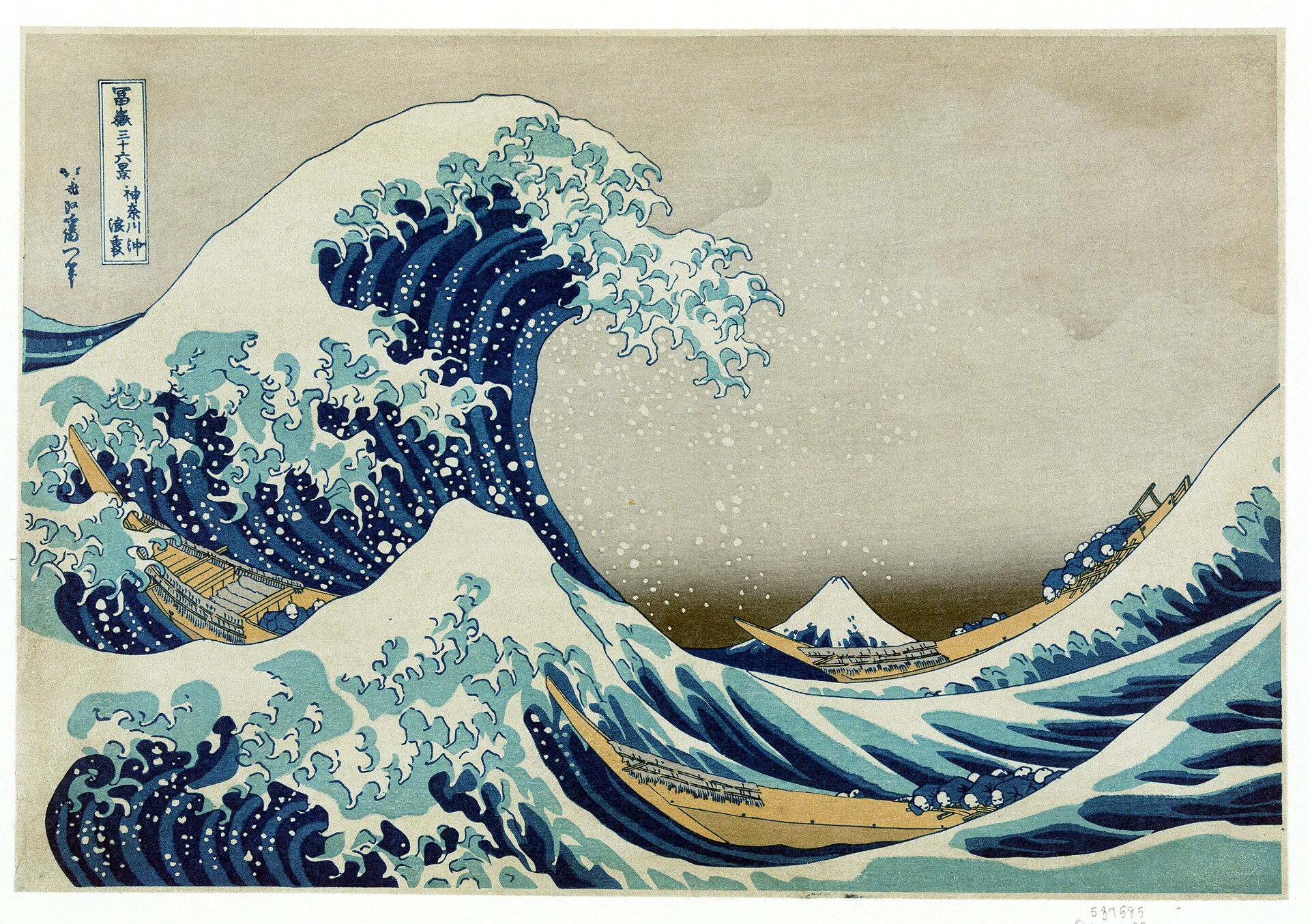
In 1832, in the print shops of Edo, a woodblock carver cut lines into cherry wood that would outlast empires. The image they produced showed three fragile boats caught beneath a towering, cresting wave, its claw-like foam frozen mid-collapse over the heads of the rowers. In the distance, small and unmoved, sat Mount Fuji. This was The Great Wave off Kanagawa, and its creator was Katsushika Hokusai, a man already past seventy when he made the piece that would define him.
Hokusai had spent a lifetime becoming ready for this print. Born in 1760 in a district east of Edo, the son of a mirror-maker, he began painting at six, apprenticed to a book shop at twelve, and trained as an engraver at sixteen. At eighteen he joined the studio of Katsukawa Shunshō, one of the era's great ukiyo-e masters. After Shunshō's death in 1793, Hokusai struck out on his own, absorbing Chinese, Japanese, and even Dutch and French painting techniques, and cycling through more than thirty pseudonyms over his career. He rose to public fame in 1804 with a colossal 240-square-metre drawing of a Buddhist monk at a Tokyo festival, and later published instructional drawing manuals and sketch volumes called manga to keep himself financially afloat.
The Great Wave belonged to a tradition called ukiyo-e — 'pictures of the floating world' — a printmaking art that had flourished in Japan since the 1670s, when Hishikawa Moronobu produced the first monochrome prints of women. Over the following century, ukiyo-e evolved from single-colour works into elaborate 'brocade prints' using ten or more carved blocks, each print the product of a divided labor: an artist who designed it, a carver who cut it, a printer who inked it, and a publisher who financed and distributed it. It was popular art, made for the newly prosperous chōnin class of merchants and craftsmen who filled Edo after it became the shogunate's capital in 1603.
Hokusai's Great Wave was the opening image of his series Thirty-six Views of Mount Fuji, first printed in 1832 as part of a series designed in the late 1820s and early 1830s. The series was so beloved that ten additional prints had to be added beyond the original thirty-six. What set it apart visually was Hokusai's use of Prussian blue, a pigment new to Japanese printmaking, which gave the wave its startling depth and intensity. The composition itself fused traditional Japanese design with graphical perspective techniques borrowed from Europe — a hybrid vision that helped the print succeed immediately in Japan and, later, captivate audiences abroad.
The print measures a modest 25 by 37 centimetres, an ōban-sized sheet in landscape format. Despite its small size, its influence proved vast. When ukiyo-e prints flooded into Europe in the nineteenth century, largely through private collections, The Great Wave found its way into the hands and imaginations of Western artists. Vincent van Gogh and Claude Monet both responded to Hokusai's work; Monet kept a copy in his house in Giverny, France. The composer Claude Debussy, too, drew inspiration from it. Within Japan, Hokusai's own younger contemporaries, Hiroshige and Utagawa Kuniyoshi, were moved to create their own wave-themed prints in response.
More from Art

The Painting With No Foreground
A single robed figure stares out at an empty grey sea — and the emptiness itself became a scandal. When it was unveiled in Berlin in 1810, no one knew quite what to do with it.

The Painter Who Chased the Light
For a few purple minutes each evening, an American exile knelt in an English garden and raced the dying sun to paint two little girls lighting lanterns. It took him two years to finish.

When a President Became a God
Look straight up inside the U.S. Capitol dome and you will find George Washington enthroned among the clouds, surrounded by goddesses — the founding father transformed into myth.

Marble Brought Back to Life
A corpse asleep, a wing barely brushing her skin — and marble somehow learns to breathe. This is the moment Antonio Canova dared to carve.

The World Turned Upside Down
Look closely at a sixteenth-century Flemish village and you'll find a man biting a pillar, another carrying daylight in a basket, and a wife slipping a blue cloak over her husband's shoulders. Every gesture is a joke — if you know the language.

The Girl in the Glass Case
She stood two-thirds life size, dressed in a real tutu and human hair — and the critics who saw her in 1881 recoiled as if she were something obscene.