The Wave That Wouldn't Ask for Help
A single tear, a swirling sea, and a thought bubble that refuses rescue — inside one of pop art's most quietly devastating paintings.
In 1963, Roy Lichtenstein painted a woman drowning. Her hair coils like seaweed, her eyes brim with tears, and a wave curls over her shoulder as if the ocean itself were closing in. Above her head floats a thought bubble: 'I Don't Care! I'd Rather Sink — Than Call Brad For Help!' The man named Brad never appears in the picture at all — he exists only as an absence, a wound implied rather than shown.
The image was not invented by Lichtenstein. It was cropped and reworked from the splash page of 'Run for Love!', a story in Secret Hearts #83, a DC Comics romance title published in November 1962, illustrated by Tony Abruzzo and lettered by Ira Schnapp. Lichtenstein stripped away surrounding panels and dialogue, isolating this one moment of melodrama and blowing it up into something monumental.
By the early 1960s, Lichtenstein had already broken from his earlier abstract expressionist work, producing Look Mickey and Popeye in 1961. He was, at the time, unaware that Andy Warhol was independently exploring comic imagery too. Warhol reportedly pivoted toward Campbell's Soup Cans partly to avoid direct competition with Lichtenstein's more polished comic-derived style.
What drew Lichtenstein to scenes like this was, in his own words, 'the highly emotional content yet detached impersonal handling of love, hate, war, etc., in these cartoon images.' He wanted to take a cliché and organize its forms into something monumental. To achieve the mechanical look of newsprint, he used Ben-Day dots — the small colored circles that mimicked commercial printing's half-tone screens — alongside bold outlines and flat, simplified color fields.
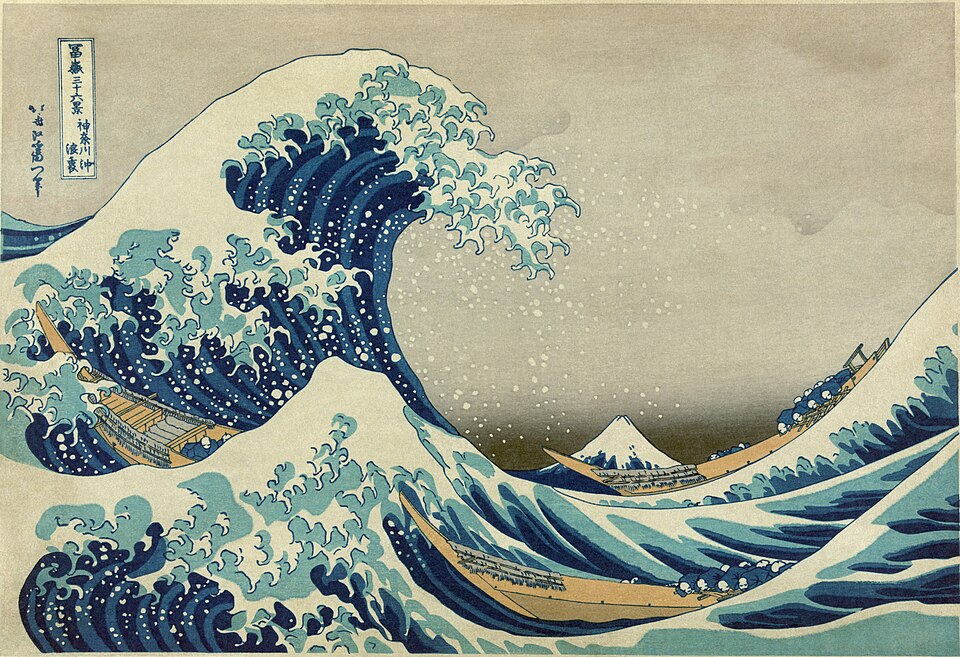
Drowning Girl also carries quieter art-historical borrowings: the curling wave recalls Hokusai's The Great Wave off Kanagawa, while the composition draws on modernist shapes associated with Jean Arp and Joan Miró. Between 1962 and 1963, Lichtenstein had also been parodying four Picassos, and Picasso's own weeping women may have shaped his interest in painting vulnerable, tearful female subjects, as seen here and in his related work Hopeless.
More from Art

The Painting With No Foreground
A single robed figure stares out at an empty grey sea — and the emptiness itself became a scandal. When it was unveiled in Berlin in 1810, no one knew quite what to do with it.

The Painter Who Chased the Light
For a few purple minutes each evening, an American exile knelt in an English garden and raced the dying sun to paint two little girls lighting lanterns. It took him two years to finish.

When a President Became a God
Look straight up inside the U.S. Capitol dome and you will find George Washington enthroned among the clouds, surrounded by goddesses — the founding father transformed into myth.

Marble Brought Back to Life
A corpse asleep, a wing barely brushing her skin — and marble somehow learns to breathe. This is the moment Antonio Canova dared to carve.

The World Turned Upside Down
Look closely at a sixteenth-century Flemish village and you'll find a man biting a pillar, another carrying daylight in a basket, and a wife slipping a blue cloak over her husband's shoulders. Every gesture is a joke — if you know the language.

The Girl in the Glass Case
She stood two-thirds life size, dressed in a real tutu and human hair — and the critics who saw her in 1881 recoiled as if she were something obscene.