The Weary Giant of Naples
A colossal marble strongman, exhausted and leaning on his club, once vanished into fragments across two cities — his legs separated from his body for over two centuries.
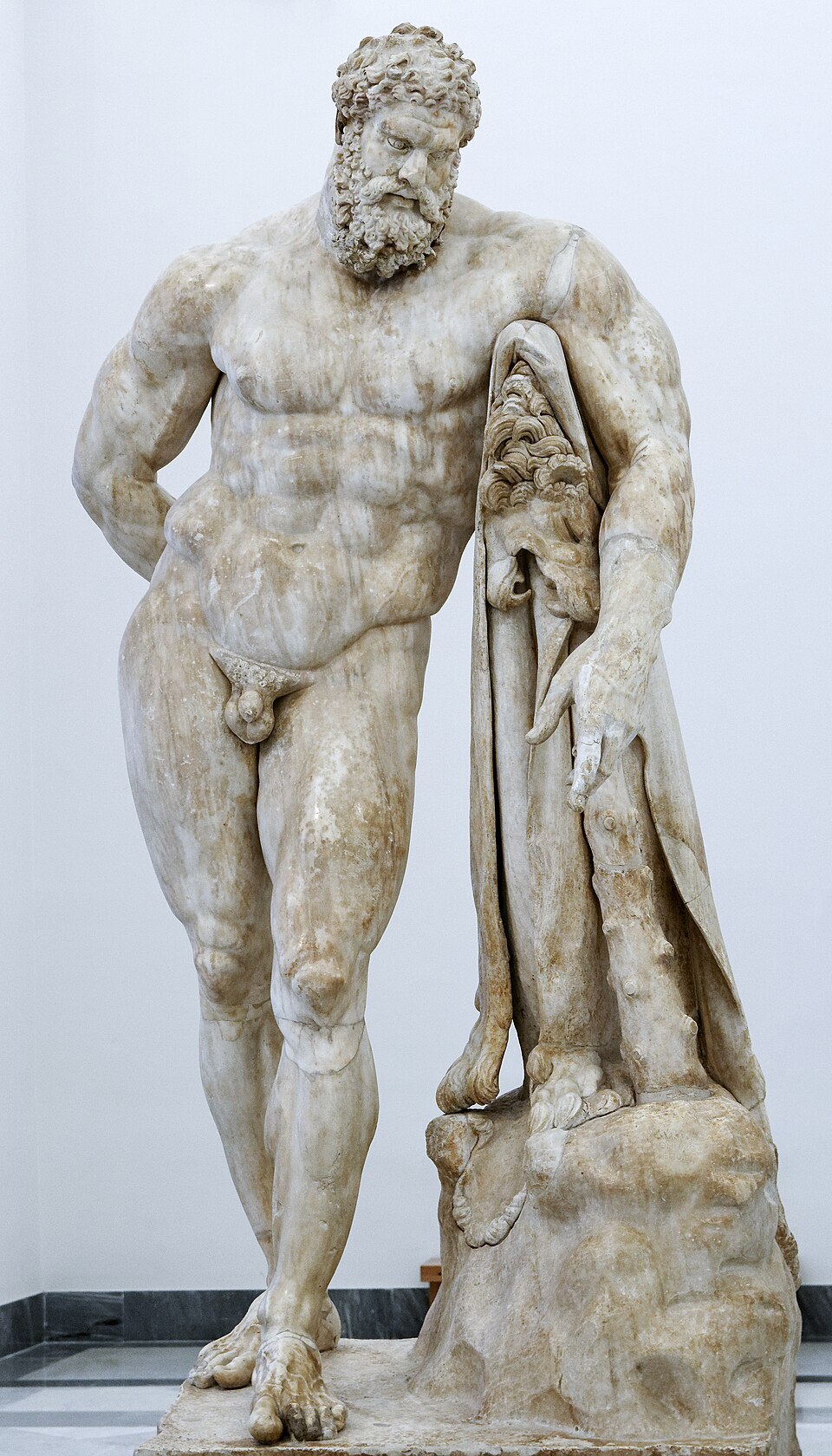
In the early third century AD, a sculptor named Glykon signed his name to a massive marble statue of Hercules — otherwise unknown to history, an Athenian who may have worked in Rome. What he carved was not an original invention but a monumental copy of a much older bronze by Lysippos or one of his circle, a work that would have been made in the fourth century BC. That bronze original endured for over 1,500 years before Crusaders melted it down in 1205 during the Sack of Constantinople, leaving Glykon's marble version as the closest surviving link to a lost masterpiece.
Glykon's Hercules was made for the Baths of Caracalla in Rome, a complex dedicated in 216 AD. There it stood for centuries until it vanished into the earth, only to resurface in 1546. The statue shows Hercules not in triumph but in a rare moment of rest: muscular yet weary, leaning on his gnarled club, over which is draped the skin of the Nemean lion — the trophy of his very first labour. Behind his back, hidden in his right hand, he holds the golden apples of the Hesperides, a task from near the end of his Twelve Labours. The pose captures a hero caught between his beginning and his end.
The rediscovered statue was quickly claimed by Cardinal Alessandro Farnese, grandson of Pope Paul III, who was assembling one of the greatest collections of classical sculpture since antiquity. For generations it stood in its own room at the Palazzo Farnese in Rome, surrounded by frescoes of Hercules's mythical feats painted by Annibale Carracci and his studio in the 1590s.
But the statue arrived incomplete. Its head had been found separately, in a well in Trastevere, and was bought for the Farnese collection through the efforts of sculptor Guglielmo della Porta. Della Porta also carved replacement legs to complete the figure — legs so admired that when the genuine original legs were later discovered at the Baths of Caracalla, della Porta's version was kept in place instead. This was reportedly on Michelangelo's advice, meant to prove that modern sculptors could rival the ancients. The real legs went instead into the Borghese collection, and the statue would not be whole again until 1787.
By then, the statue's fame had already spread far beyond Rome through prints and engravings — the primary means, before photography, of putting such an image into many hands. As early as 1562, it appeared in the Speculum Romanae Magnificentiae, and collectors, artists, and tourists flocked to see the original standing under the arcade in the Palazzo Farnese courtyard. Hendrik Goltzius sketched it during his 1590–91 trip to Rome, and in 1591 produced a bravura engraving of its rear view, exaggerating its swelling, muscular contours. The young Peter Paul Rubens also sketched the statue's planes and mass during his own travels.
More from Art

The Painting With No Foreground
A single robed figure stares out at an empty grey sea — and the emptiness itself became a scandal. When it was unveiled in Berlin in 1810, no one knew quite what to do with it.

The Painter Who Chased the Light
For a few purple minutes each evening, an American exile knelt in an English garden and raced the dying sun to paint two little girls lighting lanterns. It took him two years to finish.

When a President Became a God
Look straight up inside the U.S. Capitol dome and you will find George Washington enthroned among the clouds, surrounded by goddesses — the founding father transformed into myth.

Marble Brought Back to Life
A corpse asleep, a wing barely brushing her skin — and marble somehow learns to breathe. This is the moment Antonio Canova dared to carve.

The World Turned Upside Down
Look closely at a sixteenth-century Flemish village and you'll find a man biting a pillar, another carrying daylight in a basket, and a wife slipping a blue cloak over her husband's shoulders. Every gesture is a joke — if you know the language.

The Girl in the Glass Case
She stood two-thirds life size, dressed in a real tutu and human hair — and the critics who saw her in 1881 recoiled as if she were something obscene.