The Weeping Rock: Niobe's Endless Grief
A mother boasted once too loudly of her fourteen children — and the gods answered with arrows. What was left of her still weeps on a mountainside in Turkey today.
On the slopes of Mount Sipylus, near modern Manisa in western Turkey, there is a rock formation that resembles a woman's face, streaked with water seeping from porous limestone. Since antiquity, travelers have called it the Weeping Rock, and they have given it a name: Niobe. To stand before it, according to legend, is to look upon a mother frozen mid-sorrow, still grieving thousands of years after her children died.
Niobe was the daughter of Tantalus, ruler of a city near Sipylus sometimes called Tantalis, and of a mother named in different accounts as Dione, Eurythemista, or Euryanassa. She was sister to Pelops and Broteas, and she married Amphion, one of the twin founders of Thebes, a gifted musician who had been taught the lyre by Hermes himself. Though her father's city lay in the westernmost reaches of Anatolia, later writers styled Tantalus 'Phrygian,' even 'King of Phrygia,' despite the true Phrygian heartland lying further inland.
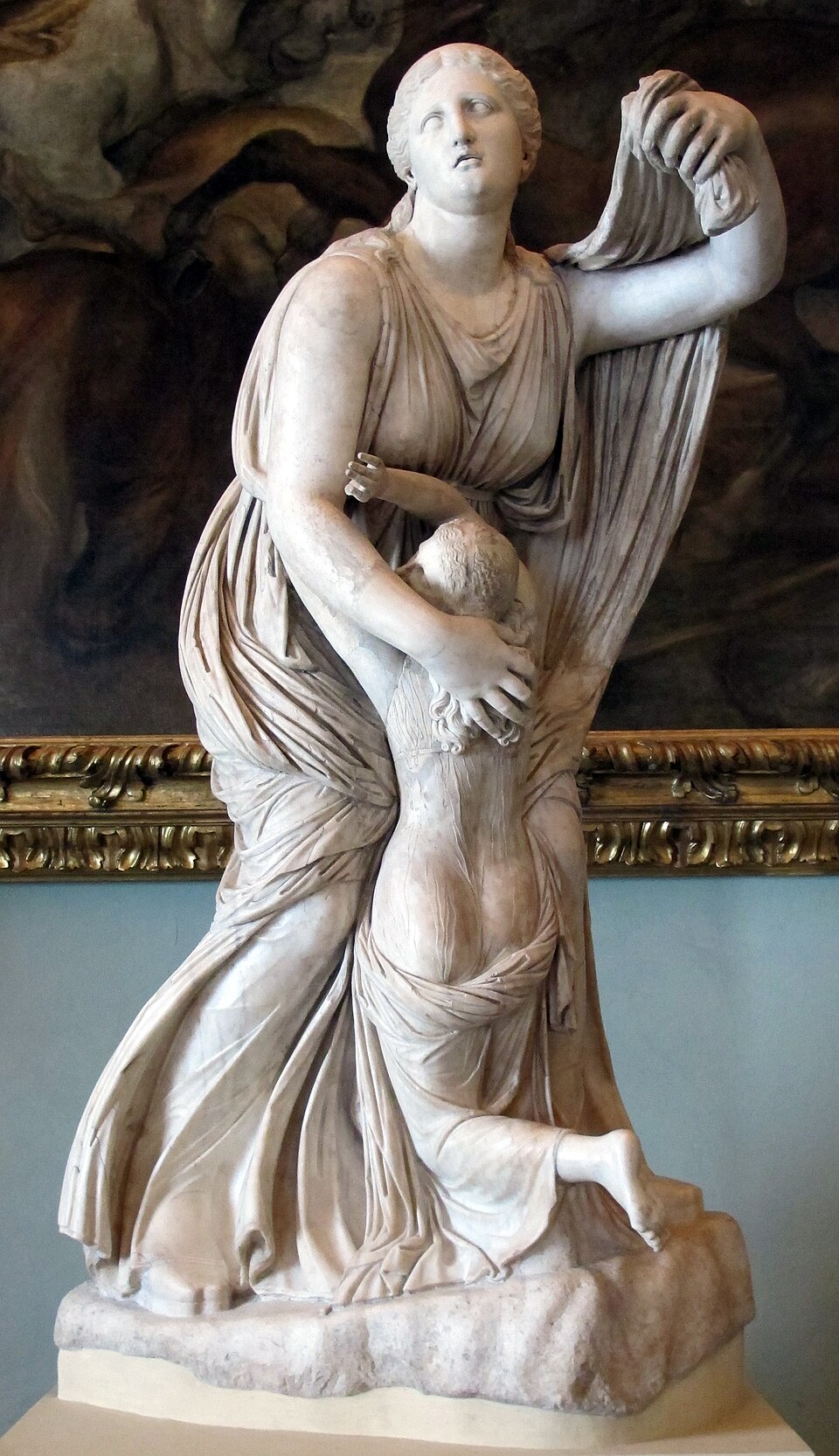
Niobe and Amphion had fourteen children — seven sons and seven daughters, known as the Niobids, though the exact number shifts between sources. It was this abundance that undid her. Boasting of her fourteen children before Leto, who had borne only two — the twins Apollo and Artemis — Niobe committed the sin the Greeks feared most: hubris, the pride that invites divine punishment.
Leto did not forgive the insult. She sent her children to avenge it. Artemis, armed with arrows, killed Niobe's daughters; Apollo killed her sons. In some versions, one or two children were spared — Meliboea, who turned permanently pale from horror and was ever after called Chloris, sometimes alongside her brother Amyclas. Amphion, in most tellings, took his own life in grief; in others, he was struck down by Apollo's arrows while attacking the god's temple in his madness.
Homer's Iliad preserves one of the oldest versions of this sorrow. Achilles invokes Niobe to console the grieving Priam, whose son Hector lay unburied — just as Niobe's children lay unburied for nine days while their mother refused all food. The comparison endured: in Sophocles's Antigone, the condemned heroine likens her own solitary death to Niobe's fate, and Sophocles is said to have written an entire lost play devoted to her story. Aeschylus, too, dramatized her grief — surviving fragments describe Niobe sitting veiled and silent through the opening of his tragedy.
More from Mythology

The Doctor Who Sang a Nation Into Being
A country doctor rode into the forests of Karelia armed with nothing but a notebook — and rode out with the soul of a nation.

The Boat That Carried the Sun
Every sunset, the ancient Egyptians believed, the sun climbed into a boat and sailed straight into the realm of the dead — only to fight a monstrous serpent before dawn could return.

The Wild Man of the Snows
At 21,000 feet, a colonel found tracks in the snow that he blamed on a wolf — but his guides knew better, and gave the world a name that would echo for a century.

The Knight Who Went Mad for Love: Orlando Furioso
A hero so devoted to duty he was Charlemagne's greatest paladin loses his mind—not to a sword wound, but to heartbreak. To cure him, a friend must ride a flying horse to the Moon.

The Book That Turned the World Into Myth
A poet condemned to exile spent his final years in Rome finishing a poem that would outlive empires—a poem about nothing standing still, not gods, not lovers, not even the shape of a man.

Paradise Lost: Milton's Rebel Angel
A blind poet, dictating verses in the dark, dared to explain the ways of God to men — and in doing so, made Hell's ruler unforgettable.