The White Snake Who Loved a Mortal Man
A woman in white steps off an ox cart in Chang'an, and a young man's fate begins to dissolve. Centuries later, that same fear would soften into one of China's greatest love stories.
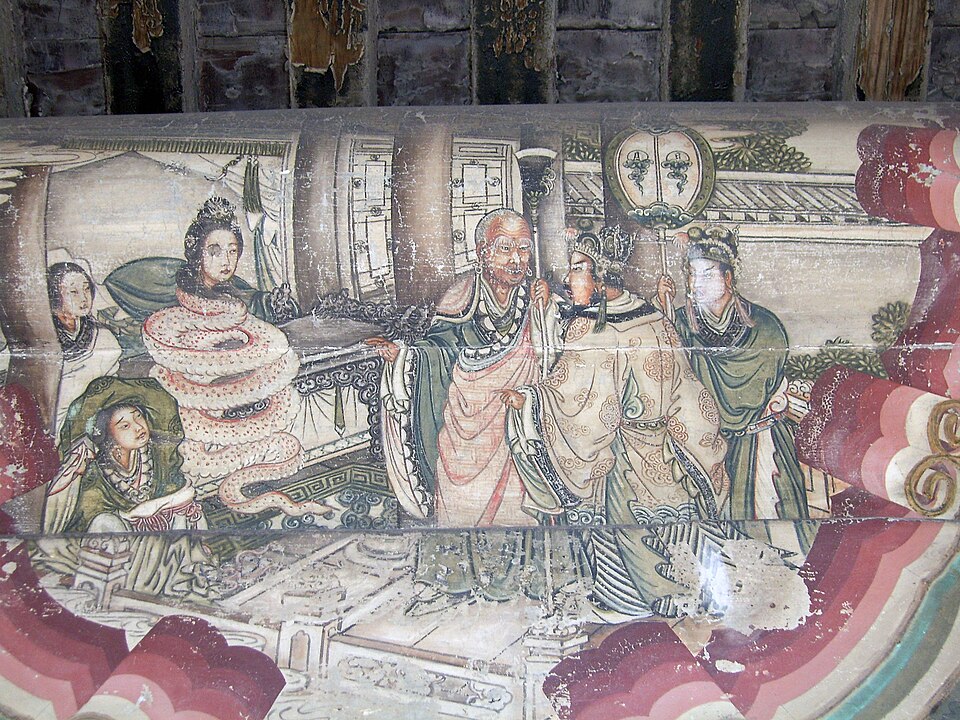
In the second year of the Yuanhe era, 807, a young man named Li Huang wandered through the East Market of Chang'an and saw a beautiful woman dressed in white, riding an ox cart. He asked her maidservant who she was and learned she was a recently widowed woman with no money. Taken with her, Li Huang offered her silk and coin, and soon found himself invited into her home.
There he met an old woman in blue-green who claimed to be the widow's aunt. She spoke of a debt of thirty thousand cash and offered the young woman's company in exchange for payment. Li Huang sent for the money and stayed three days. On the fourth, the old woman urged him home before his uncle grew suspicious. A servant who accompanied him noticed a strange, fishy smell clinging to Li Huang's body.
Back home, Li Huang fell ill almost immediately. He raved incoherently and told his fiancée he was finished. When his family lifted his bedding in fear, they found that his body had dissolved into water — only his head remained. Searching for the woman's house, they found nothing but a desolate garden and a single locust tree, with fifteen thousand cash hidden above its roots and fifteen thousand more below. Neighbors said the only creature ever seen there was a large white snake, coiled beneath that same tree.
This tale, called 'Li Huang', survives in the Tang dynasty collection Boyi zhi and is considered the oldest ancestor of what would become the Legend of the White Snake. A variant version, 'Another Version', changes small details — the protagonist becomes Li Guan, his head splits open instead of dissolving, and beneath a withered pagoda tree his family finds not one snake but a nest of small white snakes, which they kill.
Centuries passed, and the story kept changing shape. Around the Jiajing era of the Ming dynasty, between 1541 and 1551, a new version appeared in the Qingpingshantang Huaben compiled by Hong Pian: 'The Three Pagodas of West Lake'. Here the setting shifts to West Lake in Hangzhou, and three stone pagodas — not yet the famous Leifeng Pagoda — anchor the tale.
More from Mythology

The Doctor Who Sang a Nation Into Being
A country doctor rode into the forests of Karelia armed with nothing but a notebook — and rode out with the soul of a nation.

The Boat That Carried the Sun
Every sunset, the ancient Egyptians believed, the sun climbed into a boat and sailed straight into the realm of the dead — only to fight a monstrous serpent before dawn could return.

The Wild Man of the Snows
At 21,000 feet, a colonel found tracks in the snow that he blamed on a wolf — but his guides knew better, and gave the world a name that would echo for a century.

The Knight Who Went Mad for Love: Orlando Furioso
A hero so devoted to duty he was Charlemagne's greatest paladin loses his mind—not to a sword wound, but to heartbreak. To cure him, a friend must ride a flying horse to the Moon.

The Book That Turned the World Into Myth
A poet condemned to exile spent his final years in Rome finishing a poem that would outlive empires—a poem about nothing standing still, not gods, not lovers, not even the shape of a man.

Paradise Lost: Milton's Rebel Angel
A blind poet, dictating verses in the dark, dared to explain the ways of God to men — and in doing so, made Hell's ruler unforgettable.