The Woman Who Faces No One
Two women sit at a table under a neon sign that spells CHOP SUEY — and somehow, in that ordinary lunch, an entire century of loneliness gets painted into being.
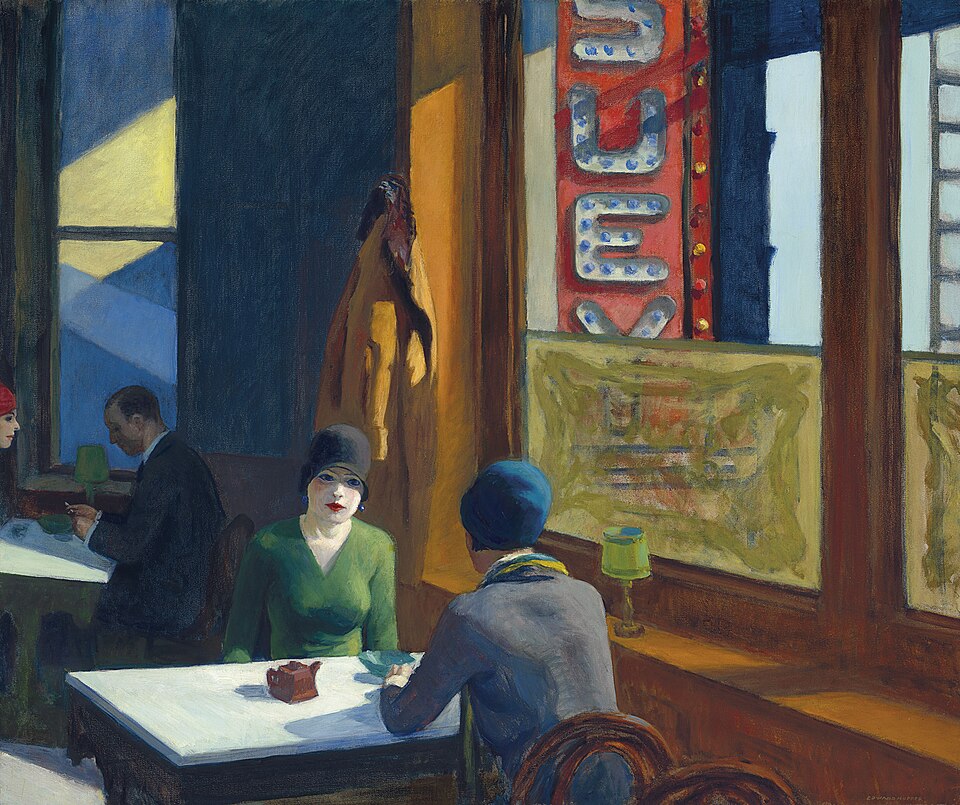
In 1929, Edward Hopper set down his brush on a canvas depicting two women mid-conversation in a cheap upstairs Chinese restaurant, the kind he and his wife Jo used to frequent near Columbus Circle. He called it Chop Suey, after the restaurant sign glowing outside the window. Nearly ninety years later, in November 2018, that same canvas sold for 92 million dollars — a record for his work, and proof that a scene most people would walk past without a second glance had become one of the most coveted paintings in America.
What Hopper actually painted is sparser than the price tag suggests. A woman in green sits facing the viewer, her makeup stark, her face pale as the blank wall behind her. Across from her sits a companion whose back is turned, unreadable. Behind them, a second couple: a man smoking, withdrawn from the woman across his own table. A teapot. A hanging coat. A masked lower window pane. And that sign outside, spelling out the restaurant's name in letters that anchor the whole scene to a specific American moment.
Hopper once described his work as a transcription of his most intimate impressions of nature, and scholars have long noted how closely this method resembles memory itself. In memory, most of a room disappears — only certain fragments stay sharp: a coat's texture, a teapot's shine, a stranger's voice from the next table. Chop Suey works the same way. The middle background is loose and rough, almost abandoned by the brush, while the objects that mattered — the sign, the coat, the window, the faces — are rendered with unusual care.
That unevenness is the whole point. It lets the eye pass over what was forgotten and rest on what was kept. Art writers have pointed out that Hopper's compositional 'weight' sits precisely in these remembered details, stretching from the tabletop conversation all the way out to the exterior signage, as if the painter were reconstructing a single afternoon from the fragments his mind chose to preserve.
More from Art

The Painting With No Foreground
A single robed figure stares out at an empty grey sea — and the emptiness itself became a scandal. When it was unveiled in Berlin in 1810, no one knew quite what to do with it.

The Painter Who Chased the Light
For a few purple minutes each evening, an American exile knelt in an English garden and raced the dying sun to paint two little girls lighting lanterns. It took him two years to finish.

When a President Became a God
Look straight up inside the U.S. Capitol dome and you will find George Washington enthroned among the clouds, surrounded by goddesses — the founding father transformed into myth.

Marble Brought Back to Life
A corpse asleep, a wing barely brushing her skin — and marble somehow learns to breathe. This is the moment Antonio Canova dared to carve.

The World Turned Upside Down
Look closely at a sixteenth-century Flemish village and you'll find a man biting a pillar, another carrying daylight in a basket, and a wife slipping a blue cloak over her husband's shoulders. Every gesture is a joke — if you know the language.

The Girl in the Glass Case
She stood two-thirds life size, dressed in a real tutu and human hair — and the critics who saw her in 1881 recoiled as if she were something obscene.